
Adrammelech is a powerful demonic entity originating from the ancient Near East (specifically associated with Assyrian and Samaritan religious practices). His name is derived from a pre-Israelite deity that was later demonized in the Hebrew scripture.
This demon is primarily known from its mention in the Book of Kings, where it is linked to child sacrifice as a form of worship by certain populations resettled in Samaria.
Adrammelech is also mentioned in later occult and demonological texts, where it is often presented as a high-ranking devil in the infernal hierarchy. In these grimoires, the demon has distinct powers and an elaborate (usually grotesque) physical description.
Table of Contents
Overview
| Attribute | Details |
| Primary Name | Adrammelech |
| Other Names | Adramelech, Adramel, Adar-malik |
| Titles | God of the Sun (original worship), Chancellor of the Infernal Regions, President of the Senate of the Devils, Grand Chancellor of Hell, King of the Samaritans, God of the Samaritans (original worship), God of the Sepharvites |
| Gender | Male |
| Alignment | Chaotic Evil |
| Role | Destroyer of Souls, Instigator of Child Sacrifice, Purveyor of Evil Counsel, Corrupter of Kings and Priests |
| Rank | One of the Eleven Evil Sephiroth, Grand Chancellor of Hell, President of the Infernal Senate |
| Hierarchy | Serves Lucifer/Satan (in later demonology) / Commands the Eighth Order of Demons |
| Legions / Followers | None |
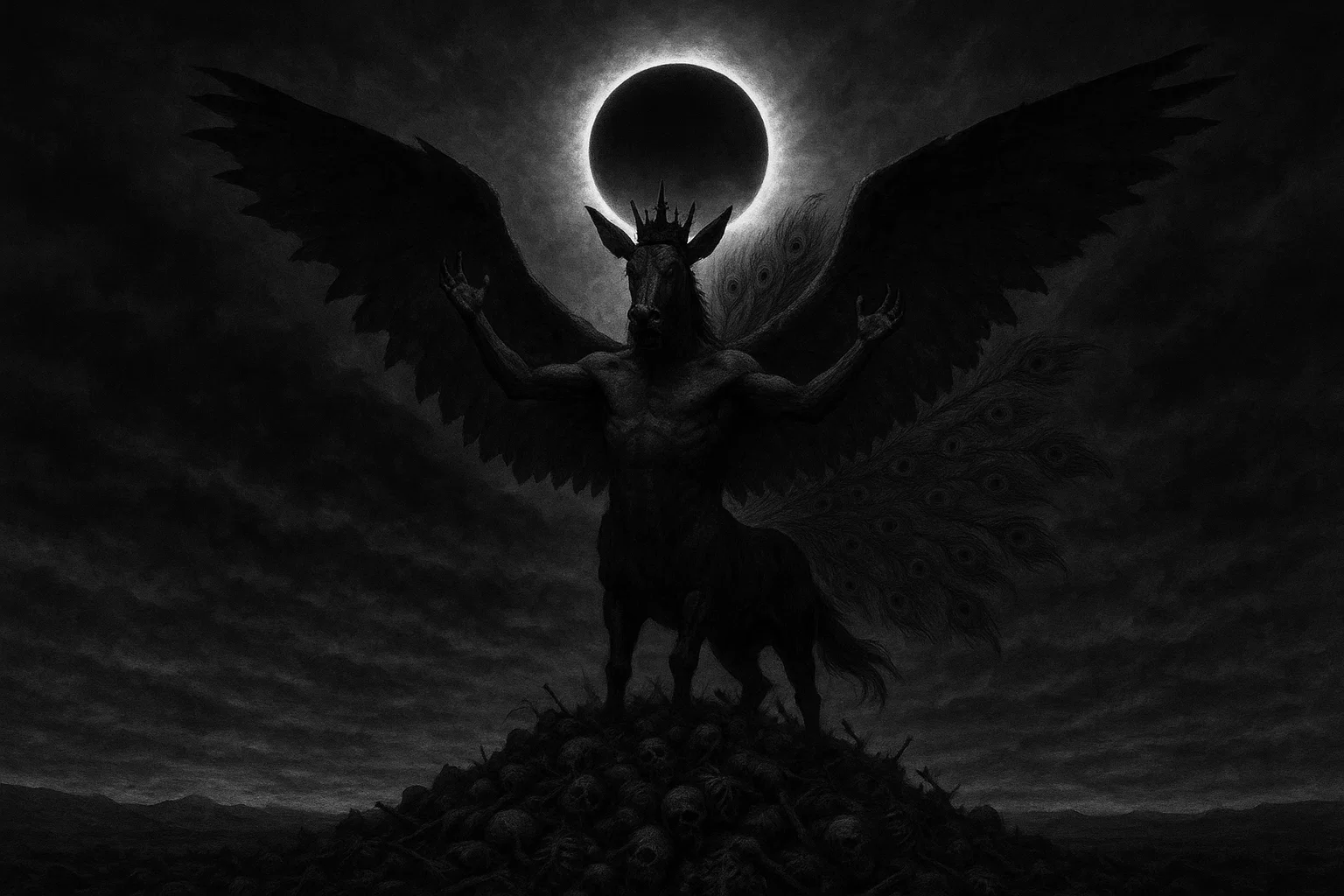
| Appearance | Often depicted as a mule, peacock, or a combination of both; sometimes shown as a crowned humanoid with the head of a mule or peacock, or a creature with a human torso and the head of a mule/peacock, and wings. |
| Powers & Abilities | Influences political and religious leaders toward evil, grants dark wisdom, inflicts terror, manipulates fire, destroys life and harvest. |
| Associated Figures | Moloch, Anammelech, Baal, Astaroth, Nebuchadnezzar, Sennacherib, Shalmaneser V, Lucifer |
| Weaknesses | Holy Names, Divine Authority, Exorcism Rites |
| Opposing Forces | Archangel Uriel (in some sources), God (Yahweh) |
| Pantheon | Mesopotamian via demonization, Abrahamic (Jewish/Christian) Demonology |
| Region of Origin | Ancient Assyria, Samaria (Sepharvaim) |
| First Known Appearance | 8th–7th Century BCE (implicitly, as a deity), documented explicitly in the Book of Kings (6th–4th Century BCE) |
| Primary Sources | 2 Kings 17:31, Testament of Solomon, Dictionnaire Infernal, Milton’s Paradise Lost |
Description
Adrammelech is a demonized god from the ancient Near East, particularly connected to the Sepharvites (a group resettled in Samaria by the Assyrian king). In the Hebrew stories, this entity is one of the twin deities, along with Anammelech, to whom the Sepharvites offered their children by sacrifice by fire.
The original nature of the pre-Israelite deity is theorized to be that of a sun god, perhaps related to the Assyrian god Adar (or Hadad). Still, its most lasting identity is that of a powerful infernal entity in later Western grimoires and demonological classifications.
His central role in demonology is often connected to the administration and governance of Hell, reflecting a perceived high rank within the diabolical hierarchy.
Appearance
The physical description of Adrammelech is subject to variation across different demonological texts, though a few recurring motifs are present.
Adrammelech is frequently depicted with a mule’s head, sometimes combined with a human body or an amalgamation of bestial forms. Other descriptions insist on the image of a peacock, granting the demon a fan of large, iridescent tail feathers, symbolizing his original solar or royal status before demonization.
In some interpretations, the creature has wings, indicative of a fallen celestial origin or a high rank. It is often crowned, stressing his title as a King or Grand Chancellor of Hell. The resulting form is a hybrid entity, typically standing erect and imposing, fusing the noble or celestial with the grotesque and earthy.
The Most Dangerous Demon Dictionary Awaits. Up to 33% OFF!
Limited Time: Up to 33% OFF the Expanded 10th Anniversary Edition. Over 1,600 demonic names, etymologies, visions of hell, historical lore, and haunting illustrations from medieval grimoires — the ultimate A–Z of the infernal hierarchy: Fallen Angels ● Goetic Spirits ● Global Demons ● Visions of Hell ● Occult History
History
Origins: The Sepharvite Deity
The earliest known mention of the name Adrammelech (or Adramelech) occurs in the Hebrew Bible, specifically in 2 Kings 17:31. This passage describes the populations transplanted from various regions, including Sepharvaim, into the cities of Samaria by the King of Assyria, who then proceeded to worship their own native deities alongside Yahweh.
The text explicitly states that the people of Sepharvaim “burned their children in the fire to Adrammelech and Anammelech, the gods of Sepharvaim.”
Researchers suggest the original deity was likely a solar god (Adar-malik, meaning ‘Adar is ruler’ or ‘glorious king’) from the Assyrian-Babylonian pantheon that was associated with the cycles of the sun and agricultural fertility, with child sacrifice possibly being a syncretic ritual adopted from neighboring Canaanite traditions like the worship of Moloch.
Demonization in Judaism and Christianity
With the establishment of the monotheistic narrative, the deities of conquered or rival nations were systematically reinterpreted as demons or false gods. Adrammelech’s association with child sacrifice, an act vehemently condemned in the Hebrew scriptures, solidified his position as a malevolent entity.
The transition from a local fertility god to an infernal spirit was complete, branding him as a primary agent of evil responsible for the most heinous of religious taboos.
Medieval Grimoires and Occult Classification
In the late Medieval and early modern periods, Adrammelech was absorbed into the elaborate taxonomies of Western demonology. He appears in various occult texts, often receiving a significant promotion in the infernal hierarchy.
Demonographers assigned him titles such as Grand Chancellor of Hell and President of the Infernal Senate, indicating a high level of administrative authority alongside other high-ranking demons, such as Lucifer, Beelzebub, and Astaroth.
This elevation suggests that his ancient association with royalty and power was re-contextualized to fit the structure of the Christian Hell.
The Complete Lesser Key of Solomon Awaits. Flash Sale – Up to 10% OFF!
The Complete Lemegeton (Books I-V). The legendary 17th-century grimoire of demon summoning, angelic evocation, sacred seals, and ancient magick — all five books in one definitive edition. Ars Goetia ● Theurgia Goetia ● Paulina ● Almadel ● Notoria.
Literary and Modern Interpretations
The demon’s profile was further cemented by literary works. John Milton’s epic poem Paradise Lost includes Adrammelech among the Fallen Angels who challenge God. Milton depicts him as a powerful warrior who is eventually overthrown by the angel Uriel:
“Adramelech and Asmadai, no less
In fury, than the best of fellest kind.”
This literary depiction solidified his image as a warrior-demon and contributed to the modern popular conception of the entity. In subsequent occult literature, such as Collin de Plancy’s Dictionnaire Infernal, his appearance became more standardized, emphasizing the bizarre hybrid forms (mule and peacock) that persist in contemporary illustrations.
In the modern era, Adrammelech is regularly featured in role-playing games, fantasy literature, and video games as a formidable archdemon, reflecting his long-standing status as a powerful, high-tier entity in the demonic pantheon.
Genealogy
| Attribute | Details |
| Parents | Theological tradition views all demons as created by God |
| Siblings | Anammelech (co-worshipped deity of the Sepharvites), Other Fallen Angels (in the Miltonic tradition) |
| Other Relationships | King Sennacherib (historical figure whose actions led to the Sepharvite resettlement), Moloch (associated entity in the practice of child sacrifice) |
Sources
| Source | Quote |
| 2 Kings 17:31 (KJV) | “And the Avites made Nibhaz and Tartak, and the Sepharvites burnt their children in fire to Adrammelech and Anammelech, the gods of Sepharvaim.” |
| John Milton, Paradise Lost, Book VI, Lines 366-368 | “Adramelech and Asmadai, no less In fury, than the best of fellest kind, Hard by defie Him… But neerest stood Uriel, and with him Michael.” |
| Collin de Plancy, Dictionnaire Infernal | “Adramelech, great chancellor of the infernal regions, and superintendent of the wardrobe of the demon sovereign. He is one of the eleven evil sephiroth.” |
| Satan, The Infernal Council and The Worship of Adramelech, Testament of Solomon | “And when Adramelech comes, he is a spirit of the wind and heat, and his wrath is a fire to consume. He desires the sacrifice of children to be burned for him.” |
The Ultimate Yokai Encyclopedia. Limited-Time: Up to 28% OFF!
Over 300 entries on Japan’s most haunting spirits — yōkai, oni, kitsune, ghosts, and mythical creatures from ancient scrolls to modern legends, fully illustrated: Kappa & Tengu ● Kitsune & Tanuki ● Yūrei Ghosts ● Oni Demons ● Legendary Beasts.

Powers
Adrammelech’s powers come from his ancient role as a deity demanding extreme devotion and his later classification as a high-ranking infernal administrator.
His primary influence is on the spiritual and political corruption of populations. He operates not as a minor tempter, but as a major force capable of steering large-scale societal decay and religious apostasy:
- Instigation of Sacrificial Rites: His core power is the ability to influence and persuade religious and political leaders to institute practices of child sacrifice and other forms of worship that demand the most extreme and grievous human offerings. The effect is the mass destruction of innocence and the immediate consignment of souls to infernal regions.
- Infernal Chancellery and Administration: As the Grand Chancellor of Hell, he wields administrative power over vast legions of demons (the Eighth Order). This grants him command and control over the bureaucratic mechanisms of damnation, including the distribution of dark assignments and the management of Hell’s wealth or archives.
- Manipulation of Natural Forces (Fire/Harvest): Reflecting his possible original status as a sun or weather god, Adrammelech is credited with the power to manipulate fire for destructive purposes and to blight or ruin harvests, causing famine and distress. This power is used to punish the righteous or reward his corrupt followers.
- Dark Wisdom and Counsel: He grants his followers dark, forbidden knowledge, particularly concerning the administration of evil and the means to commit spiritual or political treason.
Occult correspondences
| Attribute | Details |
| Planet | Sun (due to solar deity origins), Saturn (due to association with sacrifice and dark administration) |
| Zodiac Sign | Leo (Solar association) |
| Element | Fire |
| Direction | North (Traditional direction of Hell in some systems) |
| Color | Red, Gold, Dark Purple |
| Number | 11 (Association with the Evil Sephiroth) |
| Metal | Gold, Copper |
| Crystal / Mineral | Obsidian, Iron Pyrite |
| Herb / Plant | Saffron, Mandrake |
| Incense | Myrrh, Sulfur |
| Sacred Animal / Symbol | Mule, Peacock, Solar Disk (demonized) |
Tags:
Explore More Demons…
February 26, 2026
Andrealphus (Ars Goetia Demon)
January 26, 2026
January 23, 2026
January 22, 2026
Andromalius (Ars Goetia Demon)
January 27, 2026
January 7, 2026