
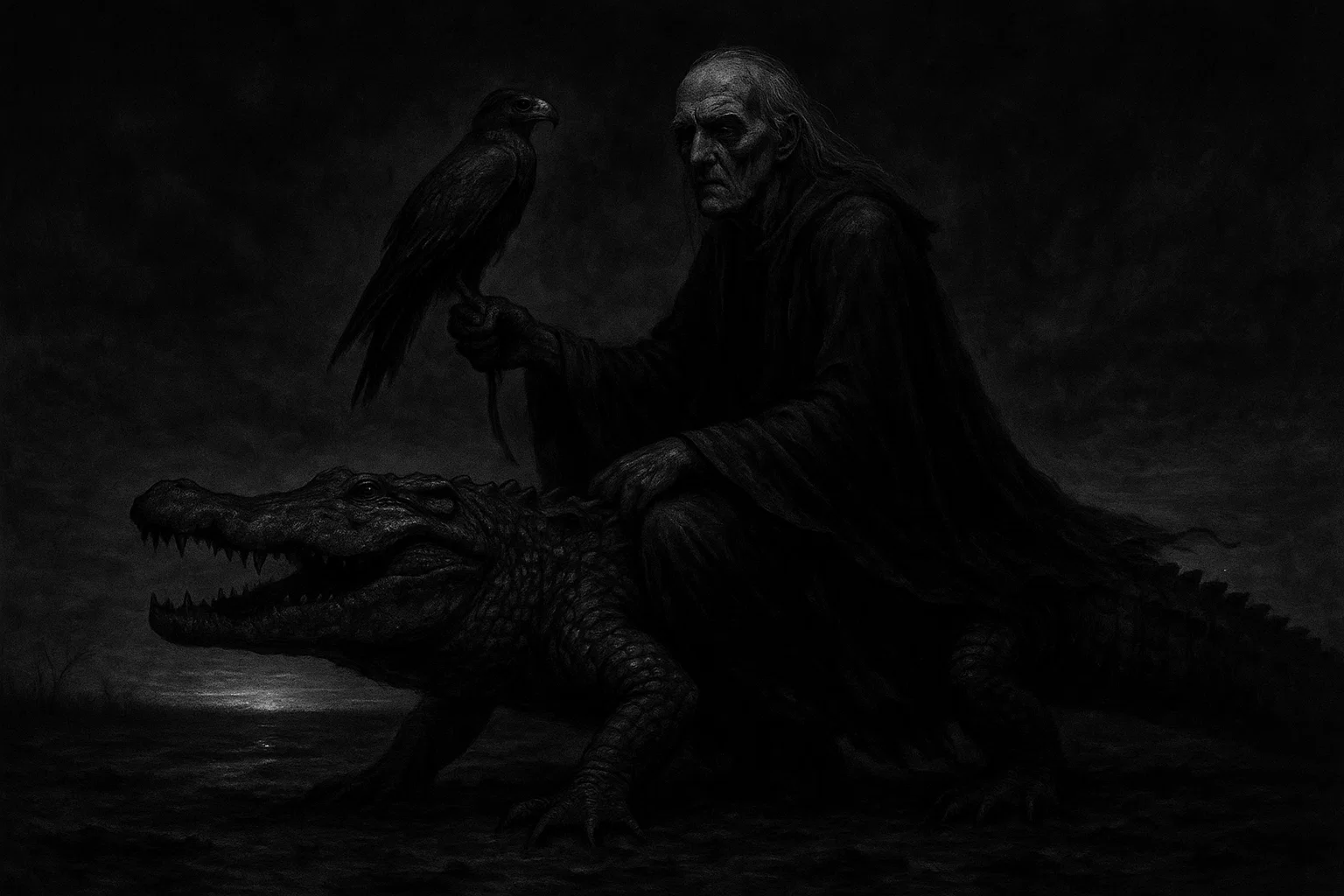

Agares is a powerful demonic entity primarily cataloged in various grimoires of the European occult tradition, specifically within the pseudepigraphical material known as the Lesser Key of Solomon.
He is consistently ranked as a Great Duke of the infernal hierarchy, possessing significant authority and command over numerous legions of subordinate spirits. His role is often associated with teaching languages, causing earthquakes, and recovering those who have fled.
Table of Contents
Overview
| Attribute | Details |
| Primary Name | Agares |
| Other Names | Agreas, Aguares |
| Titles | Great Duke, Duke, Second Spirit (in the Ars Goetia) |
| Gender | Male |
| Alignment | Lawful Evil |
| Role | Instructor of languages, Restorer of runaways, Cause of earthquakes, Destroyer of dignities (spiritual/temporal) |
| Rank | Great Duke of Hell |
| Hierarchy | Serves under the ultimate power of Hell; Commands legions of spirits |
| Legions / Followers | 31 legions of spirits |
| Appearance | An old, fair man riding a crocodile, carrying a goshawk on his wrist |
| Powers & Abilities | Teaches all languages instantly, Can recall runaways, Causes earthquakes, Destroys dignities, Causes spirits to dance (as described in some texts) |
| Associated Figures | King Solomon, Bael, Vassago, Samigina, Marbas, Valefor, Amon, Barbatos, Paimon, Buer, Gusion, Sitri, Beleth, Lernaean Hydra, Leviathan, Asmodai, Zagan, Belial, Beelzebub |
| Weaknesses | Forced obedience by the conjurer’s Divine power and the proper use of the Seal of Solomon, Inability to cross certain holy symbols when bound |
| Opposing Forces | Archangel Metatron, Archangel Raphael |
| Pantheon | Abrahamic (Christian) |
| Region of Origin | European Occultism (Early Modern Period) |
| First Known Appearance | Circa 16th-17th Century in the compilation of the Lesser Key of Solomon |
| Primary Sources | Ars Goetia, Pseudomonarchia Daemonum, Dictionnaire Infernal |
Description
Agares is a manifestation of disruption and restoration within the structure of infernal power. The demon’s presence in demonological texts signifies a concentrated force capable of overturning established human social order by destroying dignities—both spiritual authority and temporal honor—while simultaneously offering the practical ability to bridge communication gaps by instantly teaching languages.
This dual function positions him as a complex, yet pragmatic, spirit who represents the dark knowledge that can both tear down the powerful and restore the lost.
The inherent chaos of his ability to cause earthquakes contrasts with the structure provided by his expertise in language, symbolizing the entity’s fundamental representation of controlled disorder under a strict, infernal hierarchy.
Appearance
In most texts, the demon appears as an old man. However, he is said to have a fair or amiable countenance, which belies his demonic nature.
This man is traditionally depicted as mounted on a fearsome beast, specifically a crocodile. He doesn’t hold weapons or overtly aggressive symbols, but rather a tool of the hunt or falconry, as he carries a goshawk on his closed fist or wrist.
The presence of the crocodile suggests a primal, aquatic power, while the hawk signifies a sharp, aerial perspective and control. His human form ensures communication, while his conveyance and familiar reflect his raw elemental and commanding powers.
History
The Architect of Earthly Stability
Agares, in his high celestial form, was known as a luminous and mighty angel within the Order of Virtues. His duties were among the most critical to the newly formed material universe. He was tasked not merely with blessing the Earth, but with ensuring its structural integrity and geological stability.
Before the creation of humankind, it was Agares who traveled the nascent globe, meticulously weaving the lines of terrestrial power, preventing the spontaneous, chaotic ruptures that threatened to break the continents apart.
He would ride the great tectonic flows, his form radiating intense light, ensuring the crust held firm and that the primal fire beneath remained contained. He was the anchor of the world, guaranteeing that the lands of Eden and the early civilizations would have stable ground on which to flourish.
The Black Book of Forbidden Secrets. Limited-Time: Up to 71% OFF!
The infamous 19th-century grimoire of dark arts — charms, talismans, spells, omens, dream interpretation, and occult rituals once hidden from the public: Black Magick ● Love Spells ● Talismans & Amulets ● Fortune-Telling ● Curses & Hexes
The Genesis of Pride
As a Virtue, Agares also possessed an unparalleled understanding of Divine Language—the original tongue through which creation was spoken into existence.
He oversaw the celestial choir responsible for harmonizing communication between the spheres and, in turn, laid the foundation for rational thought and cohesive language among the burgeoning human species. It was this deep knowledge, however, that led to his corruption.
He began to believe that the power to communicate, to command, and to structure the very ground beneath the feet of mortals was his own genius, rather than a grace bestowed by the Creator. His meticulous attention to Earth’s design fostered a great, solitary pride that slowly distanced him from the collective purpose of the Virtues, leading him to withhold the full measure of his light.
The Great Fall and the Birth of the Crocodile
When the great rebellion tore through the Heavens, Agares did not join the battle with the ferocity of the great Kings, but rather retreated into the elemental realm of his domain. His betrayal was subtle: he ceased his work, allowing small, controlled tremors to ripple through the Earth, testing the consequences of chaos.
When he was finally cast down, his connection to the stabilizing forces of the Earth was violently severed. His luminous body did not become a winged devil but rather merged with the raw, primal energies he once controlled.
The mighty creature he now rides, the crocodile, is a physical manifestation of this corrupted, primeval Earth power—a slow, ancient, and relentless destructive force of the swamp and the depths. The goshawk on his wrist symbolizes his broken mastery over the aerial and swift, a twisted reminder of his former clarity and sight.
Solomon’s Command
The binding of Agares by King Solomon was a profound mythological event that challenged the demon’s nature. Solomon sought to restore order to a world plagued by the chaos of the fallen.
Recognizing Agares’s former domain over travel and communication, the King forced him into service to reverse the flight of the lost. This mandate was complex: Agares was compelled to send forth his subordinate legions to track not just runaway servants, but those who had fled from their spiritual duties or rightful places.
These demons acted as infernal trackers, using Agares’s knowledge of the Earth’s weave to compel the lost person’s footsteps back to their point of origin, ensuring the restoration of Solomon’s earthly dominion, however reluctantly carried out by the Duke.
The Erosion of Dignities
Agares reserves his most subtle and malevolent work for the office of destroying dignities. This power is a direct counter to his former role of upholding divine order. He does not physically attack the person holding the authority; instead, he manipulates the social and spiritual gravity around them.
When a conjurer seeks the ruin of a priest, a king, or a respected elder, Agares engineers a series of misfortunes that undermine the very foundations of their reputation and spiritual legitimacy. He creates a social “earthquake” in which the man’s history, secret flaws, or dubious judgments are suddenly exposed to the light, causing his followers to lose faith and his temporal standing to crumble into dust.
This is the ultimate expression of his corrupted celestial nature: tearing down the structure and authority of others with the same methodical precision he once used to build the world.
The Most Dangerous Demon Dictionary Awaits. Up to 33% OFF!
Limited Time: Up to 33% OFF the Expanded 10th Anniversary Edition. Over 1,600 demonic names, etymologies, visions of hell, historical lore, and haunting illustrations from medieval grimoires — the ultimate A–Z of the infernal hierarchy: Fallen Angels ● Goetic Spirits ● Global Demons ● Visions of Hell ● Occult History
Genealogy
| Attribute | Details |
| Parents | He was one of the fallen angels created by God |
| Siblings | Other Fallen Angels (e.g., Bael, Paimon, Barbatos) |
| Consorts | None |
| Offspring | None |
| Other Relationships | King Solomon (as his alleged binder), Bael (precedes him in rank) |
Sources
| Source | Quote |
| Ars Goetia (Lesser Key of Solomon) | The Second Spirit is a Duke called Agares, or Aguares. He is under the Power of the East, and cometh up in the form of an old fair Man, riding upon a Crocodile, and all the while carrying a Goshawk upon his fist, and yet he looketh very mild. He maketh all those that run away to return again, and teacheth all Languages presently. He hath power also to destroy Dignities both Spiritual and Temporal, and causeth Earthquakes. He was of the Order of Virtues. He hath under his government 31 Legions of Spirits. And this is his Seal or Character, which wear as aforesaid. |
| Pseudomonarchia Daemonum (Johann Weyer) | Aguares is a duke, under the power of the East, comming in the shape of a faire old man, riding on a crocodile, and caring a hawke on his fist, mildlie answering to everie demand. He maketh them runne that stand still, and bringeth againe runawaies. He teacheth promptlie all languages, he also overthroweth dignities spirituall and temporall, and bringeth them to nothing. He maketh also earthquakes, and is of the order of vertues, having under his government thirtie one legions. |
| The Discoverie of Witchcraft (Reginald Scot) | Aguares is a duke, under the power of the east, comming in the shape of a faire old man, riding on a crocodile, and careing a hawke on his fist, mildlie answering to everie demand. He maketh them run that stand still, and bringeth again runawaies. He teacheth promptlie all languages, he also overthroweth dignities spiritual and temporal, and bringeth them to nothing. He maketh also earthquakes, and is of the order of vertues, having under his government thirtie one legions. |
| Dictionnaire Infernal (Collin de Plancy) | Agares ou Aguares, grand-duc de la partie orientale des enfers, se montre sous la forme d’un vieillard, monté sur un crocodile, avec un épervier au poing. Il donne à ceux qui le servent la connaissance de toutes les langues, il a le pouvoir de faire revenir les fugitifs, de renverser les dignités spirituelles et temporelles, et de causer des tremblements de terre. Il commande trente et une légions. Il fut de l’ordre des Vertus. |
Powers
The infernal power of Agares functions across physical, linguistic, and socio-political domains. His ability to cause earthquakes represents a direct, calamitous manipulation of the terrestrial plane, allowing him to inflict widespread physical devastation and instability, which can be interpreted as a subversion of God’s physical creation.
On a more subtle but equally destabilizing level, he has the power to destroy dignities, which operates by eroding the perceived legitimacy, honor, or authority of powerful figures or institutions.
This mechanism works by fostering doubt, orchestrating unfortunate circumstances, or otherwise revealing flaws that lead to the downfall of both the temporal (kings, rulers) and spiritual (clergy, prophets) elite.
Agares’s most cited practical power is the ability to teach all languages instantly (or “presently”). This is achieved by implanting a profound, immediate understanding in the conjurer’s mind, bypassing the normal course of study. This linguistic power is a form of forbidden or infernal knowledge, granting the recipient mastery of communication, which itself is a fundamental tool for influence and power.
What’s more, his power to restore runaways is a form of infernal tracking and compulsion, in which the entity uses its legions to locate and compel the person who has fled to return, regardless of their will. The mention of causing spirits to dance can be seen as an expression of his absolute command over his legions and, perhaps, a power of involuntary mental control over others.
Occult Correspondences
| Attribute | Details |
| Planet | Venus |
| Zodiac Sign | Capricorn |
| Element | Earth |
| Direction | East |
| Color | Green |
| Number | 2 |
| Metal | Copper |
| Crystal / Mineral | Emerald |
| Herb / Plant | Mugwort |
| Incense | Sandalwood |
| Sacred Animal / Symbol | Crocodile |
Tags:
Explore More Demons…
January 22, 2026
January 12, 2026
Alal (Mesopotamian Destroyer Demon)
January 8, 2026
January 7, 2026
January 13, 2026
Aka Manah (Zoroastrian Arch-Demon)
January 5, 2026
