
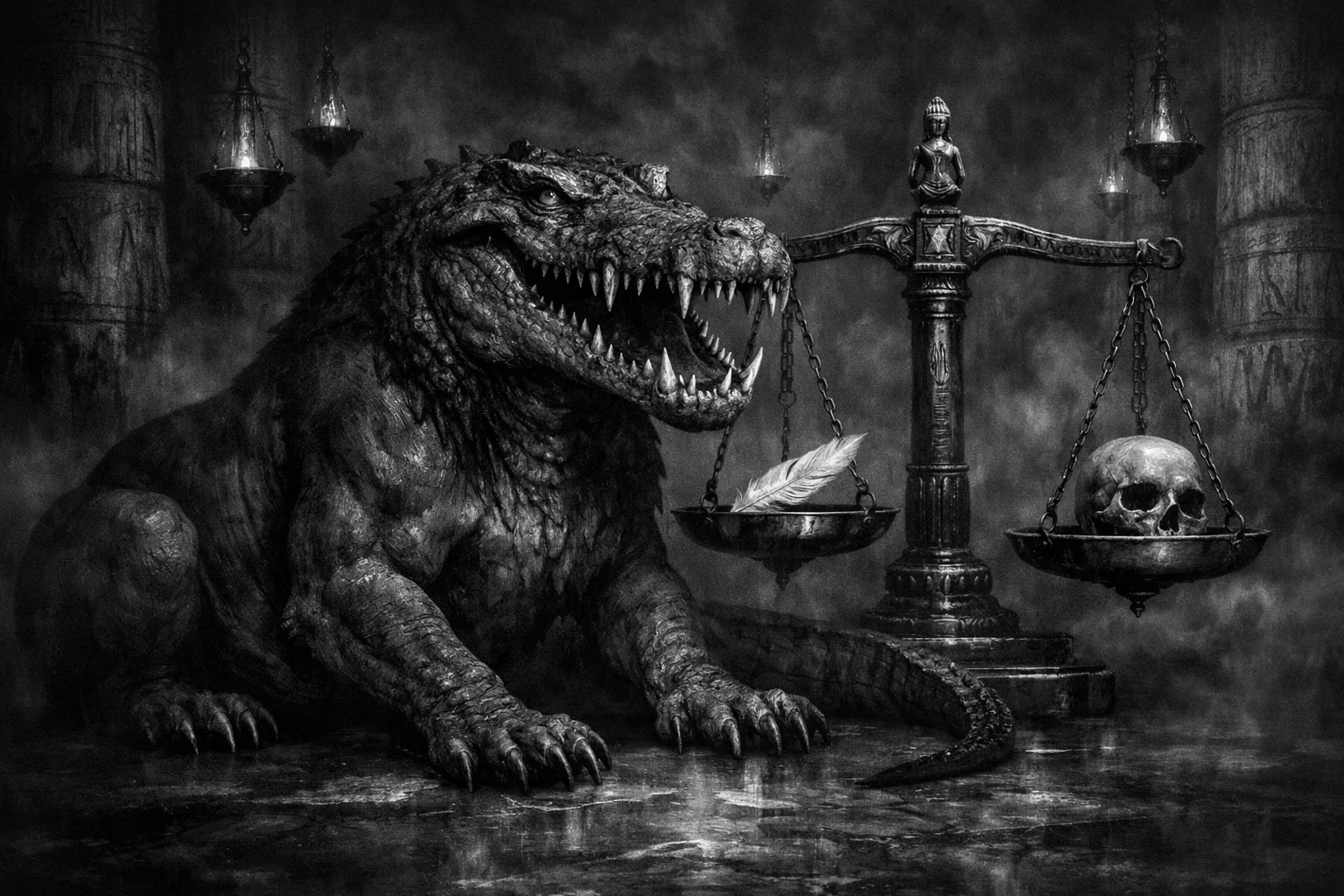
Ammit is a well-known demonic entity in ancient Egyptian funerary beliefs, living in the Hall of Two Truths in the Duat, or underworld. Called the “Devourer of the Dead,” she acts as the final judge for those found unworthy. People did not worship her; instead, they feared her as the one who would destroy the souls of those who failed Osiris’s judgment.
Table of Contents
Overview
| Attribute | Details |
| Primary Name | Ammit |
| Other Names | Ammut, Amemet, Amam, Ahemait |
| Titles | Devourer of the Dead, Eater of Souls, Eater of Hearts, Great of Death, She Who Swallows the Heart |
| Gender | Female |
| Alignment | Lawful Evil / Indifferent Cosmic Horror |
| Role | Executioner of souls, Devourer of the unworthy, Agent of Ma’at’s justice |
| Rank | Minor Deity / Underworld Demon |
| Hierarchy | Servant of Osiris, Anubis, and Thoth |
| Legions / Followers | None |
| Appearance | A hybrid beast with the head of a crocodile, the forequarters of a lion, and the hindquarters of a hippopotamus. |
| Powers & Abilities | Soul consumption, permanent erasure of existence, presence in the Hall of Ma’at |
| Associated Figures | Osiris, Anubis, Thoth, Ma’at, Horus, Isis, Nephthys, Amun, Ra, Apep, Babi, Selket, Sobek, Taweret |
| Weaknesses | Living a life in accordance with Ma’at, successful passing of the Weighing of the Heart ceremony |
| Opposing Forces | Ma’at, Osiris, Thoth, Anubis |
| Pantheon | Egyptian |
| Region of Origin | Ancient Egypt |
| First Known Appearance | Circa 1550 BCE (New Kingdom) in the Book of the Dead (Papyrus of Ani) |
| Primary Sources | Book of the Dead, Book of Gates |
Description
Ammit is the personification of divine retribution and the threat of eternal non-existence. In the Egyptian theological framework, she is a chthonic entity that symbolizes the destructive aspect of the underworld. Her existence is fundamental to the concept of Ma’at, the universal order, as she ensures that those who have lived lives of chaos, sin, or injustice do not transition into the afterlife (Aaru).
Unlike other demons who might tempt or torture, Ammit waits quietly for the outcome of the trial. She stands for the “Second Death,” which means complete oblivion for the soul, not suffering in a traditional Hell.
Appearance
Ammit is a mix of the three biggest man-eating animals known to ancient Egyptians. She has the head of a Nile crocodile with long jaws and sharp teeth, the body and front legs of a lion, and the back legs and tail of a hippopotamus. She is usually shown crouching or sitting near the Scales of Justice in the underworld, waiting for the judgment to be decided.
History
Origins and the Primordial Void
Ammit’s origins come from changes in Egyptian beliefs about the afterlife. Early on, Egyptians saw the journey to the land of the dead as dangerous, with survival depending on magical knowledge. By the Middle and New Kingdoms, the idea of a divine trial became important. Ammit was not born from parents like other mythological beings; instead, she was created to serve a purpose in the cosmic order.
She is often seen as a symbol of the “Great Void” or the “Second Death.” While the sun god Ra fought the serpent Apep to keep the universe safe, Ammit was created as a way to remove corruption from the afterlife.
She is the opposite of Ma’at. While Ma’at stands for truth and balance, Ammit shows what happens when these are missing. Some ancient texts say the god Thoth created her to make sure that those tied to chaos, called Isfet, could not receive the “breath of life.”
The Classic Masterwork of the Black Arts. Limited-Time: Up to 42% OFF!
The legendary 1967 guide to forbidden magick — witchcraft, Satanism, demonology, alchemy, astrology, rituals, and the dark history of occult power through the ages: Black Magick ● Alchemy & Astrology ● Kabbalah ● Ritual Magic ● Satan & Demons
The Hall of Two Truths
The Hall of Two Truths, also called the Hall of Ma’aty, is the main courtroom of the Egyptian underworld. Here, the dead stand before Osiris and forty-two judges. The Hall is known for its large Scales of Justice at the center. This is the only place where Ammit is always found.
Ammit’s role in the Hall is that of the ultimate deterrent. She does not participate in the interrogation or the weighing; instead, she remains in a stationary position beneath or beside the scales. Her presence creates a psychological and spiritual pressure on the deceased.
In the narrative of the judgment, the heart (Ib) of the deceased—containing their intellect, memory, and morality—is placed on one side of the scale. In contrast, the Feather of Truth (Ma’at) is placed on the other.
Ammit’s role is simple: if the scales are balanced, she stays quiet. If the heart is heavy with sin, she acts. She marks the end of the soul’s journey, turning a failed judgment into complete erasure.
Interactions with the Divine Hierarchy
Ammit exists in a state of controlled servitude under the higher deities of the Egyptian pantheon. Her primary interaction is with Anubis, the jackal-headed god of mummification and the “Opener of the Ways.” Anubis is responsible for leading the deceased to the scales and monitoring the plummet.
While Anubis is the usher and technician of judgment, Ammit is the executioner. There is a rigid professional distance between them; Anubis ensures the accuracy of the trial, and Ammit fulfills the sentence without hesitation.
Ammit is also connected to Thoth, the god of wisdom and writing. Thoth stands by the scales and records the verdict. Ammit cannot act until Thoth says the person is “unjust.” This shows that Ammit follows the Law and does not act out of chaos. She does not hunt for pleasure; she is there to carry out justice.
In some rare stories, Ammit is linked to the goddess Taweret and the god Sobek because of her animal features. She is fierce like them, but her role is only in funerals. Unlike Sobek, who could bring blessings, Ammit is never asked for help. She sits quietly at Osiris’s feet, showing his power to rule the dead and destroy the unworthy.
The Eater of the Damned
In stories about the “Second Death,” Ammit’s actions are the most feared in Egyptian belief. Unlike the idea of Hell as endless suffering, Ammit brings non-existence. After she eats the heart, the soul simply stops being. Some versions of the Book of Gates say she guards a lake of fire, where the hearts of the wicked are thrown before she eats them.
This lake of fire is not a place where souls live, but a place of destruction. Stories say that after Ammit finishes her task, the person’s name is erased from all records. As the “Eater of the Damned,” she reminded Egyptians every day of the risks tied to their actions.
Sources
| Source | Quote |
| Book of the Dead (Papyrus of Ani) | May the Devourer of the Dead not have power over me in this land of the Hall of Truth. |
| Book of the Dead (Chapter 125) | Behold, the devourer of the heart waits for the scales to tip against the sinner. |
| Book of Gates | The beast who is called Ammit, she who is near the balance, shall destroy the souls of those in the Duat who are found wanting. |
The Full Solomonic Trilogy of Power Awaits. Limited-Time: Up to 67% OFF!
The ultimate Solomonic arsenal — Greater Key (Clavicula Salomonis), Lesser Key (Lemegeton), and the ancient Testament: demon binding, angelic invocation, planetary magick, and the original spirit commands of King Solomon: Greater Key ● Lesser Key ● Testament of Solomon ● 72 Spirits ● Pentacles & Circles
Powers
Ammit’s main power is the “Second Death,” which means completely destroying the soul. When she eats the heart of the dead, the three parts of the soul—the Ka, Ba, and Akh—are cut off and destroyed. This is not a physical death, but a spiritual erasure.
Her power works through eating the heart, which Egyptians thought held a person’s memories and essence. By doing this, Ammit removes the person from the cycle of rebirth and from all memory in the universe.
She has the power of “absolute judgment.” She does not decide who is guilty, but she is the one who carries out the sentence of non-existence. No soul, no matter their status, can resist her once the scales tip. Unlike other beings, Ammit cannot be bargained with; her power is automatic and final.
Occult correspondences
| Attribute | Details |
| Planet | Saturn (liminality and judgment) |
| Zodiac Sign | Libra (the scales) |
| Element | Earth / Water |
| Direction | West (the land of the dead) |
| Color | Red (destruction), Black (underworld) |
| Number | 3 (the three beasts) |
| Metal | Lead |
| Crystal / Mineral | Obsidian, Hematite |
| Herb / Plant | Papyrus, Lotus (funerary contexts) |
| Incense | Kyphi, Myrrh |
| Sacred Animal / Symbol | Crocodile, Lion, Hippopotamus |
Liturgical Defences Against the Devourer
In the ancient Egyptian funerary tradition, the primary defence against Ammit was not physical combat, but the mastery of sacred liturgy. These spells, found within the Book of the Dead (properly known as the Book of Going Forth by Day), were designed to allow the deceased to get through the Hall of Two Truths and ensure the scales of Ma’at remained balanced.
The following spells are the most significant documented rituals used to prevent the heart from being devoured.
Spell 30B: The Heart Scarab Spell
This is arguably the most critical protection for any deceased Egyptian. It was often inscribed on a green stone scarab and placed over the mummy’s heart.
The spell is a direct plea to the person’s own heart not to testify against them during the judgment. By preventing the heart from “rising up” as a witness of sin, the scales would not tip, and Ammit would have no legal right to strike:
“O my heart of my mother… stand not up against me as a witness, oppose me not in the council of judgment, and be not hostile to me in the presence of the Keeper of the Balance.”
Spell 125: The Negative Confession
In the Book of the Dead, especially in Chapter 125, the dead person had to speak to the Forty-Two Judges. This ritual, called the Negative Confession or Declaration of Innocence, was a legal defense. If the person could say these denials and the heart did not disagree, Ammit would not act, and the soul could go safely to Aaru.
The following is the full list of the 42 sins that had to be denied to avoid the Devourer of the Dead:
- I have not committed sin.
- I have not committed robbery with violence.
- I have not stolen.
- I have not slain men and women.
- I have not stolen grain.
- I have not purloined offerings.
- I have not stolen the property of the gods.
- I have not uttered lies.
- I have not carried away food.
- I have not uttered curses.
- I have not committed adultery.
- I have not made anyone weep.
- I have not eaten the heart (i.e., I have not felt deceitful remorse or grief).
- I have not attacked any man.
- I have not been deceitful.
- I have not stolen cultivated land.
- I have not been an eavesdropper.
- I have not slandered anyone.
- I have not been angry without just cause.
- I have not debauched the wife of any man.
- I have not debauched the wife of any man (repeated to a different judge).
- I have not polluted myself.
- I have not terrorised anyone.
- I have not transgressed the Law.
- I have not been wroth (violently angry).
- I have not shut my ears to the words of truth.
- I have not blasphemed.
- I have not been a man of violence.
- I have not been a stirrer up of strife.
- I have not acted with undue haste.
- I have not pried into matters.
- I have not multiplied my words in speaking.
- I have not wronged anyone, I have done no evil.
- I have not worked witchcraft against the King.
- I have not stopped the flow of water.
- I have not raised my voice (spoken arrogantly).
- I have not cursed God.
- I have not acted with arrogance.
- I have not stolen the bread of the gods.
- I have not carried away the khenfu cakes from the spirits of the dead.
- I have not snatched away the bread of the child, nor treated with contempt the god of my city.
- I have not slain the cattle belonging to the god.
Tags:
Explore More Demons…
Alal (Mesopotamian Destroyer Demon)
January 8, 2026
Andrealphus (Ars Goetia Demon)
January 26, 2026
January 7, 2026
Belphegor (Moabite Lord of the Gap)
February 10, 2026
Apophis (Egyptian Chaos Serpent)
January 29, 2026
Bakasura (Hindu Rakshasa of Insatiable Appetite)
February 11, 2026