
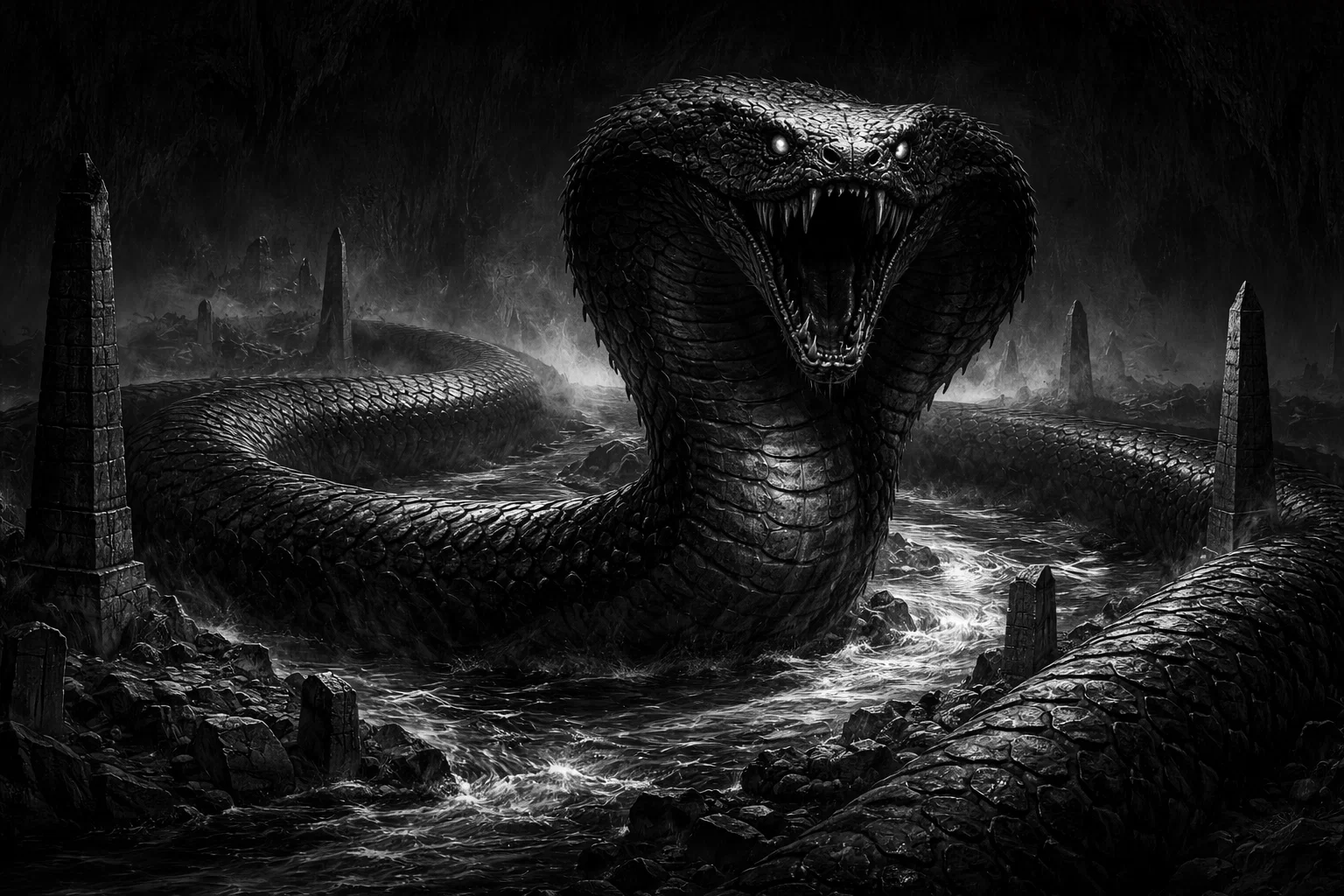
Apophis, or Apep, is the ancient Egyptian god of chaos, darkness, and destruction. Instead of being a typical demon, he is seen as a fundamental force of evil. In Egyptian mythology, he is the main enemy of the sun god Ra, symbolizing the danger of non-existence that threatens to swallow the universe and return it to a watery void.
Table of Contents
Overview
| Attribute | Details |
| Primary Name | Apophis |
| Other Names | Apep, Apepi, Aapep, Aaapep, Rerek, The Serpent of the Nile, The Evil Lizard |
| Titles | Enemy of Ra, Lord of Chaos, Serpent of Darkness, The World Encircler, The Evil One, Enemy of Order, Devourer of Souls, The Roarer, The Coiled One, Great Rebel |
| Gender | Male |
| Alignment | Pure Evil / Indifferent Cosmic Horror |
| Role | Destroyer of Light, Bringer of Chaos, Consumer of the Sun, Obstruction of the Afterlife |
| Rank | Primordial Deity / Embodiment of Isfet (Chaos) |
| Hierarchy | Superior to various chaos-demons and “serpents of the abyss.” |
| Legions / Followers | The Mesu Betesh (Children of Rebellion), various unnamed demons of darkness. |
| Appearance | A giant serpent or dragon of immense length. |
| Powers & Abilities | Solar eclipse induction, hypnotic gaze, earth-shaking roars, indestructible physical form, essence consumption. |
| Associated Figures | Ra, Set, Bastet, Sekhmet, Mehen, Atum, Nu, Geb, Nut, Osiris, Isis, Nephthys, Sobek, Serqet, Thoth |
| Weaknesses | Magical execration, burning, dismemberment via sacred blades, spears of Set, solar light. |
| Opposing Forces | Ra, Set (in his protective role), Bastet, Sekhmet, Mehen, the deceased justified in Ma’at. |
| Pantheon | Egyptian |
| Region of Origin | Middle Kingdom Egypt |
| First Known Appearance | Approximately 2100 BCE (Eighth Dynasty / First Intermediate Period). |
| Primary Sources | The Coffin Texts, The Book of the Dead, The Book of Gates, The Book of Overthrowing Apep, The Amduat. |
Description
Apophis is the living form of Isfet, which stands for chaos, lies, and injustice. Unlike other gods with unique personalities or roles, Apophis exists only as a force of emptiness. He is the opposite of Ma’at, the idea of cosmic order.
He is essential to the Egyptian idea of balance, acting as the shadow that makes light possible. People did not worship him; instead, they performed rituals to drive him away. His main goal is to stop time and destroy the sun’s daily journey. He does not want to rule the world, but to undo it, bringing back the darkness that existed before the first sunrise.
Appearance
Apophis is usually shown as a huge serpent. His body is often drawn in tight, twisting coils to show his great size and strength. Sometimes, his head looks like a viper or a cobra, with a mouth big enough to swallow the sun. His scales are sometimes said to be made of flint or iron, showing how tough he is.
Although he is most often shown as a serpent, some stories call him a “lizard” or a “crocodile-like” monster, but the snake form is the most common. He is often pictured tied up with ropes, stabbed with spears, or cut into pieces by those who protect the sun god’s boat.
History
The Birth from the Severed Cord
At first, there was only the endless, quiet, watery abyss called Nu. When Ra, the first being, brought himself into existence and rose above the waters as a golden mound, this act of creation left behind a powerful spiritual leftover.
When Ra separated from the emptiness, his umbilical cord was thrown into the dark, swirling depths. This part, created at the start of the sun but left behind, did not disappear. Instead, it changed and took shape, driven by a deep hatred of the light. The cord became a huge, mindless serpent with no end: Apophis.
He became the living shadow of the sun, not just living in darkness but actually being darkness itself. From the moment he first coiled, his only goal was to bring the universe back to the quiet, watery nothingness that existed before Ra was born.
The Complete Fiction of H.P. Lovecraft
Every tale of cosmic horror in one definitive collection — Cthulhu, Yog-Sothoth, ancient gods, forbidden tomes, and the madness that lies beyond the stars: Call of Cthulhu ● At the Mountains of Madness ● Shadow Over Innsmouth ● The Dunwich Horror ● Complete Mythos
The Ambush at the Sandbank of Bakhu
One of the most dramatic Egyptian legends starts when the sun god’s boat, the Mesektet, goes behind the western horizon and enters the rough tunnels of the underworld. As the ship moves through the Twelfth Hour of the night, the air becomes cold, and the waters of the heavenly Nile grow thick and heavy.
Deep inside the Duat, Apophis waits on the dangerous Sandbank of Bakhu. He does not fight with normal weapons, but instead uses the “Evil Eye.” As the ship comes near, the serpent lifts his huge head, his scales making a sound like iron plates. He stares at Ra with his golden, unblinking eyes.
A deep silence falls over the gods on the boat as the serpent’s stare starts to weaken their will. Thoth and Horus, who are usually full of energy, feel their bodies grow heavy as the serpent’s hypnotic power tries to put them into a waking sleep.
Apophis then starts to swallow the waters of the underworld, making a huge whirlpool meant to pull the sun god’s boat into his mouth. The ship creaks as its wood strains against the pull. Only the magic words spoken by the souls traveling with Ra, who know the spells from the Book of the Dead, can break the hypnosis and let the defenders fight back before the sun is lost forever.
The Iron Spear of the Storm God
While most gods fear the serpent, the stories highlight Set’s courage as the god of storms and chaos. At the darkest point of the night, when the other gods are frozen by the serpent’s roar, which is said to cause thunder, Set jumps to the front of the ship. Because of his own chaotic nature, Set is not affected by the serpent’s hypnotic “Evil Eye.”
The air fills with electricity as Set throws a huge spear made of celestial iron, a weapon created in the heat of the desert sun. With a loud cry that echoes through the abyss, Set thrusts the spear deep into the serpent’s skull.
The blow does not kill Apophis, since he is a primordial being and cannot truly die, but it makes him spit out the waters of the Nile he had swallowed. The serpent writhes in pain, his huge coils squeezing and making the earth above shake as earthquakes. Defeated and bleeding darkness, Apophis slides back into the deepest parts of the void, letting the sun god’s boat pass safely into the morning.
The Great Cat and the Persea Tree
In another old story from Heliopolis, the defense of the sun happens differently. Near the sacred Persea tree, which is a record of all time, Apophis tries to wrap himself around the trunk to destroy the world’s history. Seeing this danger, Ra turns into a Great Cat, called the “Mau,” with claws as sharp as flint knives.
As the serpent tried to attack, the Great Cat jumped with godlike speed. The story tells of a wild fight under the tree’s branches, a battle between the greatest hunter and the greatest serpent. The Great Cat held the serpent’s head down with one paw and quickly used a knife to cut off the beast’s head.
The legend says that the red sky at sunset is the blood of Apophis coloring the horizon after this fight. Even though his head was cut off, the myth ends with a warning: by the next night, the serpent’s pieces would find each other in the dark and join together again, ready to attack once more.
The Classic Masterwork of the Black Arts. Limited-Time: Up to 42% OFF!
The legendary 1967 guide to forbidden magick — witchcraft, Satanism, demonology, alchemy, astrology, rituals, and the dark history of occult power through the ages: Black Magick ● Alchemy & Astrology ● Kabbalah ● Ritual Magic ● Satan & Demons
The Seven Bound Heads
In later myths from the Book of Gates, the gods use a more organized way to trap the serpent. The story tells how the Four Sons of Horus and the goddess Selket, the scorpion, set a trap for Apophis. They use magical chains made from light to tie up his coils. In this version, Apophis has seven heads, each representing a different kind of lie.
The gods put heavy chains on the serpent one by one, holding him down on the floor of the Duat. The goddess Selket stings his tail, putting in a holy poison that works against his own. The story describes how the serpent struggles in vain as he is held by the “Children of the Rebellion,” who had to turn against him.
Even though he is tied up and stabbed with many knives, the story stresses that Apophis is always a prisoner who must be watched all the time. His power comes from the sins of people, and any loss of order on Earth gives him the strength to fight against his magical chains.
Genealogy
| Attribute | Details |
| Parents | Nu (Primordial Chaos) or Ra (via umbilical cord) |
| Siblings | None / Associated with the Mesu Betesh |
| Consorts | None |
| Offspring | The Mesu Betesh (Children of Rebellion) |
| Other Relationships | Eternal Arch-enemy of Ra; rival of Set; adversary of Ma’at |
Sources
| Source | Quote |
| Book of the Dead (Spells 7 & 39) | Get thee back! Depart! Get thee back from me, O Apep! Depart! Thou shalt be drowned in the lake of Nu, in the place where thy father hath ordered that thy destruction should be wrought. |
| The Bremner-Rhind Papyrus | Down upon thy face, Apep! Enemy of Ra! The flame cometh against thee, that which is in the Eye of Horus cometh against thee. |
| The Coffin Texts (Spell 414) | I have seized Apep, I have taken away his strength. The knives of those who are in the sun-disk are in his members. |
| Book of Gates (Third Hour) | The gods of the Duat bind the serpent Apep, and they place his fetters upon him. |
Powers
Apophis has powers meant to upset the natural order and the movement of the stars and planets. His strongest power is “Gaze Hypnosis,” which allows him to freeze the gods and the souls of the dead, preventing them from defending themselves or moving on in the afterlife. He also has “Terrestrial Manipulation,” where his movements in the underworld cause earthquakes and storms in the real world.
He can also perform “Solar Consumption,” a magical act where he tries to swallow the sun. In the past, people thought solar eclipses happened when Apophis briefly managed to gulp down the sun god’s boat.
His body is “Recursive,” which means that even if the gods cut him into pieces, his parts can come back together or grow again from the original chaos. This makes him an unstoppable threat who must be fought off every day, not just defeated once.
The Forbidden Book That Even Angels Feared. Limited-Time: Up to 90% OFF!
The ancient apocalyptic text banned from the Bible — visions of the Watchers, fallen angels, the Nephilim giants, secrets of heaven, and the coming judgment: Fallen Watchers ● Nephilim Origins ● Heavenly Journeys ● End-Times Prophecy ● Lost Enochian Mysteries
Occult correspondences
| Attribute | Details |
| Planet | None (Antithesis of the Sun) |
| Zodiac Sign | Scorpio |
| Element | Water (Primordial Abyss) / Darkness |
| Direction | West (The Land of the Dead) |
| Color | Black / Blood Red |
| Number | 7 (Representing his seven heads in some traditions) |
| Metal | Iron / Flint |
| Crystal / Mineral | Obsidian / Hematite |
| Herb / Plant | None (Associated with barrenness) |
| Incense | Sulfur |
| Sacred Animal / Symbol | Serpent / Turtle / Crooked Stick |
Tags:
Explore More Demons…
Baku (Japanese dream-eater demon)
February 13, 2026
January 22, 2026
Baykok (Ojibwe Flying Skeleton Demon)
March 2, 2026
January 12, 2026
Mahabali (Powerful Asura King)
February 18, 2026
Aeshma (Zoroastrian Demon of Wrath)
December 4, 2025