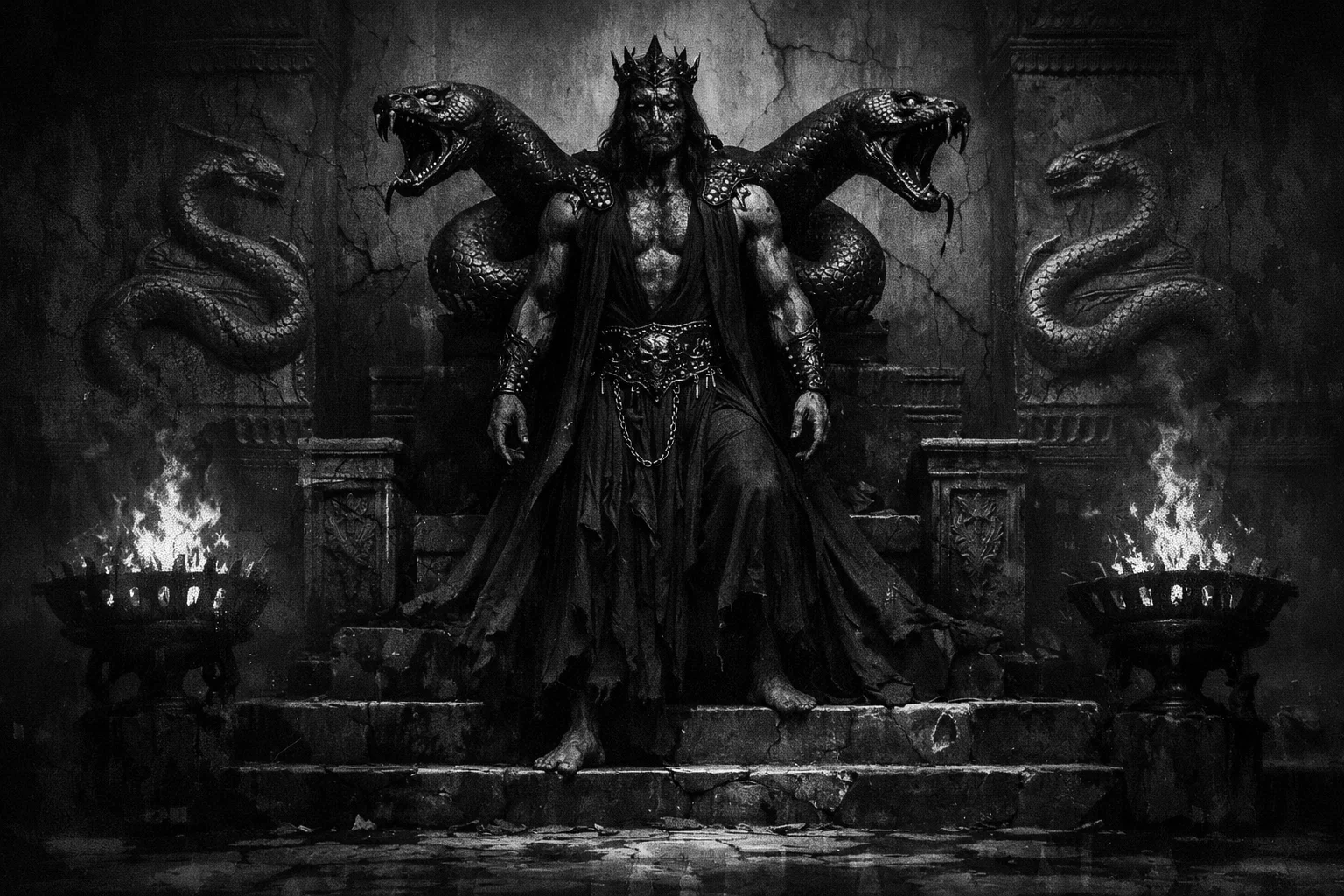
Zahhak is a key demonic entity and villain in Zoroastrian eschatology and Persian mythology. He first appears in the Avesta as the three-headed dragon-serpent Azhi Dahaka, symbolizing falsehood, greed, and tyranny.
In Zoroastrian belief, Zahhak is a top agent of Angra Mainyu (Ahriman), the main spirit of evil. He is fated to play a major part in the events that bring about the end of the world.
Table of Contents
Overview
| Attribute | Details |
| Primary Name | Zahhak |
| Other Names | Azhi Dahaka, Dahaka, Zohak, Bevar-Asp, Aži Dahāka |
| Titles | The Serpent King, Lord of the Thousand Horses, The Dragon of the Lie, Agent of Ahriman, Tyrant of the World, The Three-Mouthed, The Three-Headed, The Six-Eyed |
| Gender | Male |
| Alignment | Pure Evil |
| Role | Personification of Tyranny, Oppressor of Humanity, Consumer of Men, Harbinger of the Apocalypse |
| Rank | Archdemon / Prime Agent of Angra Mainyu |
| Hierarchy | Serves Angra Mainyu (Ahriman); Commands various daevas and demonic spirits of chaos. |
| Legions / Followers | Vast armies of demonic spirits (daevas) and human apostates. |
| Appearance | A man with two venomous black serpents growing from his shoulders. |
| Powers & Abilities | Immortality through regeneration, control over plagues, manipulation of weather, commanding serpents, inflicting drought. |
| Associated Figures | Angra Mainyu, Ahriman, Jamshid, Fereydun, Kaveh the Blacksmith, Thraetaona, Azhi, Vayu, Spityura, Erezura, Arezura |
| Weaknesses | Divine weaponry (Gorgin’s mace), imprisonment in Mount Damavand, destined defeat by Keresaspa. |
| Opposing Forces | Ahura Mazda, Fereydun (Thraetaona), Keresaspa, Atar (Fire), Mithra |
| Pantheon | Zoroastrian / Persian |
| Region of Origin | Ancient Persia (Iran) / Central Asia |
| First Known Appearance | Approx. 1000–600 BCE in the Gathas and Younger Avesta. |
| Primary Sources | Avesta (Yashts), Denkard, Bundahishn, Shahnameh (Book of Kings) |
Description
Zahhak is the physical form of the druj (the Lie) in Zoroastrian belief, serving as the main force opposing asha (Truth and Order). He is more than just a monster; he is the ultimate tyrant who drains the world’s vitality. Zahhak also shows how kingly glory (khvarenah) can become corrupt when separated from divine goodness.
In these myths, Zahhak’s presence explains the origins of suffering, social injustice, and environmental disasters like drought and famine. He is the main instrument of the Destructive Spirit, meant to cause the decline and destruction of all life before the world is renewed.
Appearance
Zahhak is usually shown as a strong, intimidating man with a unique feature: two large, living black snakes grow from his shoulders. These snakes have their own will and must be fed human brains every day to stay calm.
In older stories, Zahhak is described as a dragon-like monster with three heads, six eyes, and three sets of jaws.
Stories say Zahhak’s body is full of scorpions, lizards, and other poisonous creatures that would escape and spread across the world if his body were ever cut open. His skin is often linked to the darkness of a deep pit.
The Forbidden Book That Even Angels Feared. Limited-Time: Up to 90% OFF!
The ancient apocalyptic text banned from the Bible — visions of the Watchers, fallen angels, the Nephilim giants, secrets of heaven, and the coming judgment: Fallen Watchers ● Nephilim Origins ● Heavenly Journeys ● End-Times Prophecy ● Lost Enochian Mysteries
History
The Corruption of Prince Zahhak
Zahhak’s story starts in the deserts of Arabia. He was the son of Merdas, a kind and wealthy king with many herds. Zahhak was once a handsome and ambitious young man. Still, his nature changed after meeting Iblis (the Persian version of Ahriman or the Devil).
Iblis first appeared as a wise stranger, earning Zahhak’s trust and persuading him to make a secret deal. The demon told Zahhak that his father was too old to rule and that he deserved the throne instead.
Following the demon’s advice, Zahhak dug a deep pit in the garden where his father prayed at dawn and covered it with branches and dirt. Merdas fell in and died, allowing Zahhak to take the throne. This was the first time in myth that a son killed his father for power.
The Culinary Deception and the Serpents
After Zahhak became king, Iblis came back to his court disguised as a master chef. At that time, people mostly ate plants, but the demon introduced Zahhak to eating animal flesh, serving him blood, birds, and red meat. This new diet was meant to make Zahhak more aggressive and predatory.
Thankful for the food, Zahhak told the chef he could have any reward he wanted. The demon asked only to kiss Zahhak’s bare shoulders. As soon as he did, Iblis disappeared into the ground, and two hungry black snakes sprang from the places he had kissed.
Zahhak tried to cut off the snakes, but they grew back right away. Iblis returned again, this time as a doctor, and told Zahhak that the snakes were a divine gift and could only be calmed by feeding them human brains every day, especially from young men.
The Overthrow of King Jamshid
As Zahhak became more corrupt, the Persian king Jamshid grew proud and claimed to be the world’s creator, losing his khvarenah (Divine Glory). Seeing this change, Zahhak led a huge army from Arabia to Iran. The people, disappointed by Jamshid’s arrogance, at first saw Zahhak as a savior.
Jamshid ran away and hid for a hundred years, but Zahhak finally caught him by the Sea of China. Zahhak had Jamshid tied up and cut in half, starting a thousand years of darkness. The Avesta and the Shahnameh describe this time as one in which virtue disappeared and demons’ wishes came true.
The Prophetic Dream and the Birth of Fereydun
Late in his thousand-year rule, Zahhak had a nightmare. He dreamed of three royal brothers, and the youngest hit him with a cow-headed mace and tied him up with dragon-skin ropes. The court’s dream interpreters said a child named Fereydun, descended from Jamshid, would defeat Zahhak.
Zahhak quickly began killing every newborn in the kingdom. Fereydun’s mother, Faranak, saved him by hiding him in a forest, where he was fed by the magical cow Barmayeh. Zahhak later found the forest and killed the cow in anger. Still, Fereydun had already been moved to safety on Mount Alborz and was raised by a holy hermit.
The Complete Fiction of H.P. Lovecraft
Every tale of cosmic horror in one definitive collection — Cthulhu, Yog-Sothoth, ancient gods, forbidden tomes, and the madness that lies beyond the stars: Call of Cthulhu ● At the Mountains of Madness ● Shadow Over Innsmouth ● The Dunwich Horror ● Complete Mythos
The Rebellion of Kaveh the Blacksmith
Kaveh, a blacksmith, started Zahhak’s downfall. Zahhak forced his people to sign a document stating that he was just and merciful. When Kaveh was called to court, he learned his last son was to be given to the king’s snakes.
Filled with grief and anger, Kaveh stood up to Zahhak, tore up the document, and left the palace. He put his leather apron on a spear to make the Banner of Kaveh. This act inspired the people to join him as he marched to Mount Alborz to find Fereydun, the rightful king.
The Fall and Binding at Mount Damavand
As a young man, Fereydun joined Kaveh and his rebels. He had a mace made in the shape of a cow’s head to honor the cow that fed him. When the rebel army reached the capital, Zahhak was away in India, seeking magical means to extend his life.
When Zahhak returned, he found his palace taken over and his concubines, who were Jamshid’s sisters, serving Fereydun. Zahhak tried to kill Fereydun at night, but Fereydun hit Zahhak’s helmet with the cow-headed mace and broke it.
Before Fereydun could kill Zahhak, the angel Sorush stopped him and warned that Zahhak’s death would release many poisonous creatures (the khrafstar) from his blood into the world.
So, Fereydun took Zahhak to Mount Damavand, the tallest mountain in the Alborz range, and chained him in a dark cave, where he remains in endless pain.
The Escapades of the End Times
Zoroastrian texts like the Zand-i Vohuman Yasht predict that at the end of the world, during the time of the final savior (the Saoshyant), the world will be weakened by a cosmic winter and Ahriman’s power. Zahhak will break free, devour a third of humanity, and consume all water and fire he finds, causing a worldwide famine.
Since Fereydun is no longer alive, the gods will bring back the ancient hero Keresaspa. Keresaspa will face Zahhak in a final battle, hit him with his famous club, and finally kill the demon. Zahhak’s death is needed for the world to be purified and for Ahura Mazda to win in the end.
Genealogy
| Attribute | Details |
| Parents | Merdas (Father); Mother’s name generally unrecorded. |
| Siblings | No prominent siblings recorded. |
| Consorts | Arnavaz, Shahrnaz (daughters of Jamshid, taken by force). |
| Offspring | Numerous demonic descendants; Kush the Tusked (in some traditions). |
| Other Relationships | Protégé and servant of Angra Mainyu (Ahriman); Nemesis of Fereydun. |
Sources
| Source | Quote |
| Avesta, Yasht 5.34 | To her did Azhi Dahaka, the three-mouthed, the three-headed, the six-eyed, who has a thousand senses, that most powerful, fiendish Druj, that demon, baleful to the world… |
| Avesta, Yasht 19.37 | The Glory departed from Jamshid… Then Azhi Dahaka, the three-mouthed, the three-headed, the six-eyed, seized it. |
| Shahnameh | From his shoulders grew two black snakes. Every time they were cut off, they grew back again like the branches of a tree. |
| Bundahishn 29.9 | Dahak is fettered in Mount Dumbavand; as it is said that he is not dead, he will remain fettered until the end of the world. |
Powers
Zahhak has many supernatural powers from his link to Ahriman. His main ability is regenerative immortality—wounds to his body do not kill him, and the snakes on his shoulders grow back if cut off. He can also control snakes and other venomous creatures, using them to spy on or frighten people.
Zahhak can also control the environment to cause suffering. He can create prolonged droughts by halting rainfall and drying up rivers. This power makes him a direct cause of ruined harvests.
Just being near Zahhak harms the land. Myths say his blood is so full of evil that if it touches the ground in large amounts, it will make snakes, scorpions, and insects grow instead of plants.
In battle, Zahhak has superhuman strength and the ‘thousand senses,’ which let him detect danger from all directions at once due to his three-headed dragon form.
Occult correspondences
| Attribute | Details |
| Planet | Saturn |
| Zodiac Sign | Scorpio |
| Element | Earth (Chthonic/Polluted) |
| Direction | North (The traditional direction of Hell in Zoroastrianism) |
| Color | Black |
| Number | 3, 1000 |
| Metal | Iron |
| Crystal / Mineral | Obsidian |
| Herb / Plant | Aconite (Wolfsbane) |
| Incense | Sulfur |
| Sacred Animal / Symbol | Serpent, Dragon, Three-headed figure |
Tags:
Explore More Demons…
Alû (Mesopotamian Night Demon)
January 14, 2026
Apophis (Egyptian Chaos Serpent)
January 29, 2026
February 2, 2026
Ammit (Egyptian Devourer Demon)
January 20, 2026
Zahhak (Zoroastrian Dragon-Demon)
February 6, 2026