
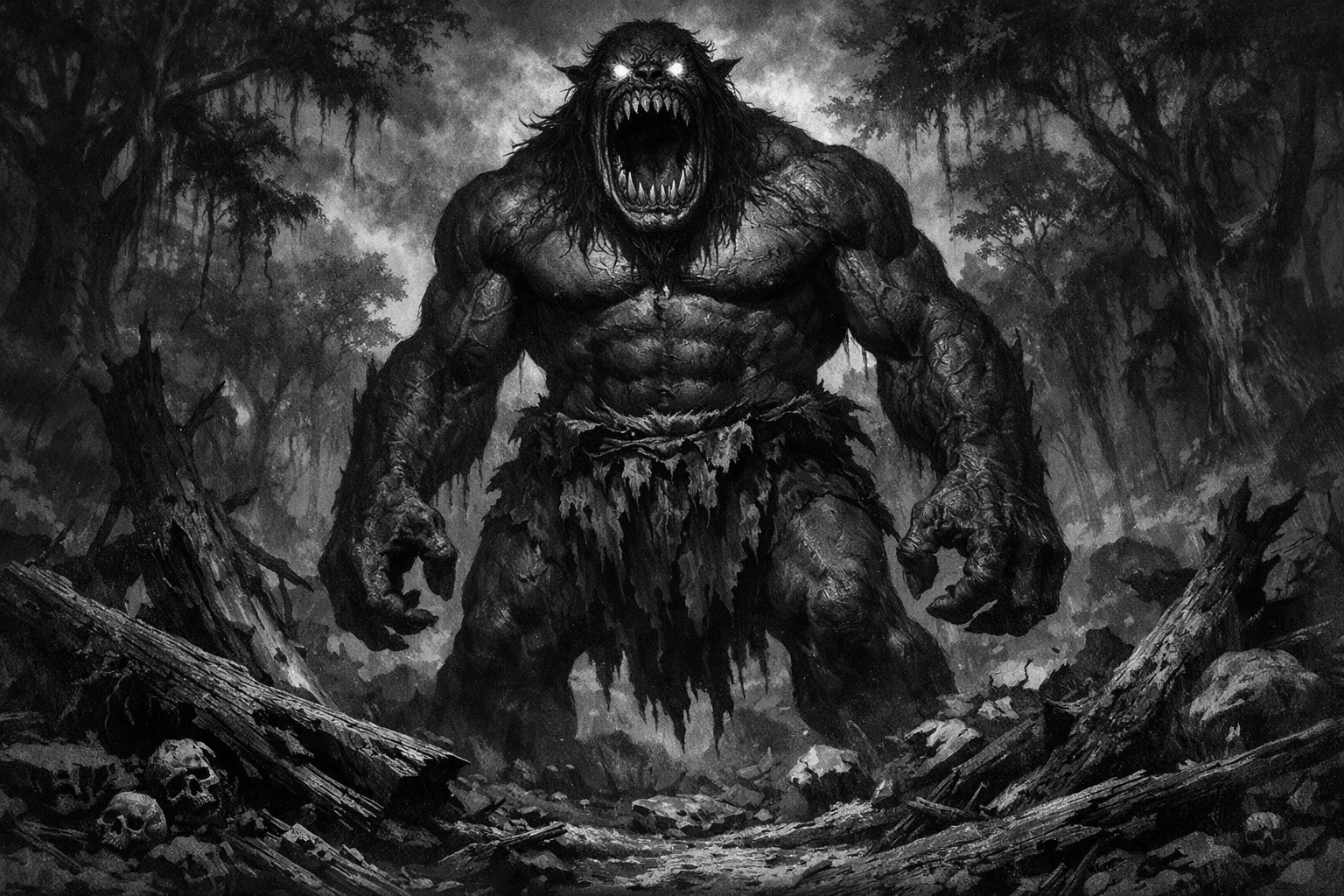
Bakasura is a well-known Asura and Rakshasa in Hindu mythology, mentioned in the Sanskrit epics. He is a powerful demon with an endless hunger and a tendency to prey on human communities.
He is best known as a major villain in the Mahabharata, where he stands for the wild and destructive forces that threaten peaceful farming communities.
Table of Contents
Overview
| Attribute | Details |
| Primary Name | Bakasura |
| Other Names | Baka, Vaka, Bakasur, Vakasura |
| Titles | The Crane Demon, The Eater of Men, The Oppressor of Ekachakra, The Devourer |
| Gender | Male |
| Alignment | Chaotic Evil |
| Role | Cannibalistic predator, Extortionist of human flesh, Terrorizer of villages |
| Rank | Rakshasa Chieftain |
| Hierarchy | Independent forest lord; peer of other Rakshasa like Hidimba and Kirmira |
| Legions / Followers | None; typically operates as a solitary predator |
| Appearance | A towering humanoid giant with monstrous features and a massive mouth |
| Powers & Abilities | Superhuman strength, invulnerability to ordinary weapons, consumption of vast quantities of food and flesh |
| Associated Figures | Bhima, Kunti, Yudhisthira, Arjuna, Nakula, Sahadeva, Hidimba, Kirmira, Krishna |
| Weaknesses | Physical grappling by a stronger opponent, internal organ rupture through blunt force |
| Opposing Forces | The Pandavas, Bhima |
| Pantheon | Hindu |
| Region of Origin | Ancient India (specifically the region of Ekachakra) |
| First Known Appearance | Circa 400 BCE – 400 CE in the Mahabharata |
| Primary Sources | Mahabharata (Adi Parva), Puranas |
Description
Bakasura symbolizes the deep fear of being eaten and the wild greed found in untamed nature.
In religious stories, he stands in the way of Dharma, which means protecting the innocent and maintaining social stability. He shows the idea of “matsya nyaya,” or the law of the fish, where the strong eat the weak without limits.
He is an example of a “bhokta” (consumer) taken to an extreme, where the need for food becomes evil and leads to human sacrifice. His role in the story gives the hero a chance to show strength and do what is right by freeing people from fear and oppression.
Appearance
Bakasura is described as a giant, much larger than normal people. He is strong and muscular, with a huge mouth made for quickly eating large amounts of food and even people.
He is usually shown with dark or earthy skin, matching his life in forests and caves. His eyes are said to glow with hunger. He wears little clothing, often just animal skins or nothing on his chest, which makes him look wild and monstrous. His long, strong arms can crush bones and lift heavy things easily.
History
The Terror of Ekachakra
After escaping the burning of the palace of lac, the Pandavas traveled through the forests. Finally, it settled in Ekachakra, pretending to be simple Brahmins.
While living with a local Brahmin family, Kunti and her son Bhima heard someone crying. When they asked about it, they learned that Bakasura, a rakshasa, was terrorizing the town. The demon lived in a cave outside the city and had forced the people into a harsh agreement.
To stop him from killing everyone, the townspeople had to send him a weekly offering: a cart full of rice, two buffaloes, and the person driving the cart. Bakasura would eat them all.
The Ultimate Yokai Encyclopedia. Limited-Time: Up to 28% OFF!
Over 300 entries on Japan’s most haunting spirits — yōkai, oni, kitsune, ghosts, and mythical creatures from ancient scrolls to modern legends, fully illustrated: Kappa & Tengu ● Kitsune & Tanuki ● Yūrei Ghosts ● Oni Demons ● Legendary Beasts.
The Sacrifice of Bhima
The Brahmin told them it was his family’s turn to give a person for the sacrifice. Seeing their sadness, Kunti suggested that her son Bhima should go instead. Yudhisthira was worried about the risk, but Kunti trusted Bhima’s great strength.
Bhima took the cart of food to the demon’s cave. When he reached the edge of the forest, he did not act afraid. Instead, he started eating the rice and food meant for Bakasura. This bold move challenged the demon’s power and endless hunger.
The Battle in the Forest
Bakasura came out of his cave, furious to see a human eating his offering. He roared and attacked Bhima, hitting him as hard as he could. Bhima calmly kept eating, ignoring the attacks until he finished his meal.
After eating, Bhima stood up and fought the demon in a fierce wrestling match. They pulled up trees and threw huge rocks at each other, shaking the forest. Bakasura tried to crush Bhima with his strength, but Bhima, the son of the wind god Vayu, was even stronger.
The Death of the Devourer
At the height of the fight, Bhima grabbed Bakasura by the waist, swung him around, and slammed him to the ground. He put his knee on the demon’s back, grabbed his neck and legs, and bent him until Bakasura’s spine broke.
Bakasura gave a final, terrifying scream that echoed through the hills before he died. Bhima dragged his huge body to the gates of Ekachakra to show the people they were free. This victory made Bhima known as a protector and ended the demon’s rule of fear.
Genealogy
| Attribute | Details |
| Parents | Unknown; identified generally as a member of the Rakshasa race |
| Siblings | Kirmira (Brother) |
| Consorts | None recorded |
| Offspring | None recorded |
| Other Relationships | Enemy of the Pandavas, specifically Bhima |
The Complete Fiction of H.P. Lovecraft
Every tale of cosmic horror in one definitive collection — Cthulhu, Yog-Sothoth, ancient gods, forbidden tomes, and the madness that lies beyond the stars: Call of Cthulhu ● At the Mountains of Madness ● Shadow Over Innsmouth ● The Dunwich Horror ● Complete Mythos

Sources
| Source | Quote |
| Mahabharata, Adi Parva (Section CLXIII) | There liveth a high-souled Rakshasa of name Vaka… He is the king of this country and of this city. |
| Mahabharata, Adi Parva (Section CLXVI) | Vaka, the Rakshasa, was killed by the mighty Bhima; and the people of the city were filled with joy. |
Powers
Bakasura’s main power is his great physical strength, which lets him defeat both human armies and other supernatural beings. His tough skin is almost impossible to cut with normal weapons like swords and spears.
His power comes from his natural, predatory body. He is like a living machine that eats everything. His roar can freeze ordinary people with fear, making it easier for him to threaten and control them.
Bakasura can also change his surroundings because of his size. He can pull up whole forests to make space for fighting. His supernatural stomach lets him quickly digest huge amounts of food, including bones and hides, which gives him more energy.
Unlike other demons who use tricks or illusions (Maya), Bakasura’s power is open and direct. He relies on brute force and physical overpowering to subdue his victims.
Occult correspondences
| Attribute | Details |
| Planet | Mars (due to violence and physical struggle) |
| Zodiac Sign | Aries |
| Element | Earth |
| Direction | Southwest (the traditional direction of Rakshasas) |
| Color | Red and Black |
| Number | 8 |
| Metal | Iron |
| Crystal / Mineral | Hematite |
| Herb / Plant | Wild thorny bushes |
| Incense | Raw meat or charred bone (symbolic) |
| Sacred Animal / Symbol | The Crane (Baka), The Buffalo |
Tags:
Explore More Demons…
Baphomet (Templar/Occult Goat-Headed Demon)
February 24, 2026
February 12, 2026
Aka Manah (Zoroastrian Arch-Demon)
January 5, 2026
February 4, 2026
Agaliarept (Commander Under Lucifer)
December 8, 2025
March 10, 2026