
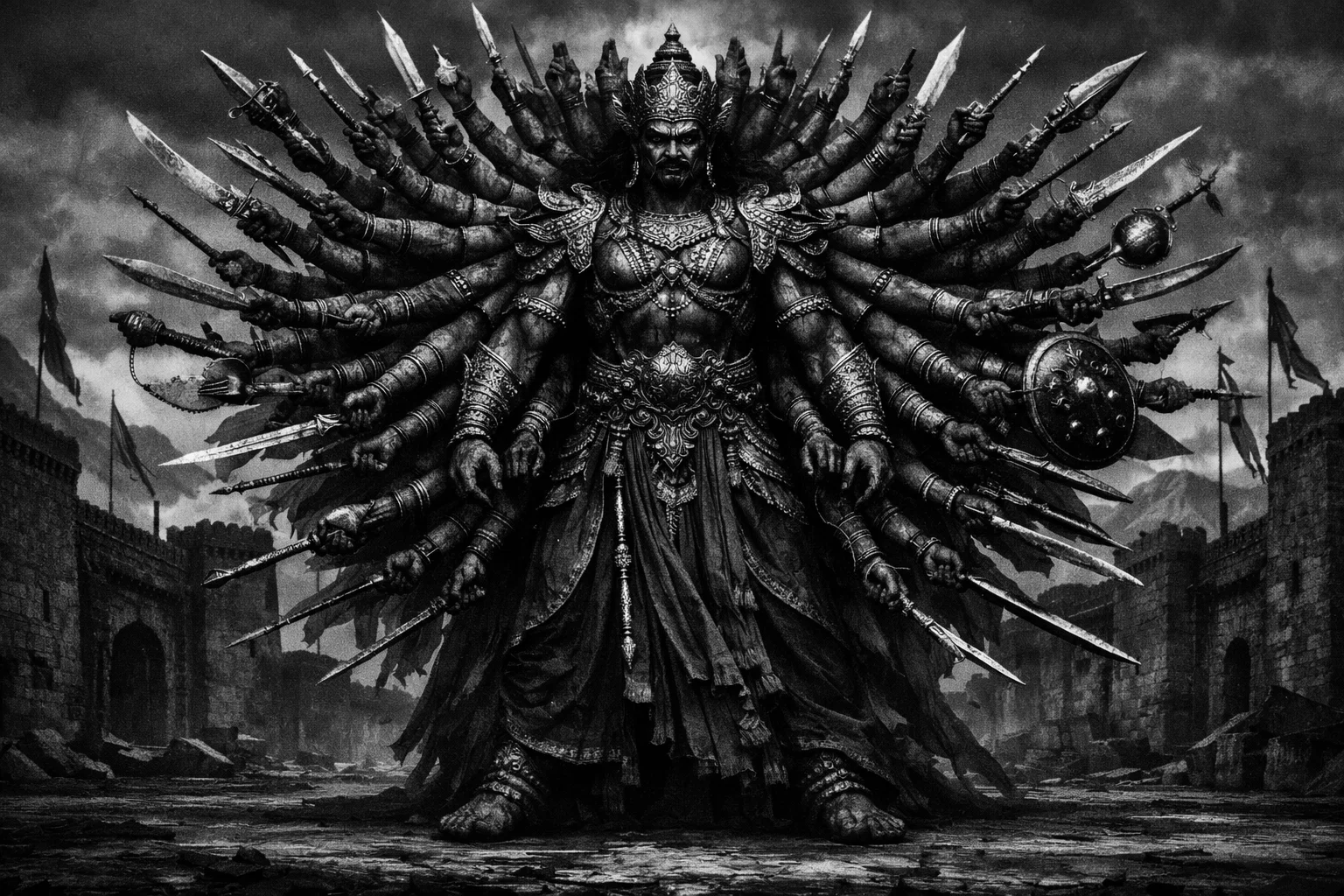
Banasura is a powerful Asura king with a thousand arms and is a well-known entity in Hindu mythology. He is best known as the eldest son of Bali and the grandson of Virochana, with a family line that goes back to the respected demon king Prahlada.
Banasura is known for his deep devotion to Shiva, which gave him great strength and a high rank among the Asuras. This devotion eventually brought him into direct conflict with Krishna.
Table of Contents
Overview
| Attribute | Details |
| Primary Name | Banasura |
| Other Names | Bana, Banasur, Mahabali-putra |
| Titles | King of Sonitpur, Thousand-Armed One, Lord of Sonitpur, Great Devotee of Shiva |
| Gender | Male |
| Alignment | Lawful Evil |
| Role | Oppressor of deities, ego-driven conqueror, jailer of Aniruddha |
| Rank | Asura King |
| Hierarchy | Servant of Shiva; superior to the armies of Sonitpur |
| Legions / Followers | Thousand-armed warriors and the demonic armies of Sonitpur |
| Appearance | A giant humanoid with a thousand arms, often depicted with a crown and regal armor. |
| Powers & Abilities | Superhuman strength, mastery of mystical weaponry, invulnerability granted by divine favor, musical proficiency used to please deities. |
| Associated Figures | Shiva, Krishna, Bali, Usha, Aniruddha, Chitralekha, Pradyumna, Balarama, Kartikeya, Ganesha, Parvati, Kumbhanda |
| Weaknesses | Excessive pride (hubris), the Sudarshana Chakra, vulnerability to Vishnu-avatars |
| Opposing Forces | Lord Krishna, Pradyumna, Balarama, the Yadav army |
| Pantheon | Hindu |
| Region of Origin | Ancient India (Sonitpur/Assam region) |
| First Known Appearance | Circa 400 BCE – 400 CE in the Mahabharata and Harivamsa |
| Primary Sources | Bhagavata Purana, Vishnu Purana, Mahabharata, Harivamsa |
Description
Banasura is an example of how strong religious devotion can mix with a dangerous ego. In stories, he is a warning about gaining power through strict practices without also having humility.
As an Asura, Banasura stands against the gods. Still, his role as a ‘Mahakala,’ or guardian of Shiva, raises his status. His thousand arms show not only his strength but also his pride and desire to challenge the gods. He is an example of a ‘dark devotee,’ someone who earns spiritual power but uses it for selfish or harmful purposes.
Appearance
Banasura is described as a giant with a commanding presence, fitting for an Asura of the highest rank. His most famous feature is his thousand-strong arms, which he used to play instruments and handle many weapons at once.
He usually wears rich royal clothing, such as a golden crown, heavy armor, and jewelry that show his status as king of Sonitpur. His skin is often shown in dark colors, which is common for Asuras.
Even though he is a demon, Banasura does not look like a beast. Instead, he appears as a larger, many-armed version of a human king, with a powerful and intimidating presence that shows his great strength and blessings.
History
Origins
Banasura was the oldest son of King Bali, who ruled the three worlds and was known for both his virtue and ambition. As a descendant of Diti, Banasura inherited the strength and long life of the Asuras. From a young age, he wanted to outdo his ancestors. While his grandfather Prahlada worshipped Vishnu, Banasura chose to devote himself to Shiva.
By practicing strict penance and performing the Tandava dance with his thousand arms, Banasura impressed Shiva so much that Shiva offered him any wish. Banasura asked Shiva to protect his city, Sonitpur, making both the city and himself unbeatable.
The Ultimate Encyclopedia of Demons. Limited-Time: Up to 25% OFF!
The definitive A–Z guide to demonology — over 400 entries on demons, possession cases, exorcisms, global traditions, and dark entities throughout history, illustrated with rare photos: Ancient Lore ● Fallen Angels ● Possession & Exorcism ● Worldwide Demons ● Modern Cases
The Burden of Power
Over the centuries, Banasura’s unbeatable power made him bored and proud. He told Shiva that his thousand arms felt like a burden because he had no worthy opponent to fight.
Shiva, bothered by Banasura’s pride, predicted that one day the flag on Banasura’s chariot would fall, showing that a rival would come to humble him. Instead of being afraid, Banasura looked forward to facing a strong challenger.
The Secret Romance of Usha
Banasura’s downfall began with his daughter, Usha. He kept her locked away in a high tower to keep suitors away. But Usha dreamed of a young man and fell in love with him. Her friend Chitralekha, who had magical powers, learned that the young man was Aniruddha, Krishna’s grandson.
Chitralekha used her magic to go to Dwarka, take Aniruddha while he slept, and bring him to Usha in Sonitpur. When Banasura found out about their secret relationship, he became furious. He used his own magic to tie up Aniruddha with snakes and locked him in a dungeon.
The Siege of Sonitpur
When Krishna heard that his grandson had been taken, he led a large army of Vrishnis and Yadavas, including Balarama and Pradyumna, to Sonitpur. Because of his promise, Shiva had to protect Banasura, which led to the ‘Hari-Hara War.’ Shiva and his sons, Kartikeya and Ganesha, fought against Krishna’s army.
The battle was huge and destructive, with both sides using magical fevers and powerful weapons. Krishna finally stopped Shiva by using a weapon that made Shiva fall into a short sleep, which allowed Krishna to get past him and face Banasura directly.
The Humbling of the King
Banasura fought Krishna in a fierce battle, using his thousand arms to attack with many weapons. Krishna used the Sudarshana Chakra to cut off Banasura’s arms one by one.
As Banasura lost his arms, Shiva woke up and begged Krishna to spare his devotee’s life. Krishna agreed, but kept cutting until Banasura had only two arms left. This was meant to humble Banasura but let him live and keep worshipping Shiva.
Banasura bowed before Krishna and admitted his pride. He then freed Aniruddha and Usha, allowing them to marry and return to Dwarka. After that, Banasura stayed as a humble follower of Shiva.
Genealogy
| Attribute | Details |
| Parents | Bali (Father), Vindhyavali (Mother) |
| Siblings | Numerous brothers, though rarely named individually in primary texts |
| Consorts | Kandala (referenced in certain regional traditions) |
| Offspring | Usha (Daughter) |
| Other Relationships | Prahlada (Great-grandfather), Virochana (Grandparent), Aniruddha (Son-in-law) |
Sources
| Source | Quote |
| Bhagavata Purana 10.62.2 | Bana, the eldest of the hundred sons of Bali, was a great devotee of Lord Shiva. He ruled the kingdom from his capital, Shonitapura. |
| Vishnu Purana 5.33 | The thousand-armed Bana, having propitiated Parameshwara, obtained the boon that the deity should reside near his city for its protection. |
| Harivamsa 2.121 | Then Janardana, the lord of the world, took up his disc Sudarshana, which was like a second sun, to lop off the arms of the king of the Daityas. |
The Complete Lesser Key of Solomon Awaits. Flash Sale – Up to 10% OFF!
The Complete Lemegeton (Books I-V). The legendary 17th-century grimoire of demon summoning, angelic evocation, sacred seals, and ancient magick — all five books in one definitive edition. Ars Goetia ● Theurgia Goetia ● Paulina ● Almadel ● Notoria.
Powers
Banasura’s main power was almost complete invincibility, thanks to Shiva’s protection. This meant that no human or ordinary god could break into his city, Sonitpur.
With his thousand arms, Banasura could fight with many weapons at once or perform complex magical gestures. This made him a master of Shastra-vidya, the science of weaponry.
Banasura also had the power of Maya, or magic and illusion. He used this to create the Naga-pasha, a serpent-noose, to capture Aniruddha. He was so strong that he could shake the foundations of mountains, which first got Shiva’s attention.
Banasura’s musical skill was also seen as supernatural. He could play the mridangam and other instruments with his many hands, making rhythms that could charm everyone in the three worlds. He used this talent to win the gods’ favor.
Occult correspondences
| Attribute | Details |
| Planet | Saturn |
| Zodiac Sign | Capricorn |
| Element | Earth |
| Direction | North-East |
| Color | Saffron and Blood Red |
| Number | 1000 |
| Metal | Iron |
| Crystal / Mineral | Hematite |
| Herb / Plant | Dhatura |
| Incense | Guggul |
| Sacred Animal / Symbol | Peacock (associated with his battle against Kartikeya) or the Chariot Flag |
Tags:
Explore More Demons…
Abezethibou (Demon from Jewish Folklore)
December 2, 2025
March 3, 2026
Andrealphus (Ars Goetia Demon)
January 26, 2026
January 23, 2026
January 22, 2026
Baykok (Ojibwe Flying Skeleton Demon)
March 2, 2026