
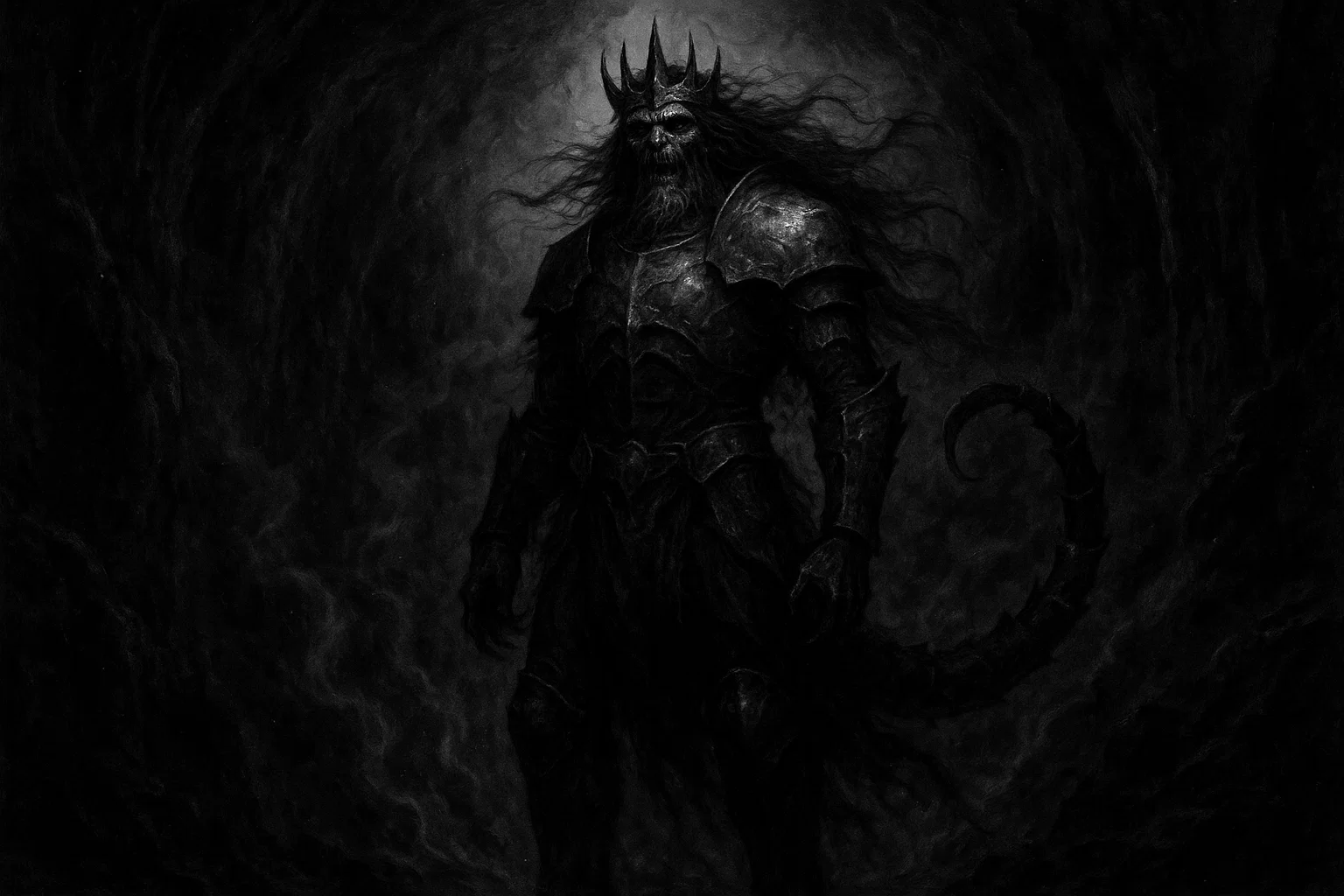

Abaddon is a demonic entity from Abrahamic religious texts, primarily recognized in the New Testament Book of Revelation as the Angel of the Abyss and the king of a plague of destructive locusts.
The name originates from the Hebrew word ‘Ăḇaddōn, meaning “destruction” or “doom,” which in the Hebrew Bible refers to a place of ruin, destruction, or the realm of the dead, often linked with Sheol.
In Christian apocalyptic literature, Abaddon transitions from being a place to a powerful personal entity, the commander of divine judgment, whose Greek equivalent is Apollyon, meaning “Destroyer.”
Table of Contents
Overview
| Attribute | Details |
| Primary Name | Abaddon |
| Other Names | Apollyon, Muriel (in some legends) |
| Titles | Angel of the Abyss, King of an Army of Locusts, Angel of Destruction, The Destroyer |
| Gender | Male |
| Alignment | Lawful Evil (as an agent of Divine Judgment) or Pure Evil (as the Destroyer/Antichrist interpretation) |
| Role | Agent of destruction, King of apocalyptic tormentors, Wielder of the key to the Bottomless Pit, Executioner of divine retribution |
| Rank | Angel/King (in Revelation 9:11), Guardian of the Abyss |
| Hierarchy | Serves God (in some interpretations, performing divine judgment), King over the locusts of the Abyss / None (in Antichrist/Satan interpretations) |
| Legions / Followers | The army of locusts unleashed from the Bottomless Pit |
| Appearance | Not explicitly described as a specific demonic form, but associated with the monstrous, horse-like locusts with crowned human faces, women’s hair, lion’s teeth, iron breastplates, and scorpion stingers in their tails. |
| Powers & Abilities | Commands the forces of the Abyss, Wields the key to the Bottomless Pit, Inflicts painful, non-lethal torment, Embodies destruction and death |
| Associated Figures | Satan, Jesus Christ (in alternative interpretations), The Antichrist, Matthew Henry, John Bunyan (Apollyon in Pilgrim’s Progress), Pseudo-Timothy of Alexandria |
| Weaknesses | Subservient to God’s command and timing, Limited to tormenting only those not marked by God’s seal |
| Opposing Forces | The Angel with the key to the Abyss (Revelation 20:1-3, which some interpret as Christ) |
| Pantheon | Abrahamic (Jewish/Christian) |
| Region of Origin | Ancient Canaan/Israel (via Hebrew Bible concepts) |
| First Known Appearance | Approx. 4th Century BCE (Hebrew Bible Wisdom Literature, e.g., Job, Proverbs) |
| Primary Sources | Book of Job, Book of Psalms, Book of Proverbs, Book of Revelation (9:11), The Thanksgiving Hymns (Dead Sea Scrolls), Biblical Antiquities |
Description
Abaddon’s identity is dual, referring both to a place and an entity.4 In the Hebrew Bible (Old Testament), Abaddon primarily signifies a location: the place of destruction, the bottomless pit, or the realm of the dead, often mentioned as a synonym for Sheol or the grave.
The personification of Abaddon is most explicit in the New Testament, specifically the Book of Revelation. Here, Abaddon is named as the Angel of the Bottomless Pit and the king who commands an army of destructive, monstrous locusts during the end times.
This demon’s role is to carry out divine judgment by inflicting torment on those who lack God’s protection. Different theological interpretations exist, seeing Abaddon as either an angel of God executing judgment, the Antichrist, or even Satan.
Appearance
Abaddon’s physical description is not explicitly detailed as a traditional demon or angel in the primary biblical text (Revelation 9:11). Still, his identity is inextricably linked to the monstrous army he commands.
He is the king over the locusts that rise from the Abyss.
These creatures are vividly described as resembling horses prepared for battle, adorned with something like golden crowns. Their faces are like the faces of men, their hair like the hair of women, and their teeth are like the teeth of lions. They wear iron breastplates and possess tails with stingers like scorpions.
Since Abaddon is the king and angel who rules this horde of destruction, his appearance is frequently portrayed as humanoid yet imbued with an overwhelming, dark, and imposing authority, reflecting the terrifying and lethal attributes of his followers.
The Forbidden Knowledge Of Demons. Limited-Time: Up to 40% OFF!
The no-nonsense deliverance manual — names, functions, and scriptural strategies to identify, bind, and cast out demons that torment believers today: Addiction ● Depression ● Witchcraft ● Infirmity ● Jealousy ● Hundreds More
History
Origins in the Hebrew Bible
The term ‘Ăḇaddōn (Abaddon) originates in the Hebrew Bible, where it is not a personal name but a descriptive noun meaning “destruction,” “ruin,” or “perishing.” It is poetically used to denote the ultimate depths of the underworld or the realm of the dead.
It appears six times in the Masoretic Text, exclusively in the Wisdom Literature (Job, Psalms, and Proverbs), always in parallel with Sheol (the grave/resting place of the dead) or Maweth (Death). This use firmly establishes Abaddon as a location of inescapable finality and divine judgment.
Second Temple and Rabbinic Era
During the Second Temple period (c. 516 BCE – 70 CE), and later in Rabbinic literature, the concept of Abaddon evolved.15 Texts found among the Dead Sea Scrolls, such as the Thanksgiving Hymns, mention the “Sheol of Abaddon” and the “torrents of Belial [that] burst into Abaddon,” maintaining its identity as a destructive place.
Later rabbinical writings, such as the Babylonian Talmud, list Abaddon as the second of seven names for Gehenna (the final destination of the wicked), so associating it more intensely with punishment by fire and snow.
This period solidified the name’s meaning from “destruction” to a named compartment of the fiery underworld. The Biblical Antiquities (pseudo-Philo) also mentions Abaddon as a place of destruction.
The Angel of the Abyss (New Testament)
The important shift from a place to a person occurs in the Book of Revelation (9:11) in the New Testament. Here, Abaddon is explicitly identified as an angel and the king who commands the monstrous locusts released from the Bottomless Pit (the Abyss).
The text provides his Hebrew name, Abaddon, and his Greek name, Apollyon, both meaning “Destroyer.” This marks his transformation into an active, malevolent figure, although his actions—inflicting a plague of torment—are orchestrated by divine will as part of God’s judgment. He is the guardian and wielder of the key to the shaft of the Abyss.
The Black Book of Forbidden Secrets. Limited-Time: Up to 71% OFF!
The infamous 19th-century grimoire of dark arts — charms, talismans, spells, omens, dream interpretation, and occult rituals once hidden from the public: Black Magick ● Love Spells ● Talismans & Amulets ● Fortune-Telling ● Curses & Hexes
Theological and Literary Interpretations
In post-Biblical Christianity, the interpretation of Abaddon becomes diverse:
- Agent of God: One theological view, citing the context of Revelation (where the angel acts at a specific, limited time and only against those without God’s seal), identifies Abaddon as a loyal angel carrying out God’s retributive justice.
- Satan or Antichrist: Other commentators, such as Matthew Henry (18th century) and the Jamieson-Fausset-Brown Bible Commentary (19th century), interpret Abaddon as a name for Satan or the Antichrist, personifying the ultimate force of evil and destruction opposed to God.
- Muriel the Guardian: An early Coptic Christian homily, The Enthronement of Abaddon (attributed to pseudo-Timothy of Alexandria), names him as the angel Muriel before his appointment. Muriel was tasked by God with collecting the dust of the earth used to create Adam. She was subsequently appointed as the fearful Guardian of the Abyss and guide of souls to the Valley of Josaphat for the Last Judgment, reinforcing his role as an agent of God’s final decrees.
- Literary Figure: The entity’s destructive nature entered broader Western literature. In John Milton’s Paradise Regained (1671), the term is extended to include the Abyss of Hell itself.
Sources
| Source | Quote |
| Job 26:6 (Masoretic Text) | Sheol is naked before Him, and Abaddon has no covering. |
| Job 28:22 (Masoretic Text) | Abaddon and Death say, ‘We have heard a report of it with our ears.’ |
| Job 31:12 (Masoretic Text) | For it is a fire that consumes to Abaddon, and would burn to the root all my increase. |
| Psalm 88:11 (Masoretic Text) | Is your steadfast love declared in the grave, or your faithfulness in Abaddon? |
| Proverbs 15:11 (Masoretic Text) | Sheol and Abaddon lie exposed to the Lord, how much more the minds of men! |
| Proverbs 27:20 (Masoretic Text) | Sheol and Abaddon are never satisfied, nor can the eyes of man be satisfied. |
| Revelation 9:11 (King James Version) | And they had a king over them, which is the angel of the bottomless pit, whose name in the Hebrew tongue is Abaddon, but in the Greek tongue hath his name Apollyon. |
| Thanksgiving Hymns (1QH 3:19) | … and the Sheol of Abaddon is opened … |
Powers
Abaddon’s documented power centers on his control over the forces of final judgment and destruction, which he can unleash or contain as commanded. His power is purely destructive and punitive, with no documented beneficial effects. He is the personification of ruin and the agent of torment.
- Wielding the Key to the Bottomless Pit: Abaddon is granted the authority to open and close the Abyss (the Bottomless Pit), controlling what is released from it. This power grants him immense, yet temporary, influence over the forces of primordial chaos and the underworld.
- Command over the Locust-Demons: He reigns as the king over a vast army of monstrous, destructive locusts. He directs their movements and targets, deploying them to execute catastrophic judgment upon the earth.
- Infliction of Torment: His legions are commanded to inflict extreme, non-lethal suffering for a fixed duration (five months) on those who do not bear the seal of God. This pain is explicitly compared to the sting of a scorpion.
Occult correspondences
Occult correspondences for Abaddon are varied and less standardized than those for entities found in Grimoires like the Ars Goetia, primarily due to his biblical context as a place or an apocalyptic figure rather than a summoned entity. The associations below are derived from his destructive role and connection to the Abyss.
| Attribute | Details |
| Planet | Pluto |
| Zodiac Sign | Scorpio |
| Element | Fire (Associated with destruction and the ‘lake of fire’ or Gehenna) |
| Direction | Below / North |
| Color | Black, Red, Ashen Grey (Black for the Abyss, Red for fire/destruction, Grey for ash/ruin) |
| Number | 9 |
| Metal | Iron |
| Crystal / Mineral | Obsidian, Volcanic Rock |
| Herb / Plant | Mandrake, Asphodel |
| Incense | Sulfur |
| Sacred Animal / Symbol | Scorpion, Locust, The Bottomless Pit/Abyss |
Tags:
Explore More Demons…
January 12, 2026
December 3, 2025
February 26, 2026
January 23, 2026
Amaymon (Demon King of the East/West)
January 15, 2026
Apophis (Egyptian Chaos Serpent)
January 29, 2026
