

Abalam is a demon servant that appears in several grimoires of Western esoteric tradition. One great example is the appendices of works related to the Lesser Key of Solomon. His primary association is as a subordinate of the more prominent demon King Paimon.
Abalam is typically cited in lists of infernal names, often mentioned alongside other principal attendants of high-ranking demonic royalty. His specific functions and attributes, while briefly noted, link him to the hierarchical structure of the demonic realm and the command of infernal legions.
Table of Contents
Overview
| Attribute | Details |
| Primary Name | Abalam |
| Other Names | None |
| Titles | Attendant of Paimon, Duke of Paimon, Infernal Retainer |
| Gender | Male |
| Alignment | Lawful Evil |
| Role | Infernal service and attendance, command of minor demonic forces, part of a triumvirate attendant to a King |
| Rank | Inferior Duke or Attendant Spirit |
| Hierarchy | Superior: Paimon. Subordinates: Unspecified legions or minor spirits. |
| Legions / Followers | Unspecified number of minor spirits, potentially part of Paimon’s 200 legions |
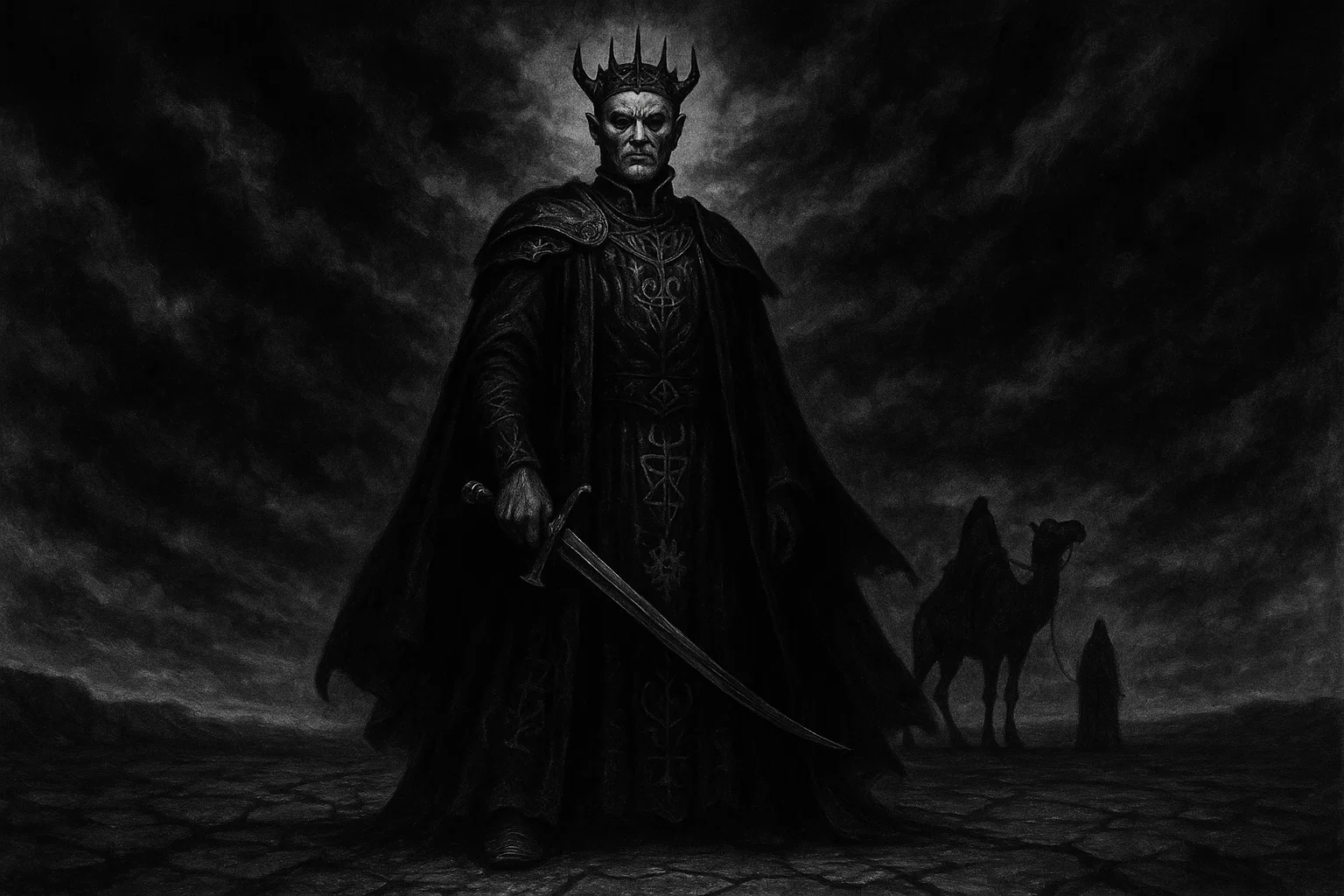
| Appearance | Unspecified physical description in primary sources; sometimes associated with Paimon’s appearance (a crowned man ridding a camel) |
| Powers & Abilities | Infernal assistance to his superior, localized summoning of minor entities, minor influence over the summoned. His power is typically dependent on Paimon’s presence. |
| Associated Figures | Paimon, Bebal, King Solomon, Lemegeton |
| Weaknesses | Holy names, divine authority, binding seals, specific conjuration rites, the will of a prepared Magus |
| Opposing Forces | The Holy Guardian Angel, Archangels, God, Jesus Christ |
| Pantheon | Abrahamic (Christian/Jewish) via demonization |
| Region of Origin | Mesopotamian/Near Eastern (via Paimon’s origins) as interpreted by European Occultism |
| First Known Appearance | 16th-17th Century in grimoires related to the Solomonic cycle. |
| Primary Sources | Pseudomonarchia Daemonum (indirect mention), The Lesser Key of Solomon (unattributed lists), The Discoverie of Witchcraft (indirect mention) |
Description
Abalam is a lesser demon that has a position of attendance and subservience to the Great King Paimon, a primary figure in the Solomonic cycle of demonology. His nature is inherently hierarchical, functioning as a necessary component in the proper summoning and control of King Paimon.
When it comes to Solomonic magic, the presence of Abalam, along with the other attendant spirit Bebal (or Balan), is frequently noted as a requirement or an unavoidable byproduct of Paimon’s manifestation.
While Abalam’s independent function is largely unexplored in the texts, his existence shows the complex court structure that governs the upper echelons of Hell’s royalty, where powerful rulers are rarely encountered alone but travel with a retinue of subordinate dukes and spirits.
Appearance
Primary sources regarding Abalam do not offer a distinct physical description of him alone. Given his role as an attendant spirit to King Paimon, his appearance is intrinsically linked to his superior’s manifestation.
King Paimon is traditionally described as appearing as a crowned man riding a dromedary (camel). When Paimon manifests, Abalam is present in his company, often alongside Bebal. This suggests Abalam’s form is either a variation of a crowned figure, a secondary figure accompanying the camel, or perhaps one of the unseen forces or spirits that constitute Paimon’s formidable retinue.
It is also implied that Abalam, like many spirits, may assume a human or partially anthropomorphic shape to accompany his king when summoned into the material plane.
The Black Book of Forbidden Secrets. Limited-Time: Up to 71% OFF!
The infamous 19th-century grimoire of dark arts — charms, talismans, spells, omens, dream interpretation, and occult rituals once hidden from the public: Black Magick ● Love Spells ● Talismans & Amulets ● Fortune-Telling ● Curses & Hexes
History
Origins and Early Solomonic Context
The history of Abalam is not one of ancient myth or a pre-Christian deity. Still, it appears directly from the European grimoire tradition of the 16th and 17th centuries.
His earliest ‘existence’ is purely textual, a name entered into lists of spirits in the Lemegeton (or Lesser Key of Solomon). Abalam’s name is most often encountered in association with King Paimon, the ninth spirit listed in the Ars Goetia section of the Lesser Key.
The texts state that when a Magus successfully summons King Paimon, two great Dukes attend him: Bebal and Abalam. This inclusion is pragmatic, detailing the required scope of the Magus’s control—they must also subdue Paimon’s essential retinue.
The Problem of Alias and Ambiguity
Within the varying recensions and translations of the grimoires, Abalam’s identity and name are subject to textual confusion. In some lists, the attendant spirit is named Balan, which is also the name of the 55th spirit of the Ars Goetia (a Great, Terrible, and Mighty King).
This overlap introduces ambiguity, leading to the speculation that Abalam may be an alternate spelling, a corruption, or an entirely separate entity conflated with the Goetic King Balan.
The names Abalideth and Amon have also been historically linked to him through similar clerical errors or variant traditions. This textual fluidity is common among minor, non-principal spirits in demonological literature, as they often lack dedicated entries.
Role in Demonic Hierarchy
Abalam is a lesser demon. His position in the hierarchy of Hell and within the infernal court is that of a servant to King Paimon. In fact, the demon’s sole role is to serve as a perfect example to King Paimon’s stature: Paimon is a highly complex and powerful entity who cannot be divorced from his immediate chain of command.
Sources
| Source | Quote |
| The Lesser Key of Solomon (Goetia), Spirit 9: Paimon (Waite Translation) | …and there attendeth him two thousand Legions of Spirits, to wit, those which were partly of the Order of Angels, and partly of the Order of Powers. If thou callest this Spirit Paimon alone, thou must make him some offering; and there will attend him two Kings, called Bebal (Balam) and Abalam (Abalideth), and other potentates in his host of spirits. |
| Pseudomonarchia Daemonum (Wier), Spirit 9: Paimon | Paimon is the ninth spirit, he is a great king…There attend him two thousand legions of spirits, some of the order of angels, others of the order of powers, if you name this Paimon alone, you must make him some sacrifice, and there will attend him two kings, Labal and Abalim, and other potentates… |
The Classic Masterwork of the Black Arts. Limited-Time: Up to 42% OFF!
The legendary 1967 guide to forbidden magick — witchcraft, Satanism, demonology, alchemy, astrology, rituals, and the dark history of occult power through the ages: Black Magick ● Alchemy & Astrology ● Kabbalah ● Ritual Magic ● Satan & Demons
Powers
Abalam’s powers are almost entirely derivative of his high-ranking superior, King Paimon. They are fundamentally powers of subservience and infernal delegation.
He functions primarily to enforce Paimon’s will on the spot and to manage the logistical aspects of Paimon’s vast legions. His existence as an attendant suggests an inherent ability to stabilize and manage the spiritual energy that accompanies a powerful demonic king’s manifestation, preventing the lesser spirits from running rampant.
Abalam has the implied ability to command minor demonic units belonging to Paimon’s 200 legions, acting as a chief of staff who organizes the movements and deployment of Paimon’s host.
Plus, Abalam’s presence is a necessary component for the proper flow of knowledge and information, as Paimon is known for granting understanding of the sciences, arts, and secret things—Abalam likely ensures the effective transmission of this perilous, forbidden knowledge from the King to the Magus.
His malevolent function is to facilitate the King’s destructive and corrupting influence in the world.
Abalam’s powers breakdown:
- Delegated Command: Manages and directs lesser spirits within Paimon’s host, ensuring military discipline and order.
- Energetic Stabilisation: Aids in containing and localizing the chaotic spiritual energy associated with King Paimon’s manifestation.
- Enforcement of Decree: Executes the immediate commands of King Paimon or acts as the enforcer of the demonic pact.
- Vector of Corruption: Facilitates the successful transfer of occult knowledge and infernal influence from his King to the human world.
Occult correspondences
| Attribute | Details |
| Planet | Jupiter (by association with Paimon, a King) |
| Zodiac Sign | Cancer (by association with Paimon) |
| Element | Water or Air (by association with Paimon’s nature) |
| Direction | West |
| Color | Yellow, Black |
| Number | 9 (via Paimon’s Goetic number) |
| Metal | Tin |
| Crystal / Mineral | Unspecified |
| Herb / Plant | Unspecified |
| Incense | Myrrh, Sandalwood |
| Sacred Animal / Symbol | Dromedary (by association with Paimon) |
Tags:
Explore More Demons…
Bakasura (Hindu Rakshasa of Insatiable Appetite)
February 11, 2026
February 2, 2026
Banasura (Hindu Thousand-Armed Asura)
February 20, 2026
Abezethibou (Demon from Jewish Folklore)
December 2, 2025
Belphegor (Moabite Lord of the Gap)
February 10, 2026
Alû (Mesopotamian Night Demon)
January 14, 2026
