
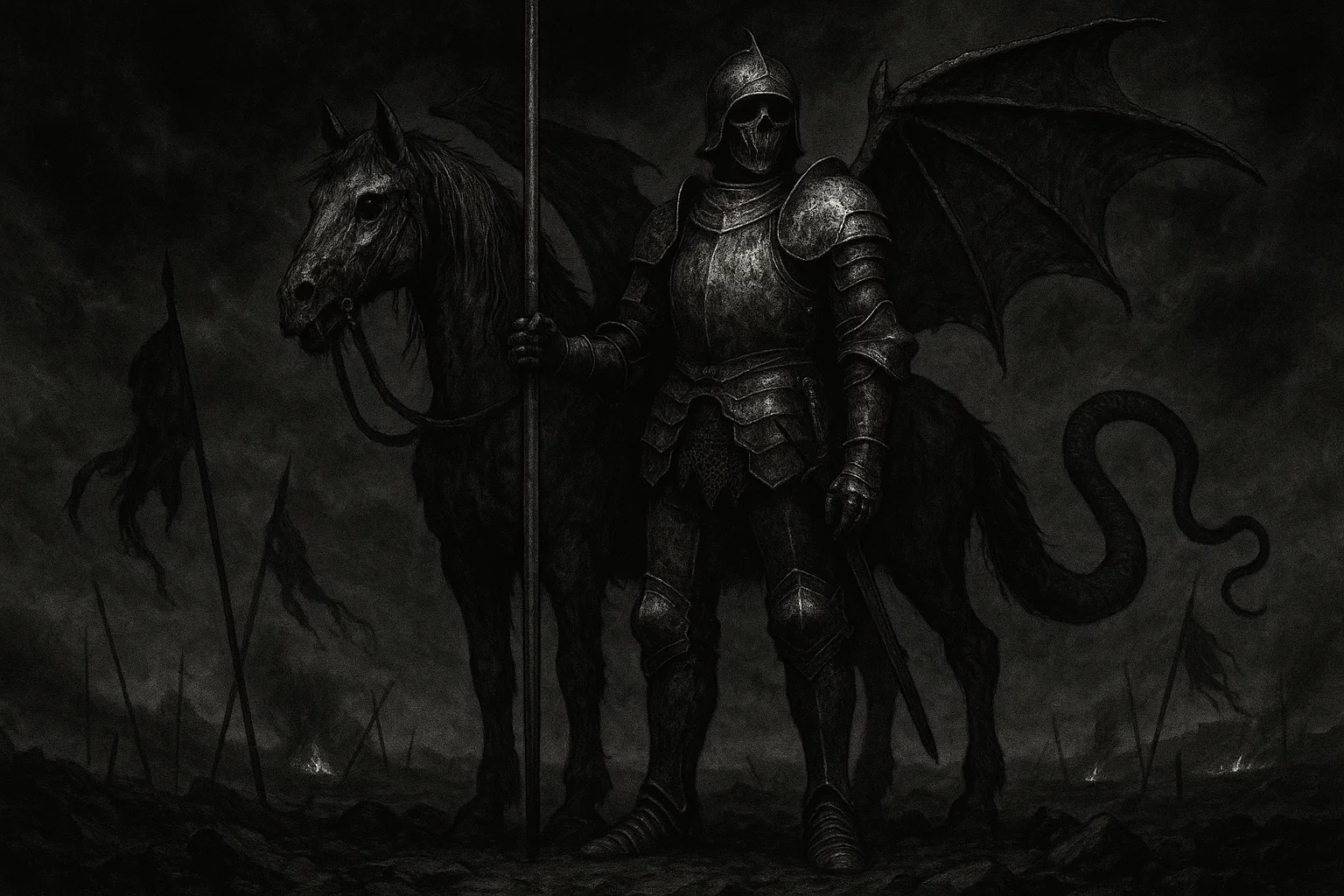

Abigor is a powerful demonic entity primarily documented in the 16th and 17th-century grimoires (most prominently those related to the Solomonic tradition). He is a Great Duke of Hell who commands up to 60 infernal legions.
The demon is typically associated with the power to foretell the future (especially in war) and to secure favor with military commanders. That’s why his counsel was explicitly sought in matters of war and generalship.
He is also one of the demons that grant command and bestow martial knowledge upon the summoner.
Table of Contents
Overview
| Attribute | Details |
| Primary Name | Abigor |
| Other Names | Eligor, Eligos, Aligor |
| Titles | Duke, Great Duke, Commander of the Forces of Hell, War-Prophet, General of the Stygian Legions |
| Gender | Male |
| Alignment | Neutral Evil |
| Role | Reveals hidden things, grants knowledge of future wars and military strategy, procures the love of knights and military men, provides infernal counsel in battle |
| Rank | Duke |
| Hierarchy | Subordinate to the Princes of Hell (e.g., Lucifer, Beelzebub, Astaroth), commands 60 legions of spirits |
| Legions / Followers | 60 legions |
| Appearance | A beautiful knight carrying a lance, a standard, or a sceptre; sometimes depicted as a spectral man or a knight with ghostly trappings, occasionally riding a winged, serpent-like beast or a horse |
| Powers & Abilities | Foreknowledge of future events, especially conflicts and wars; ability to grant military skill and favor; control over legions; ability to appear in different forms |
| Associated Figures | King Solomon, Bune, Zepar, Bathin, Vepar |
| Weaknesses | Holy names, specific prayers, the protection of the Magic Ring, the constraints of the Triangle of Art and the Seal of the demon |
| Opposing Forces | The corresponding Archangel or Angel of the Shemhamphorasch (e.g., Angel Iahhel, the Angel associated with the 15th degree of Libra) |
| Pantheon | Abrahamic (Christian/Jewish) via demonology |
| Region of Origin | Unknown (documented in Western European occult tradition) |
| First Known Appearance | 15th – 16th century (earliest likely sources) |
| Primary Sources | Pseudomonarchia Daemonum, The Lesser Key of Solomon (Ars Goetia), Dictionnaire Infernal |
Description
Abigor (also known as Eligor or Eligos) is a powerful Great Duke within the hierarchies of Hell. This rank places him among the powerful commanders under the supreme Princes. His primary function is that of an oracle of war and a purveyor of strategic military intelligence.
The entity’s nature is strongly linked with martial affairs and foreknowledge. The demon can reveal the outcomes of wars, describe how troops and legions will be deployed, and impart the secrets of effective generalship.
Beyond mere prediction, he can also inspire affection and respect among knights, soldiers, and powerful military figures, making him useful to those seeking influence within the defense or command structures of earthly kingdoms. His knowledge is considered profound, encompassing hidden elements that may determine a military campaign’s success or failure.
Appearance
The most frequently recorded appearance of Abigor is that of a handsome knight or a spectral man of war. He is typically depicted fully armored, reminiscent of a medieval or Renaissance noble. This form is often described as being ghostly or transparent in some accounts, emphasizing his spectral nature.
In most prominent sources, particularly the Ars Goetia, Abigor is described as riding on a powerful, often unsettling steed. According to lore, his monstrous horse has wings and a snake-like tail, suggesting a combination of martial power and infernal or chthonic origins.
He typically carries the symbols of his military rank and prophetic office, such as a lance, a standard (banner), or a sceptre. The overall impression is one of a noble but formidable military commander.
The Black Book of Forbidden Secrets. Limited-Time: Up to 71% OFF!
The infamous 19th-century grimoire of dark arts — charms, talismans, spells, omens, dream interpretation, and occult rituals once hidden from the public: Black Magick ● Love Spells ● Talismans & Amulets ● Fortune-Telling ● Curses & Hexes
History
Early Grimoire Documentation
The earliest significant documentation of Abigor (under the name Eligos or Eligor) places him within the tradition of Solomonic demonology.
While the legends surrounding King Solomon’s binding of seventy-two spirits predate these texts, the first explicit descriptions and instructions for summoning Abigor appear in the latter half of the 16th century.
His initial entry into the formal hierarchy of Hell is largely attributed to Johann Weyer’s 1563 text, Pseudomonarchia Daemonum. In this work, he is detailed as a powerful Duke with the specific role of foretelling the future concerning wars and garnering favor among military personnel.
The Lesser Key of Solomon
The account of Abigor was subsequently absorbed into the most famous compendium of Solomonic magic, the Lesser Key of Solomon, specifically its first book, the Ars Goetia.
Here, Abigor is listed as the 15th spirit among the 72 spirits King Solomon is reputed to have constrained. The Ars Goetia further solidifies his rank as a Great Duke who commands 60 legions. This text, influential across centuries of occult practice, cemented his role and established his primary name and attributes for future generations of practitioners.
The consistency of his description across Pseudomonarchia Daemonum and the Ars Goetia suggests that the two sources drew from a common, likely earlier, tradition or that the latter heavily relied on the former.
Later Demonological Works
In later demonological texts, such as Collin de Plancy’s 1818 Dictionnaire Infernal, Abigor’s profile remained largely unchanged. These subsequent works served to catalogue and reinforce the entity’s established characteristics rather than introduce new interpretations or origin narratives.
His association with prophecy and military strategy continued to be the defining features. In this and other similar works, he is consistently presented as a source of dark knowledge regarding warfare and political-military maneuvers, a role that positioned him as a pragmatic entity to be summoned by those in positions of political or military authority seeking an advantage.
Abigor did not typically accrue a complex mythological history involving a fall from grace or a significant role in biblical events, unlike high-ranking demons such as Lucifer or Belial. Instead, he maintained the persona of a powerful, specialized functionary within the infernal bureaucracy, focused solely on war and prophetic counsel.
The Complete Lesser Key of Solomon Awaits. Flash Sale – Up to 10% OFF!
The Complete Lemegeton (Books I-V). The legendary 17th-century grimoire of demon summoning, angelic evocation, sacred seals, and ancient magick — all five books in one definitive edition. Ars Goetia ● Theurgia Goetia ● Paulina ● Almadel ● Notoria.
Sources
| Source | Quote |
| Pseudomonarchia Daemonum (1563), Weyer | The fifteene spirit is Eligos, a great duke, and is seene in the shape of a goodlie knight, carrying a lance, a standard, and a scepter: he bewraieth hidden things, and knoweth things to come, as of wars, and how souldiers meete: he procureth the love of lords and great persons: and ruleth sixtie legions. |
| The Lesser Key of Solomon (Ars Goetia), Spirit 15 | The Fifteenth Spirit is Eligos, a Great Duke, and appeareth in the form of a handsome Knight, carrying a Lance, a Standard, and a Serpent. He discovereth hidden things, and knoweth things to come; even of Wars, and how they will begin. He procureth the love of Lords and Great Persons. He governeth 60 Legions of Spirits. |
| Dictionnaire Infernal (1863 edition), de Plancy | Abigor, ou Eligos, grand-duc aux enfers, qui a soixante légions sous ses ordres. Il apparaît sous la figure d’un beau chevalier, portant la lance, l’étendard et le sceptre. Il répond avec justesse sur ce qu’on lui demande au sujet des choses cachées, des guerres futures, de la rencontre des troupes. Il gagne la faveur des seigneurs et des chevaliers. (Translation: Abigor, or Eligos, great-duke in hell, who has sixty legions under his orders. He appears in the form of a handsome knight, carrying the lance, the standard, and the scepter. He answers precisely about what is asked of him concerning hidden things, future wars, and the meeting of troops. He wins the favor of lords and knights.) |
Powers
Abigor’s powers are strictly specialized and dedicated to military strategy, prophecy, and influence. His primary function is conveying foreknowledge related to warfare.
This is not simple divination but a detailed disclosure of future military engagements, including the causes of their commencement, troop movements, and the ultimate outcome of the conflict. The mechanism of this power involves an infernal omniscience regarding current and future earthly political and military maneuvers.
Plus, Abigor has the power to influence the perceptions and affections of high-ranking military figures. By this means, he can cause influential knights, generals, and nobles to favor the summoner, thereby granting the practitioner political and military advantages. This suggests a subtle, manipulative power over mortal hearts and minds, specifically those driven by ambition and martial honor.
As a Great Duke, he has command over 60 legions of lesser spirits, granting him significant command and organizational capacity within the infernal hierarchy, which can potentially be directed, though usually indirectly, to affect earthly matters.
Occult correspondences
| Attribute | Details |
| Planet | Mars |
| Zodiac Sign | Libra (associated with the 15th degree of Libra) |
| Element | Air |
| Direction | North-West |
| Color | Red, Black |
| Number | 15, 60 |
| Metal | Iron, Copper |
| Crystal / Mineral | Jasper, Garnet |
| Herb / Plant | Wormwood, Tobacco |
| Incense | Frankincense, Storax |
| Sacred Animal / Symbol | Winged Serpent, Horse, Knight |
Tags:
Explore More Demons…
Baykok (Ojibwe Flying Skeleton Demon)
March 2, 2026
Belphegor (Moabite Lord of the Gap)
February 10, 2026
Agaliarept (Commander Under Lucifer)
December 8, 2025
Zahhak (Zoroastrian Dragon-Demon)
February 6, 2026
December 1, 2025
