
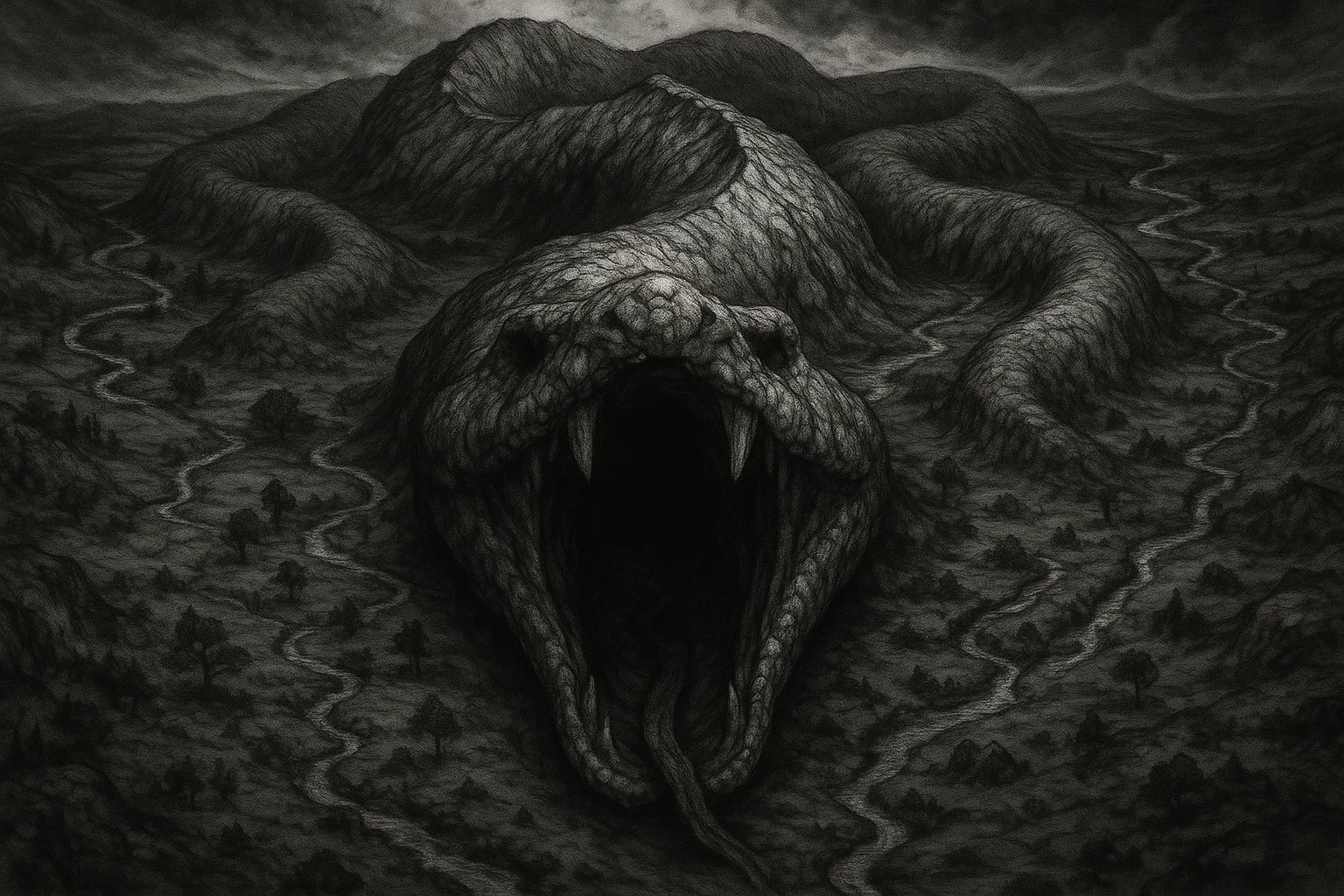

Aghasura is a powerful Asura in the Hindu Puranic tradition, prominently featured in narratives surrounding the early life of the deity Krishna. He is a malevolent, demonic creature, often mentioned among Krishna’s primary enemies during his youth, and is explicitly described as the younger brother of the female demon Putana and the snake-like monster Bakasura.
Aghasura’s primary importance lies in his elaborate and near-successful attempt to eliminate Krishna and the entire community of cowherd boys (which is a critical narrative segment revealing Krishna’s divine power and his role as a protector of Dharma).
Table of Contents
Overview
| Attribute | Details |
| Primary Name | Aghasura |
| Other Names | Agha |
| Titles | Brother of Putana and Bakasura, Serpent Demon of Vrindavan, Embodiment of Sins |
| Gender | Male |
| Alignment | Pure Evil |
| Role | Slayer of children, Servant of Kamsa, Embodiment of sin, One who is purified by death |
| Rank | Minor Asura, Servant of a King |
| Hierarchy | Subordinate of Kamsa (his superior) / None (no named subordinates) |
| Legions / Followers | None |
| Appearance | Colossal serpentine or python-like form with a vast, open mouth, resembling a mountain cave |
| Powers & Abilities | Gigantic size manipulation, Transformation into a massive creature of environmental scale, Ability to consume large groups of living beings, Deceptive physical manifestation |
| Associated Figures | Krishna, Balarama, Nanda, Yashoda, Kamsa, Putana, Bakasura, Arishtasura, Kesi, Trinavarta, Shankhachuda, Pralambasura, Brahma |
| Weaknesses | Direct confrontation with Krishna, Divine power and intervention, Inability to withstand the expansion of a deity’s form |
| Opposing Forces | Krishna, Vishnu |
| Pantheon | Hindu-Buddhist Preta, Oni, Rakshasa & Asura |
| Region of Origin | Ancient India (associated with the region of Vrindavan, Mathura) |
| First Known Appearance | Circa 500 CE (Puranic literature, specifically the Bhagavata Purana) |
| Primary Sources | Bhagavata Purana (Book 10, Chapters 12-13), Vishnu Purana, Harivamsa |
Description
Aghasura conceptually represents a profound and monstrous expression of malice and vengeance, specifically representing the accumulated sins (Agha) of the beings in the world. This entity serves within the Hindu theological framework as a dedicated Asura, a class of beings intrinsically opposed to the celestial order (Dharma) and the Devas (gods).
Aghasura’s role is to manifest immediate, devastating danger to the divine incarnation. The demon’s existence is propelled by an intense desire for revenge against the young Krishna for the prior annihilation of his siblings, Putana and Bakasura.
As a result, the Aghasura’s theological significance lies not only in his malicious intent but also in the paradoxical outcome of his death: by meeting his end at the hands of the supreme being, Krishna, the demon’s sins are instantaneously purified, and he attains Sāyujya (merging) with the divine essence.
This shows the non-discriminatory nature of divine grace, where even hatred focused on the divine can lead to ultimate liberation (Moksha).
Appearance
Aghasura is a gigantic serpent (or python). Its scale is so vast that it is consistently described as the size of an entire world and yet capable of concealing itself in a massive, naturally occurring cavern.
The body of the serpent stretches for miles, resembling a colossal mountain range when laid out. The most defining feature of this monstrous form is the gaping mouth, which the demon held wide open to serve as a deceptive entrance.
The lower and upper lips of the demon are likened to two mountainous ridges touching the sky. At the same time, the teeth are depicted as sharp, rugged cliffs or formidable mountain peaks. The red, broad tongue is described as a vast, inviting path leading into the darkness.
The interior of the mouth and throat is deliberately rendered to look like a plausible, dark tunnel or mountain pass, concealing the demon’s deadly intent and allowing for the unwitting entry of its prey.
The Most Dangerous Demon Dictionary Awaits. Up to 33% OFF!
Limited Time: Up to 33% OFF the Expanded 10th Anniversary Edition. Over 1,600 demonic names, etymologies, visions of hell, historical lore, and haunting illustrations from medieval grimoires — the ultimate A–Z of the infernal hierarchy: Fallen Angels ● Goetic Spirits ● Global Demons ● Visions of Hell ● Occult History
History
The narrative of Aghasura is situated within the cyclical and eternal conflict between the forces of order and chaos, depicted by the Devas and the Asuras. This creature belonged to the Daitya lineage, a powerful clan of Asuras. It was also a fervent servant of the tyrannical King Kamsa of Mathura.
The Avenging Oath
Aghasura’s initial manifestation in Vrindavan was not driven by Kamsa’s direct order, but by an overriding need for personal vengeance. His elder sister, the night-demoness Putana, and his brother, the crane-demon Bakasura, had both been slain by the infant Krishna in earlier failed attempts on the deity’s life.
Consumed by rage and the Asuric obligation to avenge his blood relatives, Aghasura swore an oath to eliminate Krishna, his brother Balarama, and all the innocent cowherd companions.
Aghasura’s plan was to inflict devastation so complete that it would extinguish the very joy of Krishna’s life in the village, as a result satisfying the malice of Kamsa and providing retribution for his siblings.
The Colossal Deception
One morning, as Krishna and the cowherd boys left the village of Vrindavan to tend to their calves, Aghasura executed his strategy. He used his powers of transformation to assume the form of a colossal serpent, a python so vast that its coils could cover several leagues.
He positioned himself on the path frequently used by the cowherds, contorting his body to make his immense, gaping mouth appear as a natural mountain cavern. His upper lip scraped the clouds, his lower jaw rested on the earth, and his teeth appeared as sharp, insurmountable cliffs.
The interior of his esophagus was made dark and alluring, indistinguishable from a geological feature. The young cowherd boys, fearless due to the protective presence of Krishna and Balarama, approached the formation with playful curiosity.
They debated amongst themselves whether it was a natural cave or the open mouth of a demon. Yet, they dismissed the danger, confident that the divine child among them would negate any threat.
The Swallowing and Intervention
Driven by innocent bravado and curiosity, the boys and their calves began to wander directly into the demon’s mouth, thinking it a new place to play. Aghasura patiently waited as all the cowherd boys and the calves moved deep into his gullet.
After seeing his friends vanish, Krishna instantly realized the true nature of the trap. He knew that the demon intended to crush and suffocate them all at once. As soon as Krishna himself entered the monstrous mouth, Aghasura sealed his lips shut, celebrating his perceived victory.
However, once inside the snake’s throat, Krishna immediately began to expand his divine form. He grew rapidly and enormously, pressing against the inner walls of the demon’s massive windpipe and esophagus. The intense, excruciating pressure caused the demon to gasp for air. Still, the pathway was completely blocked by Krishna’s rapidly expanding body.
Aghasura’s eyes bulged, and his life-air (Prana) was violently forced upward. The pressure was so immense that it ruptured a hole through the top of the serpent’s head, and Aghasura’s life force was expelled.
The Classic Masterwork of the Black Arts. Limited-Time: Up to 42% OFF!
The legendary 1967 guide to forbidden magick — witchcraft, Satanism, demonology, alchemy, astrology, rituals, and the dark history of occult power through the ages: Black Magick ● Alchemy & Astrology ● Kabbalah ● Ritual Magic ● Satan & Demons
Liberation and the Year of Illusion
As the gigantic serpent’s body collapsed, the life-force of Aghasura appeared from the opening in its head. This life-force, described as a brilliant effulgence, paused momentarily in the sky, paying homage to Krishna, and then merged directly into the divine body of the child.
Despite his evil intent and murderous actions, Aghasura was granted Sāyujya Mukti (impersonal liberation), proving the ultimate power of a direct relationship with the divine. Krishna then revived the cowherd boys and the calves, rescuing them all completely unharmed.
Curiously, the cowherd boys were so overwhelmed by the event that they did not recount this story until nearly a year later. This chronological gap led to the later, major event known as the Brahmā Vimohana Līlā (The illusion of Brahmā).
During this event, the creator god, baffled by how easily Aghasura was defeated and by Krishna’s demonstration of power, temporarily stole the cowherd boys and calves to test the extent of the child’s divinity.
Genealogy
| Attribute | Details |
| Parents | Unknown |
| Siblings | Putana, Bakasura |
| Consorts | None |
| Offspring | None |
| Other Relationships | Servant/Subordinate of King Kamsa. Aghasura and his siblings are generally classified as Daityas within the broader Asura lineage, who are the enemies of the Devas. |
Sources
| Source | Quote |
| Bhagavata Purana, Book 10, Chapter 12, Verse 21 | Hearing of the death of his brother and sister, Kamsa’s servant Aghasura, whom Kamsa had also sent, appeared there, desiring to take revenge on Lord Kṛṣṇa. |
| Bhagavata Purana, Book 10, Chapter 12, Verse 23 | Agha conceived a plan: “I shall somehow or other kill Kṛṣṇa and Balarāma, along with all the cowherd boys and calves. Thus I shall relieve the anxiety of my brother and sister, who were killed by Kṛṣṇa.” |
| Bhagavata Purana, Book 10, Chapter 12, Verse 24 | Having thus made his decision, that great demon, Aghasura, assumed the form of a gigantic, python-like serpent, its body extending for eight miles and as thick as a huge hill. |
| Bhagavata Purana, Book 10, Chapter 12, Verse 32 | Seeing the demon’s great mouth resembling a mountain cave, the cowherd boys clapped their hands and began to laugh, talking among themselves about its gigantic features. |
| Bhagavata Purana, Book 10, Chapter 12, Verse 38 | When Lord Kṛṣṇa, seeing that all the boys and calves were already swallowed, entered the mouth of the serpent, the demon rejoiced, thinking, “Now I shall surely kill them all.” |
| Bhagavata Purana, Book 10, Chapter 12, Verse 40 | Upon entering, Lord Kṛṣṇa at once expanded His body. As He expanded, the demon’s throat was choked, and his eyes bulged out. |
| Bhagavata Purana, Book 10, Chapter 12, Verse 42 | As the life air of the demon, being blocked in all directions, tried to escape, it went out through a hole in the top of the demon’s head, and thus his life ended. |
| Bhagavata Purana, Book 10, Chapter 12, Verse 44 | Then, as Lord Kṛṣṇa looked on, that light entered His mouth and merged into His body. |
| Bhagavata Purana, Book 10, Chapter 12, Verse 46 | The boys and calves had been dead for a moment when they were swallowed, but when they saw Kṛṣṇa come out of the demon’s mouth, they became alive and stood up. |
Powers
Aghasura has the exceptional demonic ability to undergo colossal transformation and mimic the environment.
The fundamental mechanism of this power is the instantaneous manipulation of his physical mass to assume the form of a snake-like creature of such great length and girth that it mimics a geographic feature, such as a cavern or a mountain path. This allows him to use deceptive manifestation to lure victims.
The power’s malevolent utility is realized through the act of simultaneous mass consumption. By holding his immense mouth open as a tunnel, the demon can trick large numbers of beings (such as the cowherd community) into entering his interior space. Once the mouth is sealed, the primary destructive effect is achieved through suffocation and crushing.
Aghasura’s power is purely physical and dangerous; his strategy is to trap and eliminate, rather than employing illusions, spells, or mental attacks. The successful execution of this power results in the complete, swift elimination of the trapped victims due to the creation of an airtight, inescapable confinement that restricts movement and oxygen.
The Full Solomonic Trilogy of Power Awaits. Limited-Time: Up to 67% OFF!
The ultimate Solomonic arsenal — Greater Key (Clavicula Salomonis), Lesser Key (Lemegeton), and the ancient Testament: demon binding, angelic invocation, planetary magick, and the original spirit commands of King Solomon: Greater Key ● Lesser Key ● Testament of Solomon ● 72 Spirits ● Pentacles & Circles
Occult correspondences
| Attribute | Details |
| Planet | Saturn |
| Zodiac Sign | Scorpio |
| Element | Earth (due to the deceptive form of a mountain cave/tunnel) |
| Direction | North (associated with death/Kamsa’s location) |
| Color | Black, Dark Green, Deep Red |
| Number | 1 (Focus on sole act of consuming) |
| Metal | Lead |
| Crystal / Mineral | Obsidian, Serpentinite |
| Herb / Plant | Datura, Nagakesar (for serpentine association) |
| Incense | Guggul (associated with snakes), Benzoin (for intense spiritual confrontation) |
| Sacred Animal / Symbol | Python, Serpent, Mountain Cave |
Tags:
Explore More Demons…
Amaymon (Demon King of the East/West)
January 15, 2026
Belphegor (Moabite Lord of the Gap)
February 10, 2026
January 12, 2026
February 17, 2026
December 8, 2025
Agaliarept (Commander Under Lucifer)
December 8, 2025
