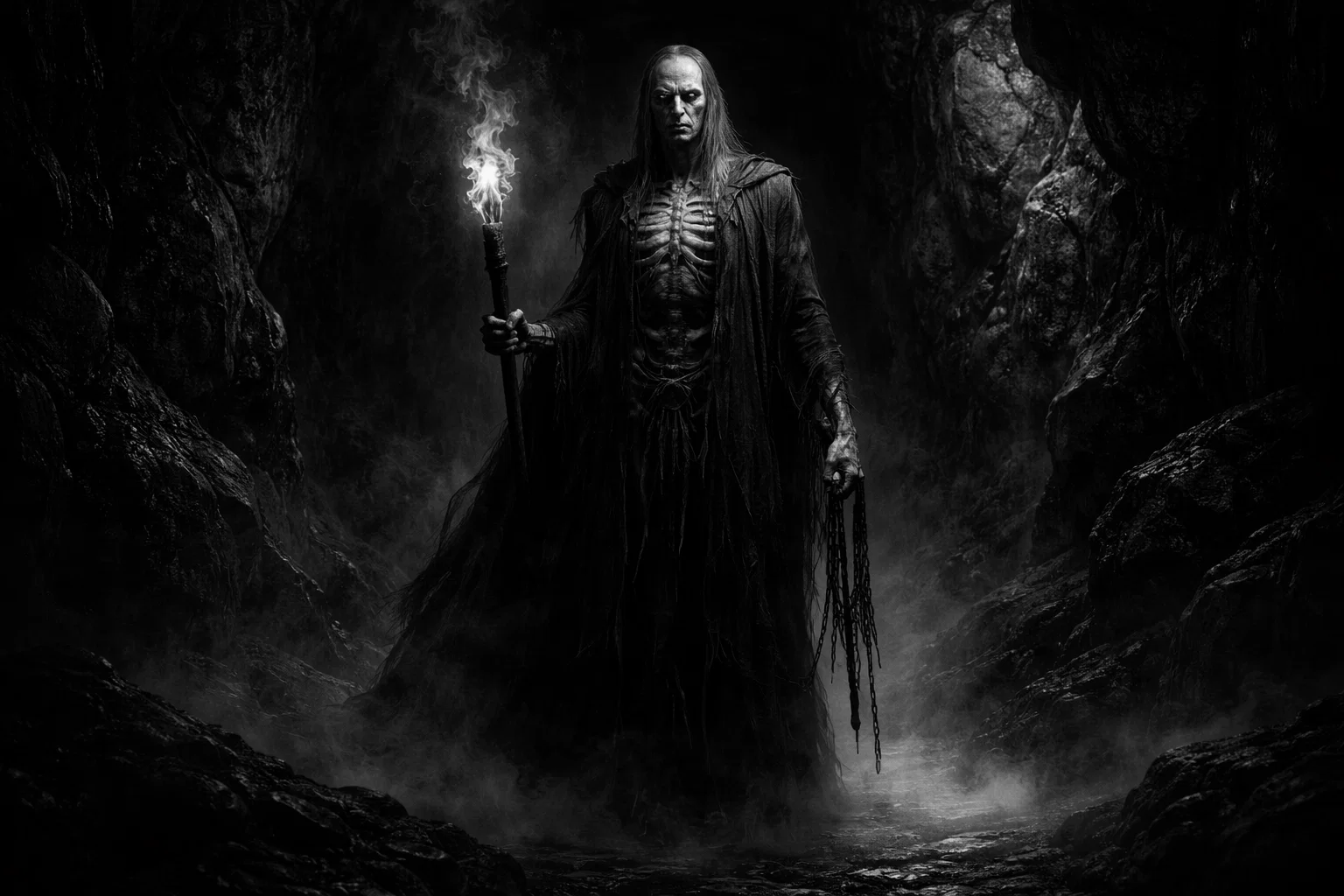

Alastor is a chthonic spirit and avenging demon in Greek mythology. He is often seen as the personification of family blood feuds and relentless vengeance, punishing those who break natural or divine laws, especially through acts like parricide or perjury.
Although Alastor is sometimes linked to Zeus in a judicial role, he mainly acts on his own as a vengeful spirit, making sure that a father’s sins are passed down to his children.
Table of Contents
Overview
| Attribute | Details |
| Primary Name | Alastor |
| Other Names | Alastros, Zeus Alastor, The Unforgetting One, The Avenger |
| Titles | Avenger of Evil Deeds, The Executioner, Spirit of Vengeance, Punisher of the Wicked, Shadow of the Blood-Feud, The Unresting One, Tormentor of the Guilty, Scourge of the Accursed |
| Gender | Male |
| Alignment | Lawful Evil |
| Role | Avenging spirit, instigator of blood feuds, punisher of familial crimes, personification of the curse |
| Rank | Chthonic Daimon / Minor Deity |
| Hierarchy | Subordinate to Pluto and Persephone; occasionally acts as an instrument of Zeus Alastor |
| Legions / Followers | None specified; often works alongside the Erinyes (Furies) |
| Appearance | A grim, shadowy humanoid figure, often depicted with a stern countenance or as an invisible pursuing force. |
| Powers & Abilities | Induces madness, perpetuates generational curses, tracks victims across borders, ensures the failure of the guilty’s endeavors, manipulation of fate |
| Associated Figures | Zeus, Pluto, Persephone, Nemesis, The Erinyes, Tisiphone, Megaera, Alecto, Hecate, Oedipus, Clytemnestra, Agamemnon, Orestes, Medea, Lycaon, Pelops, Atreus, Thyestes |
| Weaknesses | Ritual purification (katharsis), divine intervention by Apollo or Athena, fulfillment of the blood debt, ending of the family line |
| Opposing Forces | Apollo (as the Purifier), Athena (as the Judge), The Eumenides (transformed Furies) |
| Pantheon | Greco-Roman |
| Region of Origin | Ancient Greece |
| First Known Appearance | 8th–7th century BCE; mentioned in early Greek epic and tragic poetry |
| Primary Sources | Aeschylus’ Oresteia, Sophocles’ Oedipus Rex, Euripides’ Medea, Pausanias’ Description of Greece, Hesychius’ Lexicon |
Description
Alastor stands for the idea of an “unforgettable” crime. In Greek belief, he is not just a random demon, but a curse that clings to a family after a terrible act, like killing a guest or relative. His purpose is to keep cosmic justice by making sure every wrong is punished.
Alastor also symbolizes the heavy burden of guilt and the certainty of consequences. He represents the idea of “an eye for an eye,” quietly pushing a family toward ruin when they break the gods’ sacred laws.
Appearance
Alastor’s physical form is rarely described because he is mostly seen as a ghostly, relentless force. When he is shown, he looks grim and strong, with a human-like shape. His skin is usually pale or ashen, showing his ties to the underworld, and his face is rough and merciless.
Unlike the winged Furies, Alastor is usually seen as a stalking entity who stays on the ground. He might carry tools of punishment, like a whip or torch, but people mostly sense him as a cold, heavy shadow hanging over those he targets. His eyes are described as fixed and unblinking, showing that he never forgets human wrongdoing.
History
The Birth of Vengeance
In the earliest days, as the gods’ laws were first shaping the world, Alastor came out of the darkness of Erebus. He was not born from flesh, but from the first cry of a murdered family member.
As the blood of the dead soaked into the ground, the pain and need for justice took shape as a living being. The chthonic powers gave this entity the job of making sure no secret murder stayed hidden. From the start, Alastor was the shadow that followed innocent bloodshed, quietly watching until it was time to act as a fierce executioner.
The Complete Lesser Key of Solomon Awaits. Flash Sale – Up to 10% OFF!
The Complete Lemegeton (Books I-V). The legendary 17th-century grimoire of demon summoning, angelic evocation, sacred seals, and ancient magick — all five books in one definitive edition. Ars Goetia ● Theurgia Goetia ● Paulina ● Almadel ● Notoria.
The Curse of the House of Atreus
One of the best-known stories about Alastor involves the House of Atreus. The horror began when Tantalus served his son, Pelops, as food to the gods. Even though the gods brought Pelops back, the crime brought Alastor to the family. Generations later, his influence showed as Atreus and Thyestes fought bitterly for the throne.
Alastor haunted the halls of Mycenae, pushing Atreus to repeat his grandfather’s crime by serving Thyestes his own children at a feast. The demon stayed in the palace, stirring up the events that led Clytemnestra to kill Agamemnon and later drove Orestes to kill his mother.
In this story, Alastor is called a “heavy guest” in the house, a spirit who would not leave until the blood debt was fully repaid.
The Ruin of Oedipus
In Thebes, Alastor played a part in King Oedipus’s tragic story. Even though Oedipus did not know he was guilty of patricide and incest, the universe’s laws were still broken. Alastor showed up as a plague that ruined crops and made the women infertile. He weighed the city down, demanding the truth come out.
Even after Oedipus blinded himself and left Thebes, Alastor continued to haunt his sons, Eteocles and Polynices. He fueled their hatred, which led to the War of the Seven Against Thebes, where the brothers killed each other at the same time, finally meeting Alastor’s demand for the family’s destruction.
The Wrath of Medea
When Jason betrayed Medea for another woman, Medea called on the chthonic powers to witness his broken promise. Folklore says that Alastor answered her, giving her the cold determination to kill her own children.
The demon became the driving force behind Medea’s revenge, making sure Jason suffered a fate worse than death: living a long life haunted by the loss of his family. In this story, Alastor’s role as a protector of oaths stands out. Since Jason had sworn his love by the gods, Alastor became the tool of his downfall when that promise was broken.
Genealogy
| Attribute | Details |
| Parents | Nyx (Night) or Erebus (Darkness); sometimes cited as a son of Gaia |
| Siblings | The Erinyes, Nemesis, Eris, Thanatos, Hypnos |
| Consorts | None |
| Offspring | None |
| Other Relationships | Allied with the Furies; servant of Pluto and Persephone |
Sources
| Source | Quote |
| Aeschylus, Agamemnon | The ancient, bitter Alastor (avenging spirit) of the feeder [Atreus], taking the shape of this dead man’s wife, has paid out this man, sacrificing a grown man for the young. |
| Sophocles, Oedipus Rex | May the Alastor (avenger) of the gods and the Furies catch you in a shameful and evil death for your evil deeds. |
| Euripides, Medea | The Alastor (avenging spirit) sent by the gods for your father’s sake has fallen on me. |
| Pausanias, Description of Greece | They say that the name Alastor was given to him by the inhabitants because of the unforgetting nature of his vengeance. |
The Classic Masterwork of the Black Arts. Limited-Time: Up to 42% OFF!
The legendary 1967 guide to forbidden magick — witchcraft, Satanism, demonology, alchemy, astrology, rituals, and the dark history of occult power through the ages: Black Magick ● Alchemy & Astrology ● Kabbalah ● Ritual Magic ● Satan & Demons
Powers
Alastor’s main power is the Generational Taint. Instead of taking over a single body, he attaches himself to a family line. He connects to the family’s blood, pushing later generations to repeat the first crime.
This starts a never-ending cycle of doom. Alastor also uses Psychological Attrition. He does not always kill his victims right away. Instead, he brings them a series of troubles, like failed crops, being shunned by others, and nightmares, until they break down mentally.
Alastor can also control Environmental Miasma. His presence is said to poison the land around a wrongdoer, causing blighted crops and dead animals. He is like a spiritual tracker, with a perfect sense of bloodguilt, so he can find his target no matter how far they run or how much time passes.
His last power is the Clouding of Judgment. This means he makes sure a guilty person makes the very choices that lead to their own capture or death, turning them into their own executioner.
Occult correspondences
| Attribute | Details |
| Planet | Saturn |
| Zodiac Sign | Scorpio |
| Element | Earth (Chthonic) |
| Direction | North (The direction of shadows) |
| Color | Black, Blood Red |
| Number | 8 (Representing the scales of justice) |
| Metal | Lead |
| Crystal / Mineral | Obsidian, Hematite |
| Herb / Plant | Asphodel, Cypress |
| Incense | Myrrh, Sulfur |
| Sacred Animal / Symbol | The Scourge, The Broken Hearth |
Tags:
Explore More Demons…
December 1, 2025
Mahabali (Powerful Asura King)
February 18, 2026
Baphomet (Templar/Occult Goat-Headed Demon)
February 24, 2026
February 12, 2026
January 19, 2026
Belphegor (Moabite Lord of the Gap)
February 10, 2026
