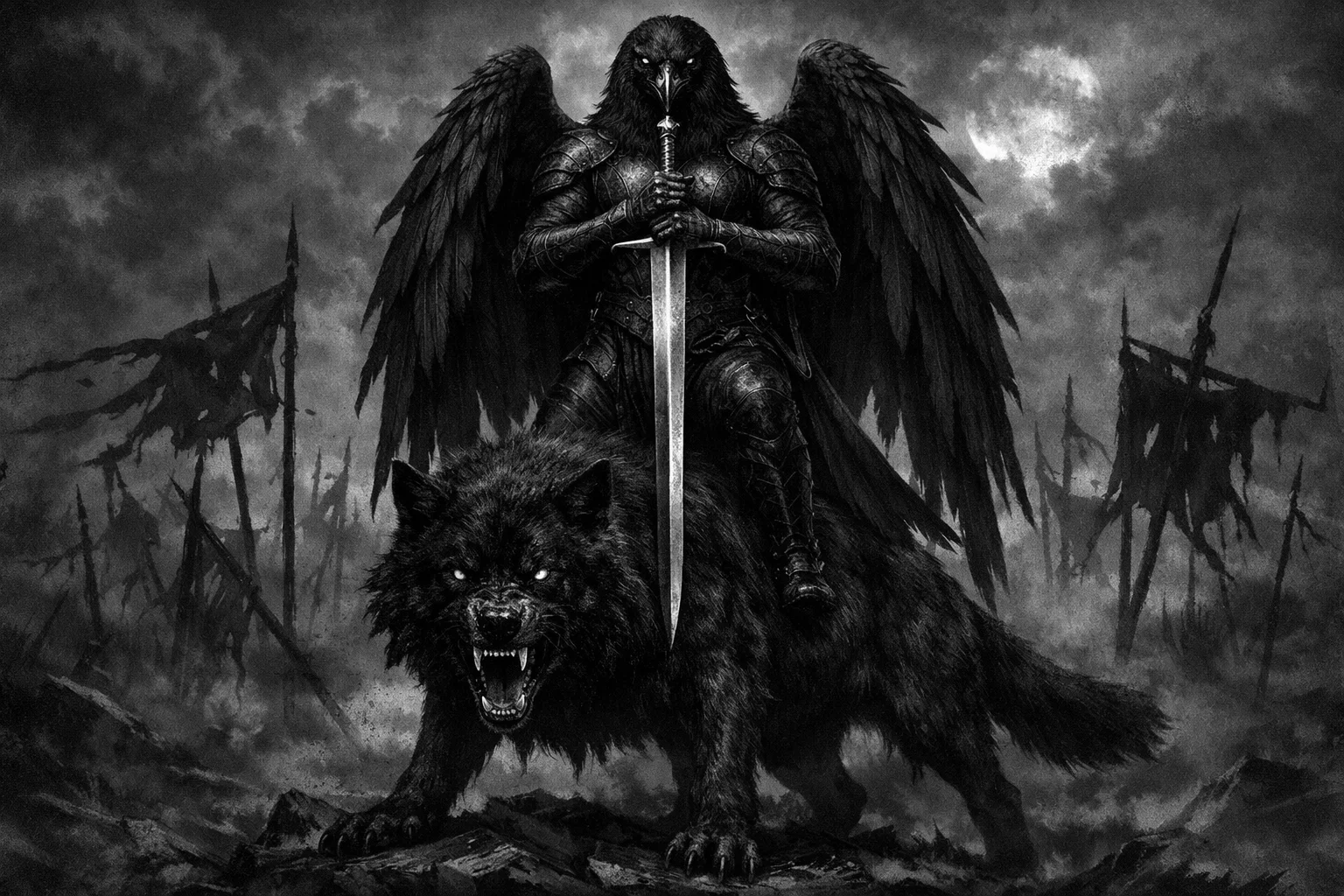

Andras is known as a Great Marquis of Hell and appears mainly in the 17th-century grimoire The Lesser Key of Solomon. He is listed as the 63rd spirit in the Ars Goetia. Andras’s main role is to create discord and provoke deadly conflict. In the infernal hierarchy, he is noted for his unpredictable nature and his command over thirty legions of spirits.
Table of Contents
Overview
| Attribute | Details |
| Primary Name | Andras |
| Other Names | None documented in primary historical grimoires |
| Titles | Great Marquis of Hell, The Author of Discords, The Instigator of Slaughters |
| Gender | Male |
| Alignment | Chaotic Evil |
| Role | Sower of discord, Instigator of murder, Destroyer of masters and servants, Teacher of how to kill |
| Rank | Great Marquis |
| Hierarchy | Subordinate to the Kings of the East; commands 30 Legions of Spirits |
| Legions / Followers | 30 Legions |
| Appearance | An angel with the head of an owl or raven, riding a strong black wolf, wielding a sharp bright sword |
| Powers & Abilities | Instigates killing, sows permanent discord, grants knowledge of how to slay enemies, destroys the bond between masters and servants |
| Associated Figures | Solomon, Haures, Ipos, Raum, Sabnock, Shax, Flauros, Leraje, Eligos, Abaddon, Belial, Beelzebub, Asmodeus, Astaroth, Bael, Paimon, Zagan, Belphegor |
| Weaknesses | Magical circles (must be contained within), specific conjurations, names of God, brass vessel containment |
| Opposing Forces | The Angel Aniel |
| Pantheon | Abrahamic (Occult/Goetic) |
| Region of Origin | Europe (Grimoire Tradition) |
| First Known Appearance | 16th Century (Pseudomonarchia Daemonum) |
| Primary Sources | Pseudomonarchia Daemonum, Ars Goetia, Dictionnaire Infernal |
Description
Andras is seen as the embodiment of irrational violence and the breakdown of social order. Unlike many Goetic spirits who offer wealth or secret knowledge, Andras is described as a purely destructive force in the Lesser Key. He stands for the collapse of social structures and sudden, deadly anger.
He is considered especially dangerous to those who summon him, as he is one of the few spirits known to try to kill the conjurer if rituals are not done correctly. Andras represents the chaos of rebellion and the malice needed to turn friends into enemies. He symbolizes how fragile human authority is and how quickly peace can turn into violence.
Appearance
Andras is usually described as a hybrid being with a consistent form. He has the body of a well-built human angel, but his head is that of a night bird, either a raven or an owl. His bird head is marked by dark feathers and a sharp, noticeable beak.
He is shown riding a large, strong black wolf. In one hand, he has a sword known for its sharpness and bright, shining blade. The mix of his angelic body and animal features highlights his deceptive and predatory side. Most accounts say he keeps this form and does not change his appearance.
History
Origins
Andras’s origins are linked to the rebellion in Heaven and the fall of the angels. Before the split between light and darkness, he was a respected angel known for his intelligence and his part in keeping order. During the Great War in Heaven, he chose to join the rebellion led by the Morning Star.
After the rebels were defeated, Andras was cast out with the others, falling until he reached the underworld. During this fall, he lost his connection to divine harmony, and his angelic wisdom turned into a special kind of malice aimed at breaking bonds and spreading discord.
The Forbidden Knowledge Of Demons. Limited-Time: Up to 40% OFF!
The no-nonsense deliverance manual — names, functions, and scriptural strategies to identify, bind, and cast out demons that torment believers today: Addiction ● Depression ● Witchcraft ● Infirmity ● Jealousy ● Hundreds More

The Architect of Mutiny
Early folklore says Andras was present in the background of great empires and military camps. One story tells of his influence during a long-forgotten siege in ancient times.
A famous general defended his city for years with the help of loyal officers. According to legend, Andras appeared in the dreams of the youngest officers, not offering wealth, but watching silently with the head of an owl. Soon after, the loyalty that kept the city safe turned into suspicion.
The officers began to view their general as a tyrant rather than a hero. Within three nights, the defenders turned on each other, and the city fell—not to the enemy outside, but to the violence caused by Andras from within.
The Grimoire Records
Over time, occultists and scholars wrote down methods to summon Andras. In the medieval era, he became a key entity in different versions of the “Books of Spirits.”
Stories about King Solomon and the 72 spirits say Andras was one of the hardest to control. Solomon is said to have trapped him in a brass vessel. Still, legends claim that even while imprisoned, Andras’s presence made the temple guards argue and fight for no reason.
These stories built his reputation as a spirit to be feared, not used, which led to warnings in later texts, such as the Pseudomonarchia Daemonum, about the deadly risk of even uttering his name.
Sources
| Source | Quote |
| Pseudomonarchia Daemonum (Weyer, 1577) | Andras est marchio magnus, visitur forma angelica, capite nycticoraci simili, nigro lupo insidens, & acutissimum gladium manu micans. Auctor est discordiarum. Si incautus fuerit exorcista, eundem cum sociis interficiet. |
| Ars Goetia (The Lesser Key of Solomon) | The Sixty-third Spirit is Andras. He is a Great Marquis, appearing in the Form of an Angel with a Head like a Black Night Raven, riding upon a strong Black Wolf, and having a Sharp and Bright Sword flourished aloft in his hand. His Office is to sow Discords. If the Exorcist have not a care, he will slay both him and his fellows. |
| Dictionnaire Infernal (Collin de Plancy, 1863) | Andras, grand marquis aux enfers. On le voit avec le corps d’un ange, la tête d’un chat-huant, à cheval sur un loup noir et portant à la main un sabre très-tranchant. Il apprend à ceux qu’il favorise à tuer leurs ennemis, leurs maîtres et leurs serviteurs; c’est lui qui élève les discordes et les querelles. |
Powers
Andras works by increasing social and psychological tension until it leads to violence. He mainly does this by making existing problems worse until people want to kill.
When he is summoned or present, he breaks down normal order and the “bonds of service.” This causes subordinates to attack their leaders and masters to turn on their servants. The result is not just a brief fight, but a deep and lasting split that often ends in murder.
Andras also teaches the skills needed to kill. This power appears as sudden, instinctive knowledge of an enemy’s weak points and the best way to use a blade against them. His influence can even break through magical protections if the person performing the ritual shows fear or hesitation.
When Andras is released into a group, the result is complete collapse, often ending in “the slaughter of all involved,” since he does not care who is friend or enemy once chaos begins.
The Complete Lesser Key of Solomon Awaits. Flash Sale – Up to 10% OFF!
The Complete Lemegeton (Books I-V). The legendary 17th-century grimoire of demon summoning, angelic evocation, sacred seals, and ancient magick — all five books in one definitive edition. Ars Goetia ● Theurgia Goetia ● Paulina ● Almadel ● Notoria.
Occult correspondences
| Attribute | Details |
| Planet | Moon (as Marquis) |
| Zodiac Sign | Aquarius |
| Element | Fire / Air |
| Direction | East |
| Color | Violet / Black |
| Number | 63 |
| Metal | Silver |
| Crystal / Mineral | Onyx |
| Herb / Plant | Wormwood |
| Incense | Jasmine |
| Sacred Animal / Symbol | Wolf / Raven / Owl |
Tags:
Explore More Demons…
Aeshma (Zoroastrian Demon of Wrath)
December 4, 2025
December 2, 2025
Bakasura (Hindu Rakshasa of Insatiable Appetite)
February 11, 2026
Alû (Mesopotamian Night Demon)
January 14, 2026
Alal (Mesopotamian Destroyer Demon)
January 8, 2026
January 22, 2026
