
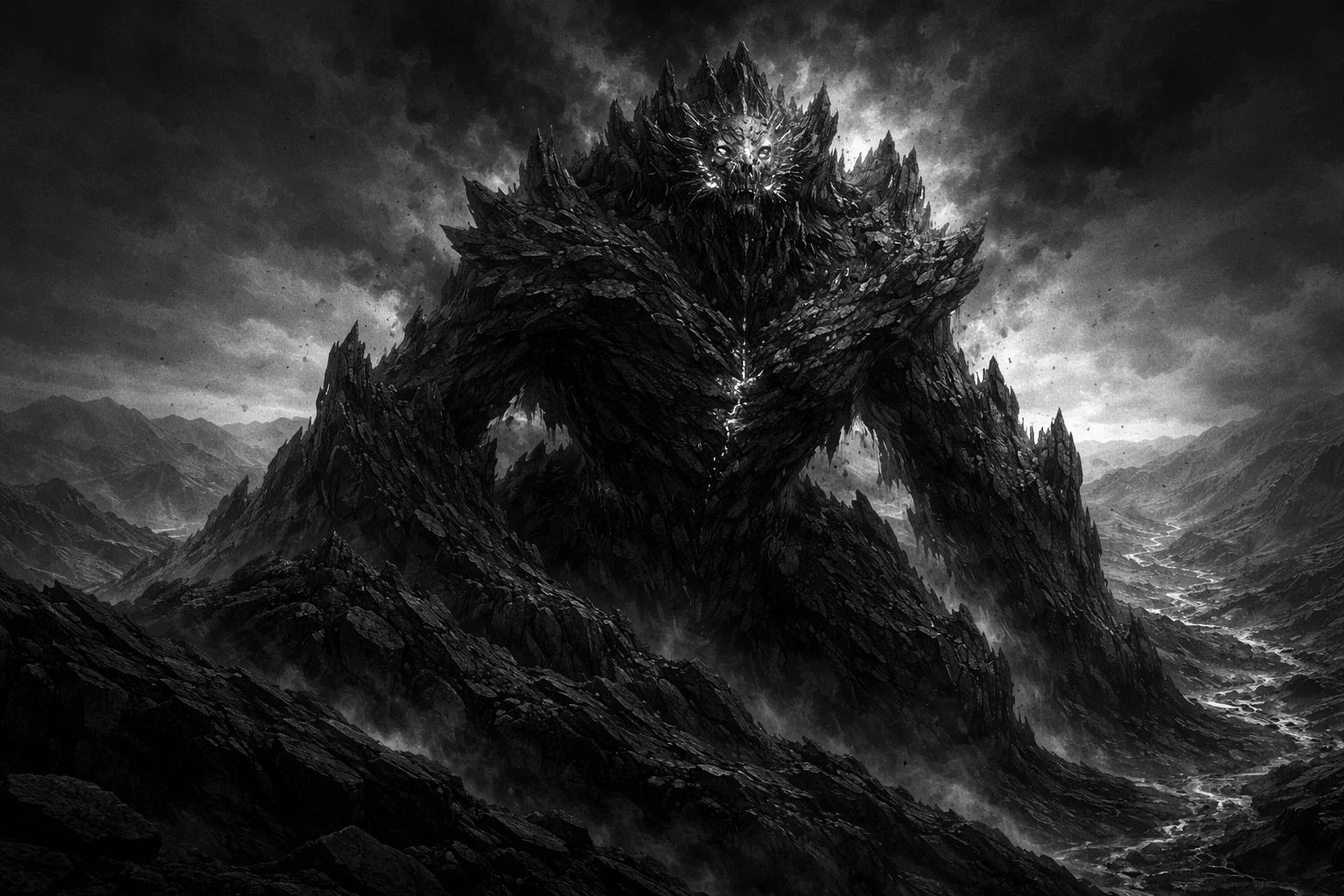

Asag is a demon from Sumerian mythology, known as the personification of disease and chaos. In Mesopotamian stories, Asag is a major enemy of the gods, especially the warrior god Ninurta. Born from the union of Earth and Sky, Asag is seen as a powerful threat who can lead an army of stone creatures against the gods.
Table of Contents
Overview
| Attribute | Details |
| Primary Name | Asag |
| Other Names | Asakku, Azag |
| Titles | The Disease-Demon, The Monster who Causes Ailments, The Conqueror of the Mountain, The Enemy of Ninurta |
| Gender | Male |
| Alignment | Chaotic Evil |
| Role | Bringer of Pestilence, Leader of the Stone Army, Destroyer of Order |
| Rank | Primordial Monstrosity / Archdemon |
| Hierarchy | Serves no superior; leads a brood of stone-demon offspring |
| Legions / Followers | An army of “stone-men” or mountain-born rock demons |
| Appearance | Hideous, monstrous, and massive; often associated with a form so foul it causes fish to boil in rivers. |
| Powers & Abilities | Induces fever and sickness, commands geological forces, telepathic manipulation of stones, paralyzes enemies with dread. |
| Associated Figures | Ninurta, Enlil, Ki, An, Sharur, Kur, Tiamat, Namtar, Pazuzu, Lamashtu, Nergal, Ereshkigal |
| Weaknesses | The mace Sharur, divine intervention by Ninurta, specific incantations of the ‘sag-gig’ type. |
| Opposing Forces | Ninurta, Enlil, Gula |
| Pantheon | Mesopotamian (Sumerian/Akkadian) |
| Region of Origin | Mesopotamia (Ancient Iraq) |
| First Known Appearance | Approx. 3rd millennium BCE in Sumerian literary texts. |
| Primary Sources | Lugal-e (The Exploits of Ninurta), Sag-gig incantations |
Description
Asag stands for the idea of sickness as a dangerous force from outside. In Sumerian belief, Asag is a symbol of the ‘Kur,’ which means the wild, chaotic mountains or the underworld that stood against the settled, farmed lands of Mesopotamia.
Asag represents headaches and fevers that trouble people, reminding them how fragile the human body is and how dangerous the wild can be. Asag’s purpose is to challenge the gods’ rule and spread sickness.
Asag’s story shows that the Mesopotamians believed illness was not just a natural event but an attack by a thinking, evil being seeking to restore chaos.
Appearance
Asag is described as huge and monstrous. Its appearance is so disturbing that it affects the world around it, making the river water boil and killing fish with heat. Ancient texts do not give many details, but Asag is always shown as a giant creature linked to the rough mountain landscape.
Unlike the gods, Asag is not beautiful or balanced. Its body is jagged and fierce, often shown as a mix of different monster features. This highlights that Asag is an unnatural being, not part of the normal world of animals or humans.
The Complete Fiction of H.P. Lovecraft
Every tale of cosmic horror in one definitive collection — Cthulhu, Yog-Sothoth, ancient gods, forbidden tomes, and the madness that lies beyond the stars: Call of Cthulhu ● At the Mountains of Madness ● Shadow Over Innsmouth ● The Dunwich Horror ● Complete Mythos
History
The Birth in the Mountains
Asag was born in the rough, hard-to-reach mountains east of the Sumerian cities. It came from the union of Sky and Earth, making it neither fully a god nor fully a creature of the earth.
As soon as Asag appeared, it tried to take control of the world. It did not live with the gods but stayed in the ‘Kur,’ building its strength. Asag deeply resented the order and fertility of the river valleys, seeing human civilization and the gods’ rules as insults to its own chaotic nature.
The Brood of Stones
While in the mountains, Asag joined with the earth and rocks, creating a frightening race of beings. These ‘stone-children’ were warriors made of living stone, who could not be hurt by normal weapons and felt no pain.
Asag spent centuries building and training this army, making sure they were loyal only to him. These stone-demons acted as his hands, helping him spread his power from the mountains down to the lower lands. Their movements caused tremors that shook the temples in the plains below.
The Rebellion Against the Gods
Eventually, Asag became bold enough to challenge the gods directly. He called himself the ruler of the mountains. He blocked the waters flowing from the highlands to the Sumerian fields, putting the world at risk of drought and famine. The gods soon heard about this rebellion.
The gods were frightened by stories of Asag’s ugliness and his unstoppable stone army. Some said that just hearing Asag’s name made the gods tremble and hide. Asag’s power grew so much that he changed the weather and sent fevers across the land, showing he was ready to attack the gods.
The Conflict with Ninurta
Ninurta, the warrior-god and son of Enlil, was the only one brave enough to face Asag. With his talking mace, Sharur, Ninurta went to the mountains to fight Asag alone. Their battle was so fierce it shook the world. Asag used disease and heat to weaken Ninurta and almost defeated him at first.
Asag’s stone army fought so fiercely that they pushed the gods back. But Sharur gave Ninurta advice and strength, helping him keep going. Ninurta finally called up a huge storm and used his divine weapons to break the stone warriors.
In the end, Ninurta defeated Asag, ending his terror. The fallen stone warriors became the mountains and roads of the earth.
Genealogy
| Attribute | Details |
| Parents | An (Sky) and Ki (Earth) |
| Siblings | Enlil, Enki (half-siblings in some traditions) |
| Consorts | The Mountains |
| Offspring | The Army of Stone-Demons |
| Other Relationships | Adversary of Ninurta |
The Full Solomonic Trilogy of Power Awaits. Limited-Time: Up to 67% OFF!
The ultimate Solomonic arsenal — Greater Key (Clavicula Salomonis), Lesser Key (Lemegeton), and the ancient Testament: demon binding, angelic invocation, planetary magick, and the original spirit commands of King Solomon: Greater Key ● Lesser Key ● Testament of Solomon ● 72 Spirits ● Pentacles & Circles
Sources
| Source | Quote |
| Lugal-e, Tablet I | The Asag, a monster that knows no fear, its shadow is thick and black. |
| Lugal-e, Tablet III | The Asag was attacking the city from the mountains, the stone-men were following it. |
| Sag-gig-ga-meš | The Asakku-demon has approached the man’s head, the neck is seized by the Asakku. |
Powers
Asag’s main power is to create and spread dangerous diseases, especially those with high fever and pain, like migraines. Asag is not just a carrier but the source of these illnesses. When Asag attacks someone, the air feels heavy, and their body fluids are said to dry up or boil.
Besides spreading disease, Asag can control stone. He can bring rocks and boulders to life, turning them into living servants. He can also cause landslides, earthquakes, and even heat up riverbeds.
When Asag is near, the environment collapses: water is undrinkable, the land becomes barren, and the air spreads weakness and death. In battle, Asag can cast a horror so strong that even lesser gods freeze, making them feel as if a mountain is pressing down on them.
Occult correspondences
| Attribute | Details |
| Planet | Saturn |
| Zodiac Sign | Capricorn |
| Element | Earth / Fire |
| Direction | East |
| Color | Brown / Grey |
| Number | 7 |
| Metal | Lead |
| Crystal / Mineral | Basalt / Granite |
| Herb / Plant | Desert Scrub / Thorns |
| Incense | Sulfur |
| Sacred Animal / Symbol | The Serpent-Dragon / Jagged Rock |
Tags:
Explore More Demons…
Ammit (Egyptian Devourer Demon)
January 20, 2026
Banasura (Hindu Thousand-Armed Asura)
February 20, 2026
December 1, 2025
February 2, 2026
Aeshma (Zoroastrian Demon of Wrath)
December 4, 2025
January 21, 2026
