
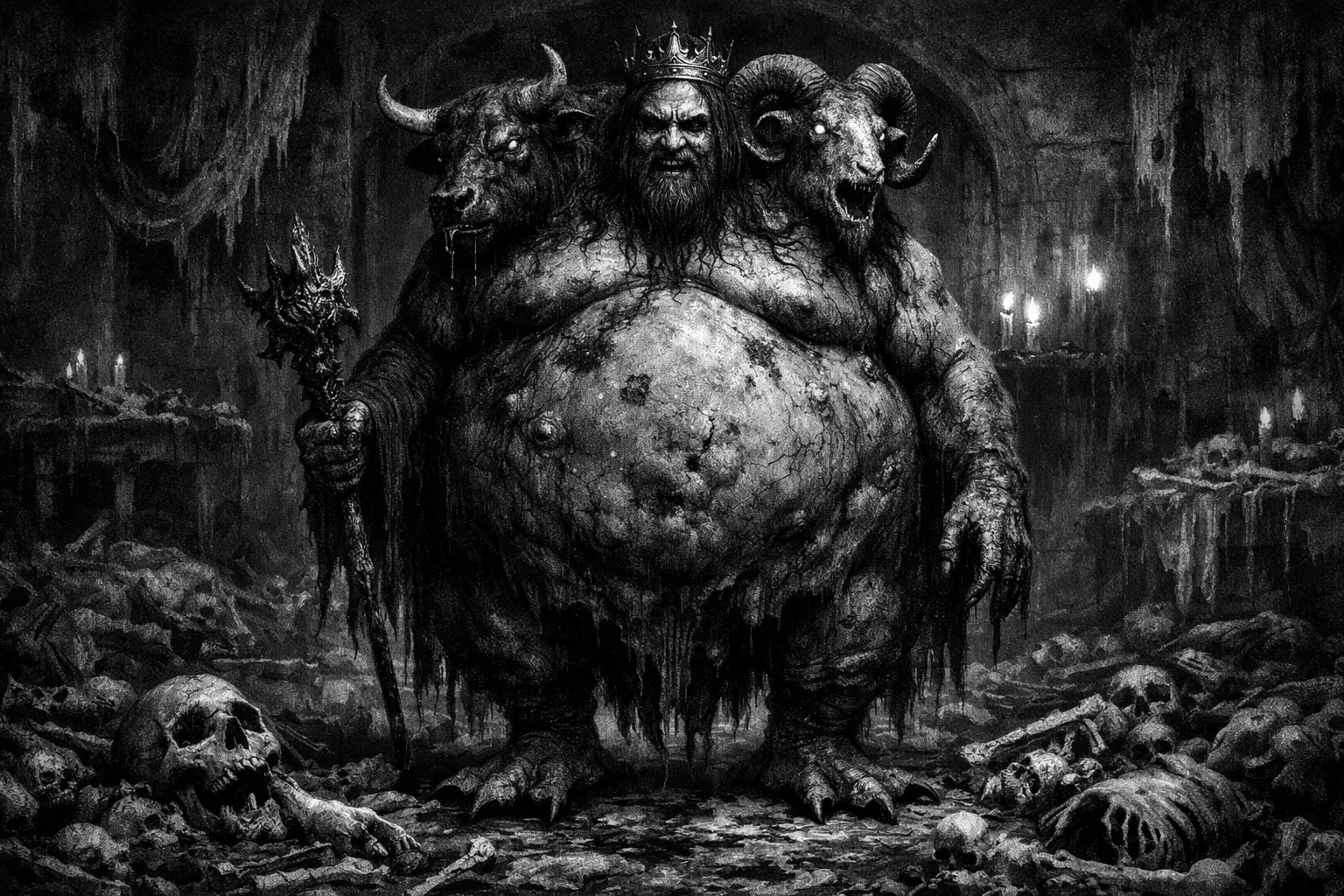

Asmodeus is known as a Great King of Hell and one of the Seven Princes of Hell, representing the sin of lust. In Judeo-Christian traditions, he is seen as one of the most powerful archdemons. His story appears in ancient texts such as the Book of Tobit and in medieval grimoires, including the Ars Goetia, where he commands many legions of spirits.
Table of Contents
Overview
| Attribute | Details |
| Primary Name | Asmodeus |
| Other Names | Asmodai, Asmoday, Asmodée, Ashmedai, Asmodaios, Hashmodai, Hasmoday, Ashmodai, Sidonay, Sydonay, Asmodas, Asmody |
| Titles | King of Demons, Prince of Revenge, The Destroyer, Prince of Lust, One of the Seven Princes of Hell, Lord of the Fourth Hierarchy, The Gambler, King of the Nine Hells, Master of the Houses of Judgment, The Murderer, The Raging One, The Adversary of Solomon, Warden of the Abyss |
| Gender | Male |
| Alignment | Lawful Evil |
| Role | Tempter of Lust, Destroyer of Marriages, Instigator of Wrath, Teacher of Geometry and Astronomy, Guardian of Hidden Treasures, Corrupter of Kings, Sower of Discord |
| Rank | One of the Seven Princes of Hell, King within the Goetic Hierarchy |
| Hierarchy | Subordinate to Lucifer or Amaymon (depending on source) / Commands 72 legions of inferior spirits |
| Legions / Followers | 72 Legions |
| Appearance | A creature with three heads (bull, man, ram), snake’s tail, goose feet, riding a dragon and carrying a lance. |
| Powers & Abilities | Induces insatiable lust, breaks marital bonds, grants invisibility, teaches mathematics and handicrafts, reveals hidden treasures, bestows the ring of virtues, causes destruction through wrath. |
| Associated Figures | King Solomon, Archangel Raphael, Tobias, Sarah, Lilith, Samael, Abraham, Beelzebub, Agrat bat Mahlat, Naamah, Mephistopheles, Lucifer, Azazel |
| Weaknesses | Smell of burning fish liver and heart (as per Tobit), holy names, specific geometric seals, iron, the sign of the cross |
| Opposing Forces | Archangel Raphael, Saint John the Baptist |
| Pantheon | Abrahamic (Jewish/Christian), Persian (via Aeshma) |
| Region of Origin | Ancient Persia / Levant |
| First Known Appearance | Approx. 2nd Century BCE in the Book of Tobit; roots in Avestan texts (as Aeshma-daeva) |
| Primary Sources | Book of Tobit, Testament of Solomon, Lesser Key of Solomon (Ars Goetia), Malleus Maleficarum, Dictionnaire Infernal |
Description
Asmodeus plays a key role in demonology as the main force behind broken marriages and sexual corruption. He stands for the twisting of human desire and the loss of self-control. His story is often used as a warning against losing moral discipline and respect for family life.
In many stories, Asmodeus is seen as a fallen angel who kept much of his heavenly knowledge. He uses this knowledge to trap souls through pride and temptation. Rather than causing random chaos, he is often described as a clever and royal enemy who operates within the rules and slowly weakens people’s spiritual strength.
Appearance
Asmodeus is often described as having a strange, mixed appearance. He has three heads: one like a bull, one like a man, and one like a ram. His feet look like those of a goose and are sometimes hidden or resting on a dragon’s back. He is usually shown holding a banner or a lance.
He is said to breathe fire from his mouth. In some stories, he appears as a proud but frightening human king. However, signs of his monstrous nature often remain, either in his posture or through the presence of his dragon mount.
History
Origins
Many believe Asmodeus comes from the ancient Persian demon of wrath, Aeshma-daeva. In Zoroastrian belief, Aeshma stood for “fury” and “the wounding spear,” and was an enemy of the divine order called Asha, or truth.
Aeshma’s main role was to distract people from their faith and stir up violence among cattle-herders in ancient Iran. When Jewish beliefs mixed with Persian ideas during the Babylonian exile, Aeshma became part of Hebrew stories as Ashmedai.
Rabbinic texts give different stories about how Asmodeus was born. One well-known version from the Zohar says he was the child of the mortal Shamdon and Naamah, who was Tubal-cain’s sister. Naamah was said to be so beautiful that she tempted the fallen angels, and her son Asmodeus inherited both heavenly and earthly traits.
Other stories say Asmodeus was created at the end of the sixth day of creation. Since the Sabbath started before he was finished, he was left without a physical body. He became the king of the Shedim, or spirits. This is said to be why he is always jealous of human relationships.
The Most Dangerous Demon Dictionary Awaits. Up to 33% OFF!
Limited Time: Up to 33% OFF the Expanded 10th Anniversary Edition. Over 1,600 demonic names, etymologies, visions of hell, historical lore, and haunting illustrations from medieval grimoires — the ultimate A–Z of the infernal hierarchy: Fallen Angels ● Goetic Spirits ● Global Demons ● Visions of Hell ● Occult History
The Torment of Sarah and the Seven Husbands
In the Book of Tobit, Asmodeus is known for destroying family happiness. He fell in love with Sarah, the daughter of Raguel, and decided that no man should ever marry her.
Every time Sarah was married, Asmodeus entered the bridal room on the wedding night. They killed the groom before the marriage could be completed. This happened seven times, leaving Sarah deeply troubled and isolated.
In this story, Asmodeus’s power is shown as overwhelming and could only be stopped by special rituals. When Tobias wanted to marry Sarah, the Archangel Raphael, disguised as Azarias, told him to use the organs of a special fish caught in the Tigris River.
Tobias burned the heart and liver of the fish on incense, creating a smoke that the demon could not stand. The smell, along with the couple’s prayers, made Asmodeus give up and flee far away.
The Flight to Upper Egypt and Imprisonment
Asmodeus escaped from the Levant to Upper Egypt, a place once thought to be home to wild spirits. But he did not stay free for long. The Archangel Raphael, showing God’s healing power, chased him down in the desert and tied him up.
This act of binding is important in demon stories, showing how divine order can control wrath. Some versions say Asmodeus stayed trapped in Egypt for centuries, while others say King Solomon later freed him using magic.
Occult texts often link Asmodeus’s time in Egypt to his connection with the south and east, and to his power over desert spirits.
The Building of the First Temple
The Testament of Solomon tells how Asmodeus was brought before King Solomon using a magical ring marked with the Seal of God. Asmodeus bragged about his heavenly origins and his goal to spread trouble, but Solomon used the ring to control him.
Asmodeus was made to help build the Temple in Jerusalem. He had to use his great knowledge of geometry and building to assist the workers.
He was given the job of spinning hemp for ropes and, more importantly, helping Solomon find the Shamir. The Shamir was a legendary creature or stone that could cut through the hardest rock without iron tools, which were not allowed in the construction of the Temple. Asmodeus, though unwilling, showed where to find the Shamir and other needed materials.
The Usurpation of the Throne
The story of Solomon and Asmodeus ends with a dramatic trick. The Talmud says Solomon asked Asmodeus why demons were better than humans if a simple ring could control them. Asmodeus answered that if Solomon took off the ring and freed him, he would show his real power.
Solomon, feeling proud, agreed. Asmodeus instantly grew huge, with wings that filled the sky. He grabbed the ring, swallowed it (or threw it into the sea in some stories), and threw Solomon far away. Then Asmodeus took on Solomon’s appearance and sat on the throne.
For years, Asmodeus ruled Israel, puzzling Solomon’s advisors and wives with his strange actions. The real Solomon wandered as a beggar, unknown to his people. He finally got the ring back from a fish’s belly and returned to the palace. When Asmodeus saw the real Seal, he had to drop his disguise and escape back into the Abyss.
The Full Solomonic Trilogy of Power Awaits. Limited-Time: Up to 67% OFF!
The ultimate Solomonic arsenal — Greater Key (Clavicula Salomonis), Lesser Key (Lemegeton), and the ancient Testament: demon binding, angelic invocation, planetary magick, and the original spirit commands of King Solomon: Greater Key ● Lesser Key ● Testament of Solomon ● 72 Spirits ● Pentacles & Circles
The Prince of the Nine Hells
In later medieval and Renaissance stories, Asmodeus changed from a local troublemaker to a ruler of the cosmos. He became one of the Seven Princes of Hell, in charge of the Fourth Circle, or the realm of Lust. In these tales, he is not just a king of spirits but also a general leading 72 legions of demons.
Asmodeus’s story grew to include mentions in the Malleus Maleficarum and other witch-hunting texts, where he was blamed as the main cause of “the sin of the flesh.” In 17th-century France, during the Loudun possessions, he was said to be one of the demons that possessed the Ursuline nuns.
He was also said to have stolen the pact between the priest Urbain Grandier and the Devil. This added to his reputation as a top official in Hell, overseeing the legal and contractual aspects of damnation.
Genealogy
| Attribute | Details |
| Parents | Naamah and Shamdon (Rabbinic tradition); sometimes listed as offspring of Adam and Lilith |
| Siblings | Various Shedim; in some accounts, related to Tubal-cain |
| Consorts | Lilith (The Elder or Younger), Agrat bat Mahlat |
| Offspring | Alefpene’ash, and various other demonic entities |
| Other Relationships | Rival of Archangel Raphael; bound servant of King Solomon |
Sources
| Source | Quote |
| Tobit 3:8 | For she had been married to seven husbands, and the wicked demon Asmodeus had killed each of them before they had been with her as is customary for wives. |
| The Testament of Solomon 21 | I am called Asmodeus among mortals, and my business is to plot against the newly wedded, so that they may not know one another. And I sever them utterly by many calamities. |
| The Lesser Key of Solomon | The Thirty-second Spirit is Asmoday, or Asmodai. He is a Great King, Strong, and Powerful. He appeareth with Three Heads, whereof the first is like a Bull, the second like a Man, and the third like a Ram. |
Powers
Asmodeus mainly influences people by manipulating their emotions and minds. His power to create lust is not just physical, but also a mental urge that can lead people to ruin their relationships and homes.
He often does this by making people ignore the results of their actions. He is also said to have the power to give out the “Ring of Virtues,” which makes the wearer invisible and able to influence others.
He also shows his power by finding hidden treasures and teaching advanced knowledge. In Goetic tradition, he only shares this knowledge with those who follow the right rituals, often making them stand and stay uncovered to show respect for his royal status.
His destructive power is tied to fire, which he can use to punish his enemies or to seal his agreements.
The Classic Masterwork of the Black Arts. Limited-Time: Up to 42% OFF!
The legendary 1967 guide to forbidden magick — witchcraft, Satanism, demonology, alchemy, astrology, rituals, and the dark history of occult power through the ages: Black Magick ● Alchemy & Astrology ● Kabbalah ● Ritual Magic ● Satan & Demons
Occult correspondences
| Attribute | Details |
| Planet | Sun (in Goetia) / Mars (as Prince of Wrath) |
| Zodiac Sign | Aquarius |
| Element | Fire |
| Direction | East |
| Color | Red, Gold, Black |
| Number | 32 (Goetic rank), 9 |
| Metal | Gold |
| Crystal / Mineral | Ruby, Amethyst |
| Herb / Plant | Wormwood, Mint |
| Incense | Dragon’s Blood, Sulfur |
| Sacred Animal / Symbol | Dragon, Goose, Bull, Ram |
Tags:
Explore More Demons…
Andrealphus (Ars Goetia Demon)
January 26, 2026
February 9, 2026
Asmodeus (Ars Goetia Demon of Lust)
February 3, 2026
December 1, 2025
Aghasura (Hindu/Krishna Demon)
December 9, 2025
January 12, 2026
