

Astaroth is a prominent demon in both Abrahamic and Goetic traditions, known as one of the most powerful princes in the infernal hierarchy. Often grouped with Lucifer and Beelzebub as part of an unholy trinity, Astaroth is called a Great Duke of Hell.
The demon is mainly linked to granting forbidden knowledge, revealing hidden secrets, and tempting people through pride in their intellect and laziness.
Table of Contents
Overview
| Attribute | Details |
| Primary Name | Astaroth |
| Other Names | Ashtaroth, Astarot, Asteroth, Ashtar, Ishtar, Astarte |
| Titles | Great Duke of Hell, Lord of the Crossroads, Prince of Accusers, Treasurer of Hell, Lord of Sloth, Grand Duke of the Western Regions |
| Gender | Male (in demonological texts); historically derived from feminine deities (Astarte). |
| Alignment | Lawful Evil |
| Role | Granter of Forbidden Knowledge, Teacher of Liberal Sciences, Tempter of Intellectual Vanity, Revealor of Secrets, Accuser of Souls |
| Rank | Great Duke of Hell, Grand Duke, One of the Infernal Trinity |
| Hierarchy | Serves Lucifer and Beelzebub; commands numerous subordinate spirits including Amon and Gaap. |
| Legions / Followers | 40 Legions of Spirits |
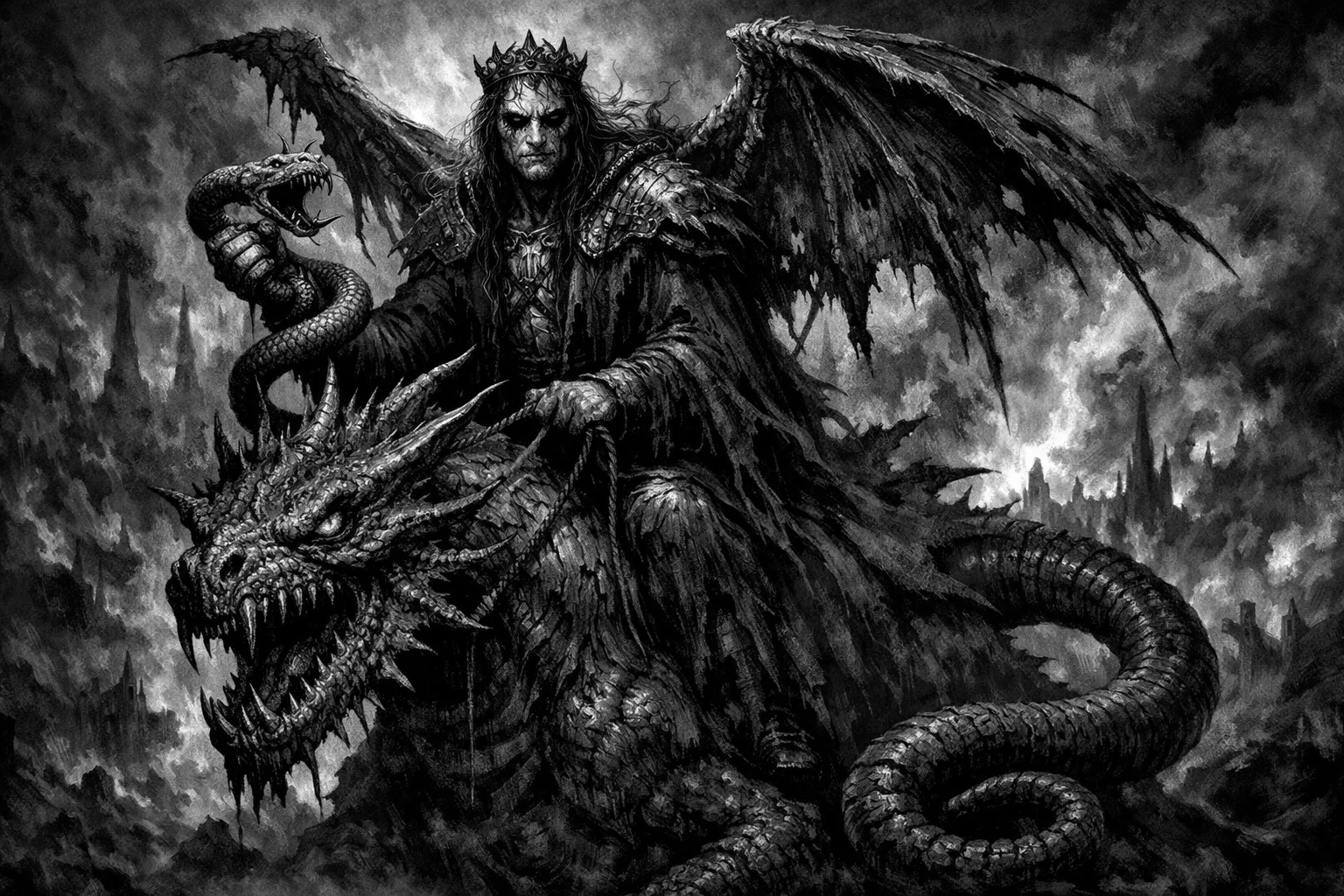
| Appearance | A hurtful angel riding an infernal dragon and carrying a viper. |
| Powers & Abilities | Reveals past, present, and future; teaches all liberal sciences; discovers hidden treasures; grants invisibility; provides prophetic dreams; induces sloth. |
| Associated Figures | Lucifer, Beelzebub, Solomon, Astarte, Ishtar, Inanna, Belial, Sargatanas, Nebiros, Abaddon, Asmodeus, Paimon, Moloch, Lilith, Baal, Adrammelech |
| Weaknesses | Magical rings of protection (St. Peter’s Ring), specific banishing rituals, holy names of God, the presence of the Archangel Bartholomew. |
| Opposing Forces | Archangel Bartholomew, Saint Peter, The Holy Spirit |
| Pantheon | Abrahamic (Christian/Jewish demonology), derived from Canaanite/Mesopotamian origins. |
| Region of Origin | Ancient Canaan and Phoenicia (as Astarte); Western Europe (as Astaroth). |
| First Known Appearance | As Astarte (2nd Millennium BCE); as the male demon Astaroth (15th-century grimoires). |
| Primary Sources | The Lesser Key of Solomon (Ars Goetia), Pseudomonarchia Daemonum, Dictionnaire Infernal, The Book of Abramelin, The Grimoire of Honorius. |
Description
Astaroth brings together ideas from ancient pagan gods and medieval demonology. In theology, he stands for turning wisdom into forbidden knowledge. He is seen as a patron of those seeking knowledge beyond what is allowed by religion. Astaroth is known as a main tempter who takes advantage of human curiosity and the wish to be intellectually superior.
Unlike demons known for violence, Astaroth is a clever tempter who targets the mind. He leads scholars, theologians, and seekers astray by sharing secrets about the fall of angels and the creation of the world. In the hierarchy of Hell, Astaroth is called the “Grand Treasurer,” symbolizing the misuse of worldly value and the keeping of heavenly secrets.
Appearance
Astaroth is described as appearing in a form that is “hurtful” or “unclean.” He looks like an angel with human features, but often has a dark or sinister appearance. He is usually shown riding a large, monstrous beast, frequently called an infernal dragon or a basilisk-like creature with a long tail.
Astaroth has a live, venomous viper in his right hand. He is known for giving off a strong, poisonous breath that can be deadly to anyone who comes near without protection.
Because of this, magicians are told to hold a silver ring in front of their faces to protect themselves. Even while riding the dragon, Astaroth keeps a regal but frightening angelic appearance.
History
Origins
Astaroth’s history and mythology come from the development of the Northwest Semitic goddess Astarte, known in Hebrew as Ashtoreth.
During the Bronze Age, Astarte was a main goddess for the Phoenicians, linked to fertility, sexuality, and war. She was the Canaanite version of the Babylonian Ishtar and the Sumerian Inanna. Archaeological finds from places like Ugarit and Sidon show she was called the “Queen of Heaven.”
The change from goddess to demon started in the Hebrew scriptures. Biblical writers used the plural form Ashtaroth to refer to pagan idols or goddesses.
To show their dislike, Masoretic scribes changed the way Ashtoreth was pronounced by using vowels from the Hebrew word bosheth, which means “shame.” This was done to turn the goddess into a symbol of spiritual impurity.
By medieval times, Astaroth’s gender changed from female to male. This change was formalized in European grimoires such as the 15th-century Le Livre d’Abramelin, where Astaroth became one of the four main princes of Hell.
Some demonologists believed Astaroth was once a high-ranking angel, either a Seraph or a Throne, who joined Lucifer’s original rebellion. In Christian tradition, Astaroth was no longer seen as a goddess of life and war, but as a “Grand Duke” of the Abyss who works to undermine human intellect.
The Black Book of Forbidden Secrets. Limited-Time: Up to 71% OFF!
The infamous 19th-century grimoire of dark arts — charms, talismans, spells, omens, dream interpretation, and occult rituals once hidden from the public: Black Magick ● Love Spells ● Talismans & Amulets ● Fortune-Telling ● Curses & Hexes
The Fall from Grace
Before the great split, Astaroth held a very high rank among the angels. Theological works, such as those by Sebastien Michaelis and Alphonse de Spina, say Astaroth was a prince in the Order of Seraphim or the Order of Thrones.
At that time, he was a being of light and pure intellect, focused on understanding divine mysteries. His fall is closely tied to the Great Rebellion started by Lucifer. Astaroth was one of the first and strongest spirits to join the rebellion, motivated by what demonologists call intellectual pride, or the belief that his wisdom matched God’s.
During the War in Heaven, Astaroth was not just a soldier but also a top strategist and advisor to the rebels. While Archangel Michael led the loyal angels, Astaroth used his deep knowledge of the heavens to challenge their rule. Esoteric texts describe this conflict as a spiritual struggle rather than a physical fight, and it ended with the rebels’ complete defeat.
The Dictionnaire Infernal says that Astaroth still claims he was cast out unfairly, arguing that he did not know the full consequences of the rebellion or that he was misled by the main conspirators.
After the defeat, Astaroth was cast out of Heaven along with a third of the angels. Medieval stories say his fall was a traumatic change; as he fell, his bright form faded and darkened, and he took on the “hurtful” and “unclean” look described in the Ars Goetia.
When he reached the Abyss, Astaroth played a key role in setting up the structure of Hell. He became a Grand Duke, ruling over the western part of the underworld and joining the top council that leads the legions of the damned.
The Solomonic Binding
A key story in Goetic tradition tells of King Solomon and the 72 spirits of the Ars Goetia. Using a magical ring with the Seal of God, Solomon summoned Astaroth to help build the Temple of Jerusalem.
During this time, Astaroth had to reveal the locations of hidden materials and share knowledge of the liberal arts. Still, he tried to mislead Solomon and push him toward idolatry. Legends say that even though Solomon controlled Astaroth, the demon’s influence later played a part in the King’s spiritual downfall.
The Affair of the Devils of Loudun
In the 17th century, Astaroth appeared in the famous accounts of the Loudun possessions in France. A group of Ursuline nuns said they were possessed by several demons, and Astaroth was named as one of the main ones.
During the exorcisms and trials that followed, Astaroth was said to speak through the nuns, accusing the priest Urbain Grandier of making a deal with the devil. This story helped make Astaroth known in popular culture as a demon involved in legal pacts and public accusations against clergy.
Genealogy
| Attribute | Details |
| Parents | None (Created as an Angel) |
| Siblings | Other Angels/Fallen Angels (e.g., Lucifer, Beelzebub) |
| Consorts | None documented in primary grimoires; sometimes linked to Astarte in modern syncretism. |
| Offspring | None |
| Other Relationships | Member of the Infernal Trinity with Lucifer and Beelzebub; Superior to Amon, Gaap, and Rashaverak. |
The Complete Lesser Key of Solomon Awaits. Flash Sale – Up to 10% OFF!
The Complete Lemegeton (Books I-V). The legendary 17th-century grimoire of demon summoning, angelic evocation, sacred seals, and ancient magick — all five books in one definitive edition. Ars Goetia ● Theurgia Goetia ● Paulina ● Almadel ● Notoria.
Sources
| Source | Quote |
| Ars Goetia | The 29th Spirit is Astaroth. He is a Mighty, Strong Duke, and appeareth in the Form of an hurtful Angel riding on an Infernal Beast like a Dragon, and carrying in his right hand a Viper. |
| Pseudomonarchia Daemonum | Astaroth is a great and a strong duke, comming foorth in the shape of a fowle angell, sitting upon an infernall dragon, and carrying on his right hand a viper. |
| Dictionnaire Infernal | Astaroth, grand-duc très-puissant aux enfers, il a la figure d’un ange fort laid, et se montre assis sur un dragon infernal; il tient à la main une vipère. |
Powers
Astaroth’s powers focus on gaining and sharing information. His main ability is to reveal knowledge, giving true answers about the past, present, and future, allowing people to go beyond normal human limits. He is also known as a teacher of the liberal sciences, such as geometry, astronomy, and rhetoric, which gave his followers unusual skill in these areas.
Astaroth can also find hidden treasures and secrets lost over time. He influences people socially and psychologically, causing “sloth” or spiritual laziness in his targets and making them less determined.
He is also said to grant invisibility and guide people to hidden riches through visions. In a darker role, Astaroth is called the “Prince of Accusers,” with the power to reveal others’ secret sins and hypocrisies, which can ruin reputations and create social chaos.
Occult correspondences
| Attribute | Details |
| Planet | Venus (formerly), Jupiter, or Mercury (in grimoires) |
| Zodiac Sign | Capricorn (10-20 degrees) |
| Element | Earth or Air |
| Direction | West |
| Color | Brown, Green, or Black |
| Number | 29, 8 |
| Metal | Copper or Tin |
| Crystal / Mineral | Lapis Lazuli, Turquoise |
| Herb / Plant | Mandrake, Rose |
| Incense | Sandalwood, Myrtle |
| Sacred Animal / Symbol | Viper, Dragon, Star |
Tags:
Explore More Demons…
February 25, 2026
Aeshma (Zoroastrian Demon of Wrath)
December 4, 2025
Baykok (Ojibwe Flying Skeleton Demon)
March 2, 2026
Agaliarept (Commander Under Lucifer)
December 8, 2025
Mahabali (Powerful Asura King)
February 18, 2026
Apophis (Egyptian Chaos Serpent)
January 29, 2026
