
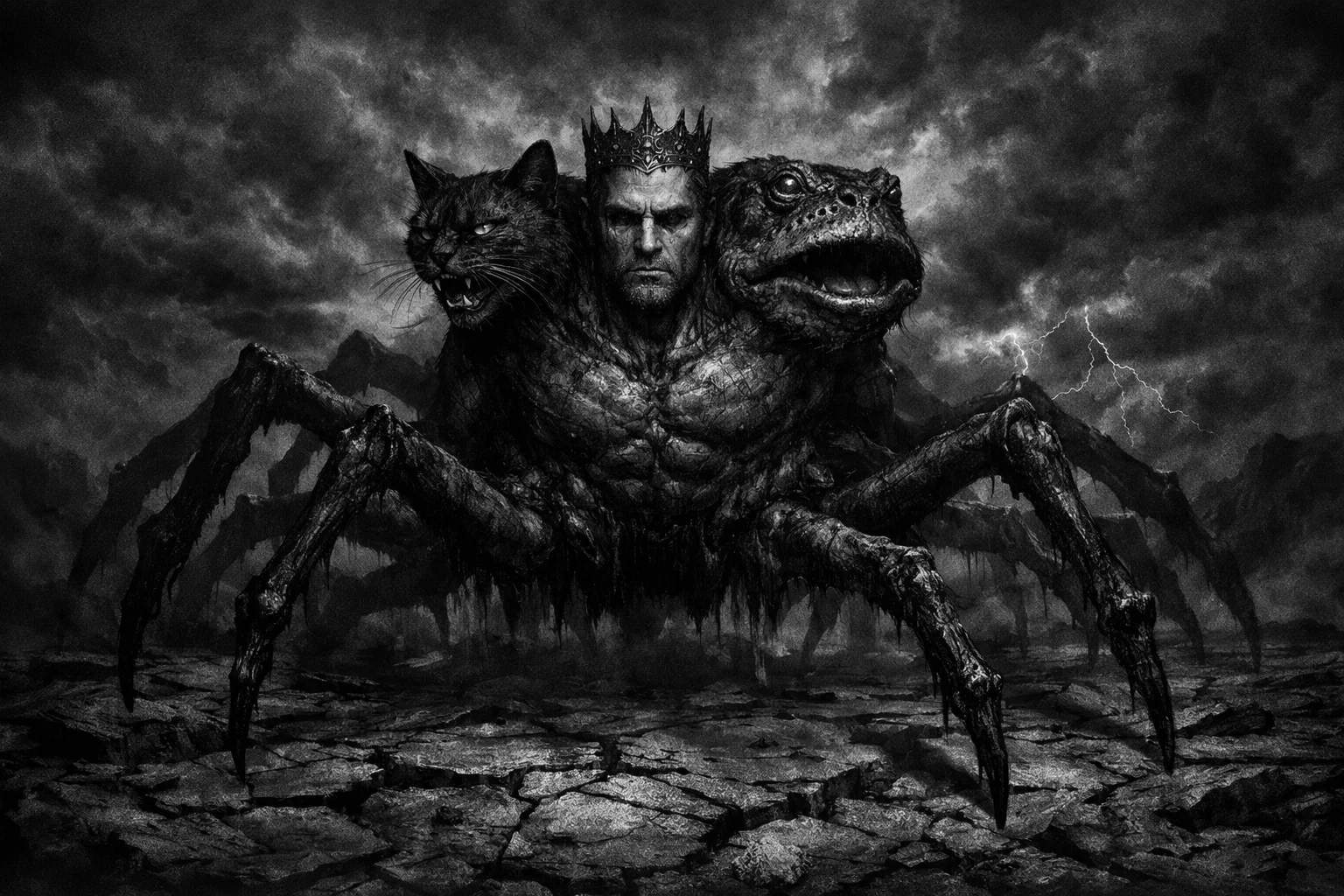

Baal began as an important god in Northwest Semitic and Canaanite cultures, but later became known as a high-ranking demon in Abrahamic traditions and Western demonology.
Baal was once a storm and fertility god, but later became known as one of the main “false gods” opposed by Hebrew prophets. In later occult writings, he is described as a Great Duke or the first King of Hell, leading many spirits.
Table of Contents
Overview
| Attribute | Details |
| Primary Name | Baal |
| Other Names | Bael, Ba’al, Beel, Bel, Bahl, Beli, Baal-Zebub, Baalsebul, Bel-Khorsa, Baall, Baell |
| Titles | King of Hell, Lord of the Flies, Lord of the Earth, Rider on the Clouds, Prince of the Seraphim, First King of the East, Master of Thunder and Rain, The Ruler of the High Place, Lord of Covenant, Master of Heavens, The Victorious One, Lord of Lebanon, Baal-Peor, Baal-Berith, Baal-Hadad, Baal-Hammon, Baal-Zaphon, The Exalted One |
| Gender | Male |
| Alignment | Lawful Evil |
| Role | Deceiver of Nations, Corrupter of Faith, Harvest Ruiner, Tempter of Idolatry, Bringer of Storms, Master of Invisibility |
| Rank | King of Hell / Archdemon / Former Deity |
| Hierarchy | Serves as a primary monarch within the Ars Goetia hierarchy; often listed alongside or beneath Lucifer and Beelzebub in specific infernal triads. |
| Legions / Followers | 66 legions of spirits |
| Appearance | Appears with three heads: a toad, a man, and a cat, often on spider-like legs. |
| Powers & Abilities | Grants the power of invisibility, provides forbidden wisdom, commands weather and storms, enables shapeshifting, induces spiritual apostasy. |
| Associated Figures | Asherah, Mot, Yam, El, Anat, Elijah, Jezebel, King Solomon, Beelzebub, Astaroth, Moloch, Lilith, Mephistopheles, Lucifer, Belial |
| Weaknesses | Holy names, specific sigils of Solomon, divine intervention, rituals of banishment involving light. |
| Opposing Forces | Archangel Michael, The Prophet Elijah, Yahweh |
| Pantheon | Abrahamic (demonized Canaanite/Phoenician) |
| Region of Origin | Ancient Canaan, Phoenicia, Ugarit & North Syria |
| First Known Appearance | Approx. 2nd millennium BCE in Ugaritic texts (as a deity); later demonized in Hebrew scriptures (Tanakh) and the 16th-century Pseudomonarchia Daemonum. |
| Primary Sources | The Baal Cycle (Ugarit), The Old Testament (Book of Kings), Pseudomonarchia Daemonum, Ars Goetia, Dictionnaire Infernal. |
Description
Baal is an example of a “Demonized God,” changing from a life-giving entity to one seen as spiritually corrupt. In religious stories, he stands for rebellion against monotheism and is the main rival to the Abrahamic God.
Baal is often seen as a warning against false idols and the disruption of sacred order. He is thought to be a master of deception, using his ancient reputation to lead people away from accepted religious beliefs.
In demonology, Baal has cold authority and sharp intelligence. He tries to expand his influence by giving those who summon him special abilities, like invisibility and cleverness.
Appearance
Baal is most often shown in demonology with three heads. The middle head is a human male with a serious or royal look. On one side is a toad’s head, and on the other is a cat’s head.
These three heads are attached to a strong body. Instead of human arms and legs, Baal’s lower body has many long, thin legs like a spider or crab. His voice is said to be rough and hoarse. Sometimes, he appears as a crowned man or a single animal, but the three-headed spider form is the most common in occult books.
History
The Storm Lord
Before being seen as a demon, Baal was a central god in the Canaanite and Phoenician religions during the second millennium BCE. In Ugaritic texts, he is called Baal-Hadad, the son of Dagon or El. He lived on Mount Zaphon and was known as the “Rider on the Clouds.”
As a weather god, Baal’s main job was to keep order by controlling rain and dew. Early on, people saw him as a bringer of life, vital to farming communities.
Baal’s rise to power was marked by violent struggles to prove he deserved to rule over the other gods (the Elohim) and to earn a palace that showed his authority on earth.
The Black Book of Forbidden Secrets. Limited-Time: Up to 71% OFF!
The infamous 19th-century grimoire of dark arts — charms, talismans, spells, omens, dream interpretation, and occult rituals once hidden from the public: Black Magick ● Love Spells ● Talismans & Amulets ● Fortune-Telling ● Curses & Hexes
The Conflict with Yam-Nahar
A key legend about Baal’s early power is his battle with Yam, the god of the sea and rivers, who stood for chaos and destruction. Yam asked the other gods to hand Baal over as a prisoner.
While the other gods were afraid, Baal refused to give in. With help from the craftsman god Kothar-wa-Khasis, who made two magic clubs called Yagrush (Chaser) and Aymur (Driver), Baal fought Yam in a fierce battle.
Baal hit Yam on the head and chest with the magic clubs, defeating the chaotic waters and creating the boundary between sea and land. This story shows Baal as the protector who brings order to the world.
The Palace of Zaphon and the Window of Heaven
After defeating Yam, Baal complained that he was the only god without a proper house or palace. With help from the mother goddess Asherah, El allowed a palace to be built for him on Mount Zaphon. Kothar-wa-Khasis wanted to add a window, but Baal first refused, fearing enemies could get in.
Baal eventually agreed, and the opening of this “window in the clouds” became the myth for how rain is released. This story marks his change from a wandering warrior to a settled king, whose presence in his palace brought fertility to the land.
The Descent into the Maw of Mot
The most detailed story about Baal is his cycle of death and return. Mot, the god of sterility and the underworld, challenged Baal’s power, saying that rain was useless against death.
Because of ancient rules and fate, Baal had to go into Mot’s realm, which meant he died. While he was gone, the earth dried up, and the gods mourned. Baal’s sister and partner, the fierce goddess Anat, went to find Mot.
In her anger, Anat attacked Mot, cut him with a sword, sifted him, burned him, and ground him up. After Mot was destroyed, Baal came back to life and returned to his throne.
This story showed Baal as a strong force who could overcome death. This trait was later seen as a kind of “immortality” in demonology.
The Struggle Against the Hebrew Prophets
As Baal worship spread to Israel and Judah, stories about him changed from myths to more critical historical accounts. The Hebrew scriptures describe a long “war of altars.”
Queen Jezebel, a Phoenician princess, tried to make Baal worship the official religion of Israel, which led to the killing of Yahweh’s prophets. The story’s climax happened at Mount Carmel, where Elijah challenged 450 prophets of Baal.
When Baal did not answer his followers’ prayers with fire, even after their rituals, the story shows he lost his status. After this, Baal was no longer seen as a real god, but as an “abomination” and a “falsehood.”
Transformation into Beelzebul and Beelzebub
During the time between the Old and New Testaments and early Christianity, Baal’s name became mixed with “Beelzebub” (Lord of the Flies), likely as an insult to “Beelzebul” (Lord of the High Place/Prince). In the New Testament, Baal-Beelzebub is called the “Prince of Demons.”
This change in language and belief finished Baal’s shift into a demon. He was no longer just a local storm god, but a worldwide spiritual enemy. Stories from this time say Baal was one of the first spirits to fall from grace, losing his “divine lightning” and being sent to the lower air, where he still controlled the winds but only to cause shipwrecks and spread disease.
Recognition in the Goetic Tradition
By the 16th and 17th centuries, Baal’s role in Western occultism was established in works such as the Pseudomonarchia Daemonum and the Lemegeton (Ars Goetia). These stories say King Solomon was able to summon Baal and trap him in a brass vessel.
In the Goetia, Baal is the first spirit and is shown as a king ruling in the East. Folklore from this time says he was the main demon who taught people how to become invisible to trick their enemies.
Baal’s story ends with him as a permanent member of the infernal court. He changed from a god who brought rain to a shadowy king who rules over the hidden and unspoken parts of the world.
Genealogy
| Attribute | Details |
| Parents | El (Father), Asherah (Mother) |
| Siblings | Mot, Yam, Anat, Athtar |
| Consorts | Anat, Ashtart (Astarte) |
| Offspring | Numerous unnamed minor deities in Canaanite myth; none typically listed in Goetic demonology. |
| Other Relationships | Rival of Yahweh/Elijah; Servant of Lucifer (in later Christian tradition). |
The Complete Lesser Key of Solomon Awaits. Flash Sale – Up to 10% OFF!
The Complete Lemegeton (Books I-V). The legendary 17th-century grimoire of demon summoning, angelic evocation, sacred seals, and ancient magick — all five books in one definitive edition. Ars Goetia ● Theurgia Goetia ● Paulina ● Almadel ● Notoria.
Sources
| Source | Quote |
| 1 Kings 18:27 | And it came to pass at noon, that Elijah mocked them, and said, Cry aloud: for he is a god; either he is talking, or he is pursuing, or he is in a journey, or peradventure he sleepeth, and must be awaked. |
| Pseudomonarchia Daemonum | The first principall king (which is of the power of the east) is called Bael who when he is conjured, he appeareth with three heads; the first like a tode; the second like a man; the third like a cat. He speaketh with a hoarse voice, and maketh a man go invisible. |
| The Lesser Key of Solomon | The First Principal Spirit is a King ruling in the East, called Bael. He maketh thee to go Invisible. He ruleth over 66 Legions of Infernal Spirits. |
| Matthew 12:24 | But when the Pharisees heard it, they said, This fellow doth not cast out devils, but by Beelzebub the prince of the devils. |
Powers
Baal’s main power is invisibility. This is more than just hiding from sight; it lets him or anyone he helps move unseen in both the physical and spiritual worlds. He does this by changing how others see things, creating a kind of “infernal shadow” that hides them.
Baal also has strong control over the weather. As a former storm god, he can create sudden winds, thick mists, or thunder. When he uses these powers, it often leads to ruined crops or interrupted religious ceremonies.
Baal is also said to give “cunning wisdom,” especially for political tricks and social manipulation. He is believed to influence leaders, making them act with cold strategy and put power before morals. His presence often leads to a loss of faith in a community, as people focus more on material things and appearances.
Occult correspondences
| Attribute | Details |
| Planet | Sun (in Goetic systems), sometimes associated with Saturn |
| Zodiac Sign | Aries |
| Element | Fire |
| Direction | East |
| Color | Yellow, Gold, or White |
| Number | 1, 6, 66 |
| Metal | Gold |
| Crystal / Mineral | Diamond, Citrine |
| Herb / Plant | Fern, Sage |
| Incense | Frankincense |
| Sacred Animal / Symbol | Bull, Toad, Cat, Spider |
Tags:
Explore More Demons…
Baphomet (Templar/Occult Goat-Headed Demon)
February 24, 2026
January 23, 2026
January 13, 2026
Asmodeus (Ars Goetia Demon of Lust)
February 3, 2026
Alû (Mesopotamian Night Demon)
January 14, 2026
Ahriman (Zoroastrian Principle of Evil)
December 9, 2025
