
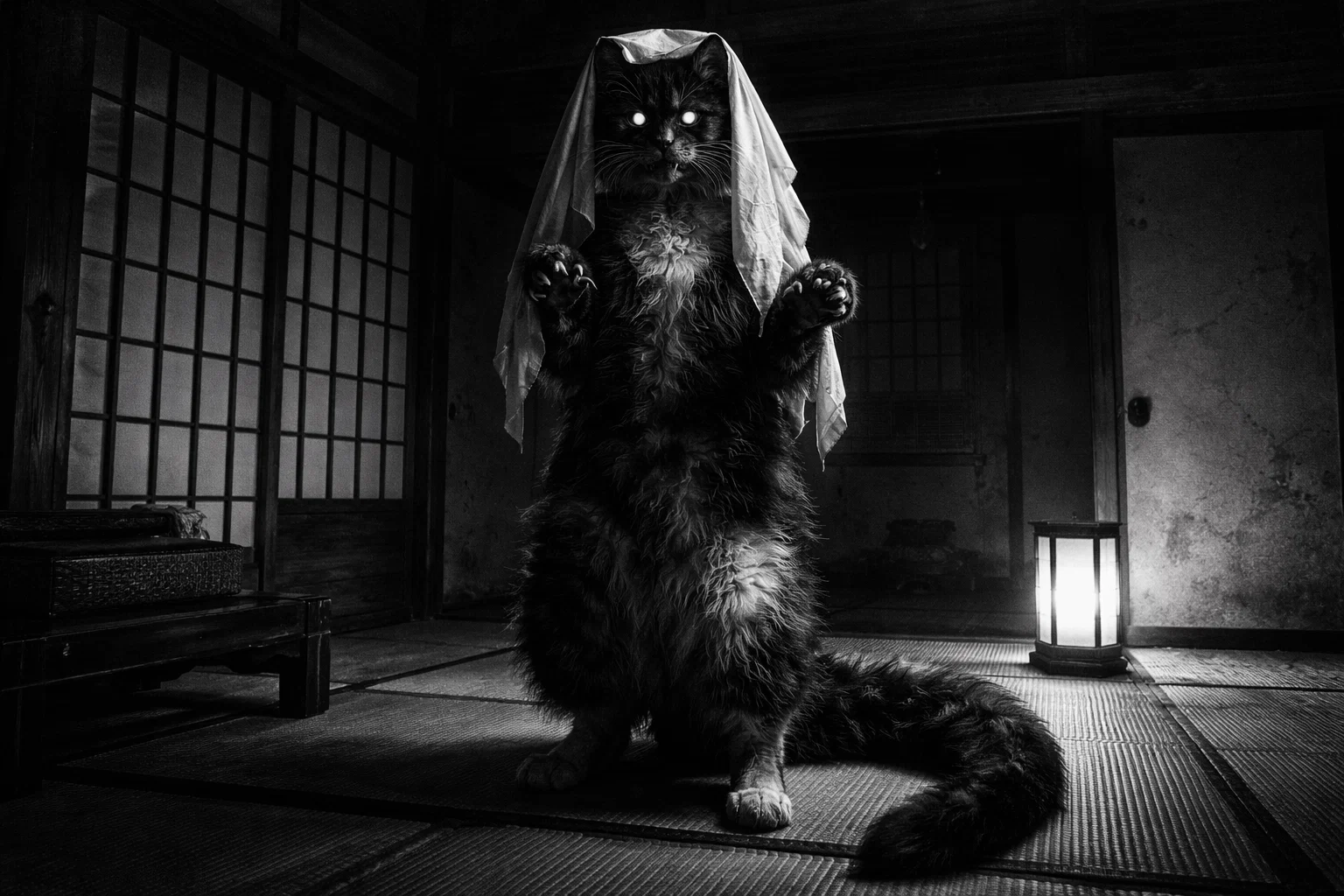

The Bakeneko is a supernatural creature from Japan, known as a type of yokai or ayakashi. It comes from ordinary house cats that have grown old, become unusually large, or changed in some way. In Japanese folklore, the Bakeneko is seen as a powerful spirit that can haunt homes and influence people.
The Bakeneko is important because it shows how a familiar house pet can become a supernatural danger. Unlike the Nekomata, which has a split tail, the Bakeneko is any cat that turns into a demon. It is known for changing into a human and for its links to fire and the dead.
Table of Contents
Overview
| Attribute | Details |
| Primary Name | Bakeneko |
| Other Names | Kaibyo, Ghost Cat, Monster Cat, Changing Cat |
| Titles | The Changing Cat, The Haunted Feline, The Lamp-Oil Licker, The Corpse-Stealer |
| Gender | Male / Female (Capable of assuming either gender via shapeshifting) |
| Alignment | Ambivalent / Mischievous / Chaotic Evil |
| Role | Household Haunter, Shapeshifter, Corpse-Manipulator, Bringer of Misfortune |
| Rank | Minor Yokai / Urban Legend Entity |
| Hierarchy | Independent spirit; occasionally serves as a familiar to powerful witches or vengeful spirits |
| Legions / Followers | None; typically acts as a solitary predator |
| Appearance | Large cat with a long tail, often seen wearing a towel on its head or walking on hind legs |
| Powers & Abilities | Shapeshifting, speech, necromancy (controlling corpses), fire manipulation, flight, cursing humans |
| Associated Figures | Nekomata, Kasha, Nabeshima Naoshige, Toyotomi Hideyoshi, Inugami, Kitsune, Tanuki, Itsumade, Ubume, Okiku |
| Weaknesses | Bladed weapons (katanas), dogs, being discovered in human form, physical exhaustion |
| Opposing Forces | Buddhist monks, Onmyoji (diviners), Samurai, Inugami (dog spirits) |
| Pantheon | Japanese Shinto-Buddhist |
| Region of Origin | Edo-period Japan |
| First Known Appearance | 17th Century (Edo Period), documented in various illustrated scrolls (Emaki) |
| Primary Sources | Wakan Sansai Zue, Bakemono Chakutocho, Gansaku Edo Murasaki, Buson Yokai Emaki |
Description
The Bakeneko reflects the fear that something familiar can become strange or threatening. In Japanese folklore, it shows the belief that animals that live a long time gain spiritual power, which can turn harmful. The Bakeneko also symbolizes the connection between animals and people, and warns against mistreating pets or ignoring household spirits.
As a demon, the Bakeneko stands for chaos in the home. It is a warning about how we treat our pets and the surprises that can come with old age. The Bakeneko is usually shown as clever and vengeful, sometimes trying to take over a family or punish people who were unkind to it.
Appearance
The Bakeneko usually looks like a very large house cat, sometimes as big as a calf or a small horse. It often stands and walks on its back legs, keeping its cat-like shape. In art, it is often shown with a towel or handkerchief on its head, especially when it is dancing.
Sometimes, the Bakeneko has a human-like face but still has fur and claws. When it changes completely into a human, it often looks like an old woman or someone it has killed. Even then, its eyes still look like a cat’s, and it might accidentally show its long, single tail, which is different from the Nekomata’s split tail.
History
The story of the Bakeneko is closely linked to how people in Japan saw house cats over time. At first, during the Heian period, cats were rare and valuable, brought from China to protect Buddhist texts from mice. They were often kept on leashes so they would not run away.
Later, as more cats were needed to control pests in the silk industry, they became more common in homes. People started to notice strange behaviors in cats, which made them seem mysterious or unsettling.
By the middle of the Edo period, many people believed that cats could go beyond their natural limits and turn into yokai. This idea, called henge, became a common part of city legends and even influenced local laws and customs.
The Classic Masterwork of the Black Arts. Limited-Time: Up to 42% OFF!
The legendary 1967 guide to forbidden magick — witchcraft, Satanism, demonology, alchemy, astrology, rituals, and the dark history of occult power through the ages: Black Magick ● Alchemy & Astrology ● Kabbalah ● Ritual Magic ● Satan & Demons
The Threshold of Transformation
A cat does not become a Bakeneko right away. This change happens when the cat crosses certain age or size limits. Records from the Edo period show that owners were truly afraid of their cats turning thirteen, as this was thought to be the main sign of a spiritual change.
Some stories say that any cat weighing more than one kan (3.75 kg) or with a long tail would eventually learn to talk and change shape. This belief was so strong that people began cutting kittens’ tails, which led is the Japanese Bobtail breed becoming common. They did this to stop cats from turning into demons.
The Nabeshima Cat Disturbance
The ‘Nabeshima Bakeneko Sodo’ is the most famous story about the Bakeneko. It appears in kabuki plays and kondan storytelling. The story is about Nabeshima Mitsushige, who was the second lord of the Saga Domain.
Mitsushige had his servant, Ryuzoji Matashichiro, killed for what he saw as an insult. Matashichiro’s mother was so upset that she took her own life. Her loyal calico cat licked her blood, taking in her angry spirit. The cat then entered Nabeshima castle, killed Mitsushige’s favorite concubine, Otyo, and took her place.
While pretending to be Otyo, the Bakeneko slowly took away Mitsushige’s strength each night. The castle guards could not stay awake around her because she made them feel unnaturally sleepy. Only a young soldier named Komori Hanzaemon managed to stay awake by stabbing his own leg with a knife.
He noticed that the concubine’s shadow on the paper doors still looked like a huge cat, even though she appeared human. Hanzaemon chased the creature into the mountains and killed it, revealing that it was really a giant, two-tailed cat over five feet long.
The Cat of the Adachi House
In Nihonmatsu, there is a well-known story about a Bakeneko that took over as the head of a family. After the elderly mother vanished, the family cat started wearing her clothes and copying her voice exactly. The family only became suspicious when their dog kept growling at the ‘grandmother.’
One night, the son looked through a hole in the door and saw the creature in his mother’s kimono, crouched over a body and eating it like a wild cat. This story shows a common theme in Bakeneko tales, where the demon does not just haunt a home but also takes over the life of its victim.
The Dancing Cats of Tokaido
Stories from the Edo and Meiji periods tell of a lighter but still strange legend along the Tokaido road. Travelers said they saw groups of cats meeting at night in empty shrines or under bridges, standing on their back legs and dancing. These Bakeneko were said to steal towels from inns to wear on their heads while they danced.
This story moved from being told by word of mouth to being shown in art, especially by Utagawa Kuniyoshi. Some people believed the dancing was a way for Bakeneko to gather spiritual power, share news about their homes, and plan revenge on cruel owners.
The Ultimate Yokai Encyclopedia. Limited-Time: Up to 28% OFF!
Over 300 entries on Japan’s most haunting spirits — yōkai, oni, kitsune, ghosts, and mythical creatures from ancient scrolls to modern legends, fully illustrated: Kappa & Tengu ● Kitsune & Tanuki ● Yūrei Ghosts ● Oni Demons ● Legendary Beasts.
The Corpse-Mover and the Funeral Taboo
A darker part of Bakeneko stories is their power over the dead. In many rural areas, people never leave a cat alone with a dead body. They believed that if a cat jumped over a coffin, it could control the life force still left in the body.
The Bakeneko could use this power to make the corpse move or dance like a puppet, a frightening event called shatai. Some stories say the Bakeneko would even steal the body to eat it in secret. Because people believed Bakeneko feared iron, they would place an iron pair of scissors or a knife on top of a coffin to keep the creature away.
The Lamp-Oil Lickers of Tokyo
In old Tokyo, the Bakeneko was often known for licking oil from paper-covered lamps called andon. Since the oil was usually made from sardines or herring, cats were attracted to it.
But seeing a cat stand up to reach the lamp, with glowing eyes and a large shadow, was often used as proof in ‘witch trials’ against pets. Records from the 1700s tell of cats being thrown out or killed for ‘licking oil,’ which people thought meant they were about to become demons.
Genealogy
| Attribute | Details |
| Parents | Domestic Cat (Felis catus) through spiritual evolution |
| Siblings | Nekomata (cousin/related evolution), Kasha (related funeral demon) |
| Other Relationships | Enemy of Inugami; mimic of human owners |
Sources
| Source | Quote |
| Wakan Sansai Zue | A cat that has lived for many years will develop a long tail and become a monster capable of bewitching humans. |
| Bakemono Chakutocho | It walks on its hind legs and wears a towel, dancing under the moonlight when the master is asleep. |
| Gansaku Edo Murasaki | The cat licked the blood of its mistress and took her shape to seek revenge upon the house. |
The Forbidden Knowledge Of Demons. Limited-Time: Up to 40% OFF!
The no-nonsense deliverance manual — names, functions, and scriptural strategies to identify, bind, and cast out demons that torment believers today: Addiction ● Depression ● Witchcraft ● Infirmity ● Jealousy ● Hundreds More

Powers
The Bakeneko’s main powers are trickery and breaking natural rules. Its main skill is metamorphosis, which it uses to blend in with people. Unlike other shapeshifters that use objects like leaves or stones, the Bakeneko changes shape using its own spiritual energy, often copying someone it has already eaten.
The Bakeneko also has special fire powers. It is often linked to hitodama, or ghost fire, and can light the end of its tail or make floating fireballs to scare people. This ability is connected to its habit of drinking lamp oil. The Bakeneko can also control the bodies of the dead by moving their muscles.
If a Bakeneko jumps over a coffin, it can make the body stand up or obey its orders. This was said to ruin funerals and bring fear or shame to families. The Bakeneko is also believed to bring a ‘cat’s curse,’ slowly making people in the house sick or mentally unstable.
Occult Correspondences
| Attribute | Details |
| Planet | Moon |
| Zodiac Sign | Scorpio |
| Element | Water / Fire |
| Direction | Northeast (The Demon Gate) |
| Color | Black / Calico |
| Number | 13 |
| Metal | Iron (as a deterrent) |
| Crystal / Mineral | Cat’s Eye Chrysoberyl |
| Herb / Plant | Silver Vine (Matatabi) |
| Incense | Sandalwood |
| Sacred Animal / Symbol | Cat / Fireball |
Tags:
Explore More Demons…
January 19, 2026
Apophis (Egyptian Chaos Serpent)
January 29, 2026
Amaymon (Demon King of the East/West)
January 15, 2026
Banasura (Hindu Thousand-Armed Asura)
February 20, 2026
Agaliarept (Commander Under Lucifer)
December 8, 2025
