
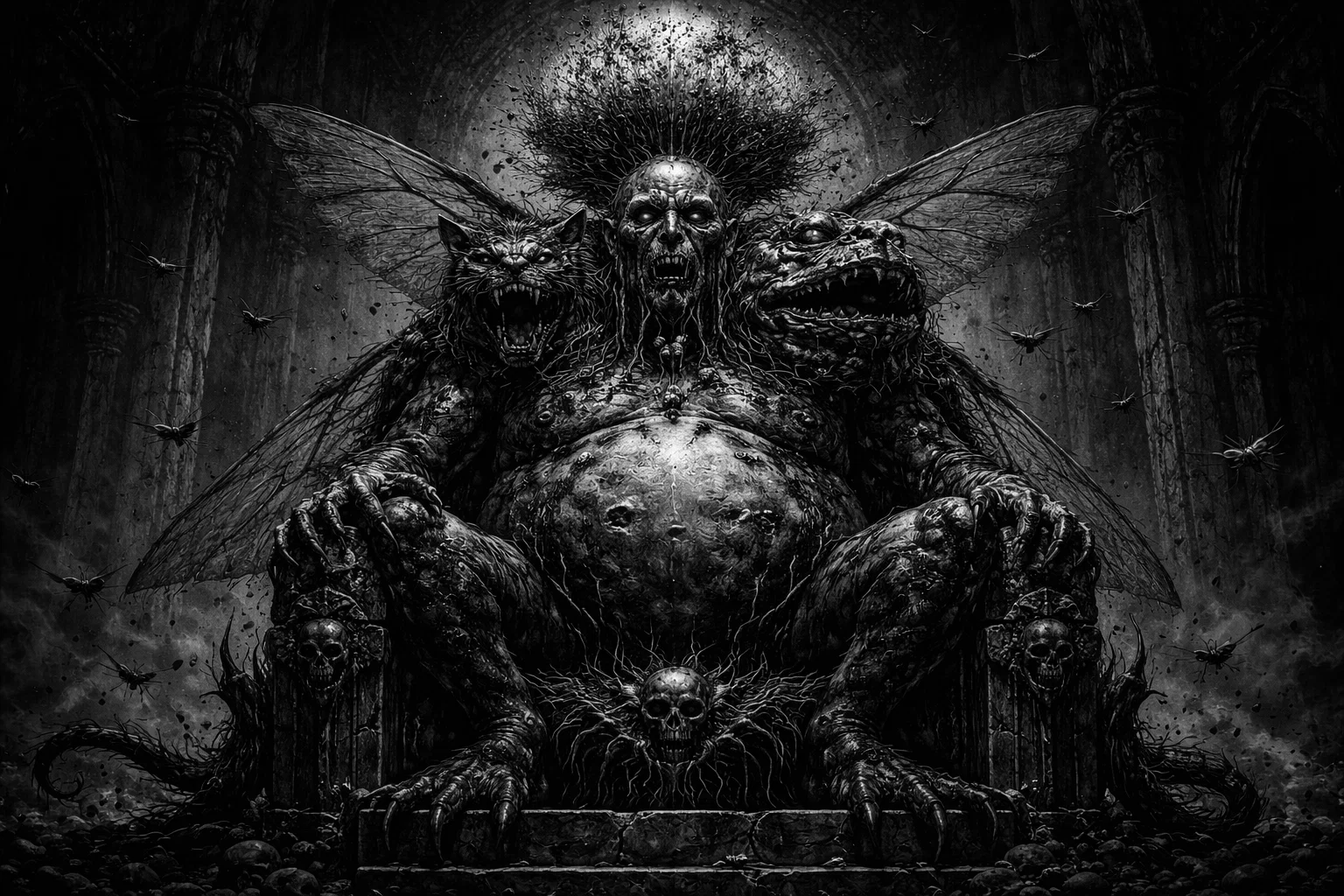

Beelzebub is a major demon known in Abrahamic religions and occult traditions. He started as a Philistine god called Baal-Zebub and was later included in Christian and Jewish demonology as a prince of Hell. He is often seen as one of the top three fallen angels, sometimes acting as Lucifer’s lieutenant or as a ruler in his own right in different infernal hierarchies.
Beelzebub is mainly known as the “Lord of the Flies” and is linked to the deadly sin of Gluttony. Many grimoires and religious texts describe him as a strong leader who commands many spirits and plays a key part in tempting and corrupting people.
Table of Contents
Overview
| Attribute | Details |
| Primary Name | Beelzebub |
| Other Names | Baal-Zebub, Beelzebul, Belzebud, Beezelbub, Ba’al Zebub, Beelzebubus, Enlil (syncretic), Beliar (occasionally conflated) |
| Titles | Lord of the Flies, Prince of Demons, Lord of Ra-at-at-ach, Chief of the Nine Hierarchies of Hell, Prince of Seraphim, Sovereign of the Order of the Fly, The Fly-God, Prince of Gluttony, Patron of the Philistines, The Great Demon, Lieutenant of Lucifer |
| Gender | Male |
| Alignment | Lawful Evil |
| Role | Lord of Gluttony, Tempter of Pride, Bringer of Pestilence, Corruptor of Kings, False God, Commander of Infernal Legions |
| Rank | One of the Seven Princes of Hell, Supreme Chief of the Infernal Empire |
| Hierarchy | Serves under Lucifer; Commands the Order of the Fly and numerous subordinate dukes including Barbatos and Buer |
| Legions / Followers | 6,666 legions of demons |
| Appearance | A giant fly, a gargantuan three-headed creature (human, cat, toad), or a winged man with a bloated face. |
| Powers & Abilities | Commands insects, induces pestilence and disease, grants wealth through corruption, facilitates false prophecy, causes gluttony and obsession, flight, telepathy |
| Associated Figures | Lucifer, Astaroth, Solomon, Jesus Christ, Faust, Ahaziah, Michael, Gabriel, Moloch, Belial, Abaddon, Lilith, Mephistopheles, Baal, Dagon |
| Weaknesses | Holy names of God, the sign of the cross, exorcism rites, specific prayers to St. John the Baptist, Iron |
| Opposing Forces | The Holy Spirit, Archangel Michael, St. Francis of Assisi, St. John the Baptist |
| Pantheon | Abrahamic (Christian/Jewish/Islamic) via Philistine demonization |
| Region of Origin | Ancient Canaan (Ekron) |
| First Known Appearance | Approx. 9th Century BCE in the Second Book of Kings |
| Primary Sources | 2 Kings 1, Gospel of Matthew, Testament of Solomon, Paradise Lost, Dictionnaire Infernal, The Grimoire of Honorius |
Description
Beelzebub is seen as a symbol of decay, filth, and the twisting of divine authority. In theology, he shows how a pagan god came to be viewed as an evil force through Christian interpretation. He acts as the main enemy, trying to lead people away from spiritual discipline by encouraging excess and pride in false knowledge.
Beelzebub is known for his sharp, logical mind and organized approach to evil. Unlike demons linked to chaos, he stands for the orderly side of Hell, acting as a ruler and enforcer of its laws. He also symbolizes the constant temptation and the way small sins can build up and take over, much like a swarm of insects.
Appearance
Beelzebub is usually described as a huge, monstrous fly. In this form, he has large, dark, multi-faceted eyes and see-through wings that make a loud, harsh buzzing sound. His body is covered in rough black hair and is split into clear segments.
Some occult texts describe him as a huge figure with three heads: one human, one cat, and one toad. These heads rest on a thick neck. His chest is often said to be swollen, and he has a serpent’s tail.
Other stories show him as a tall, striking figure with bright red skin, a crown, and dark, bat-like wings. His face often has wide nostrils and heavy, drooping features.
The Complete Fiction of H.P. Lovecraft
Every tale of cosmic horror in one definitive collection — Cthulhu, Yog-Sothoth, ancient gods, forbidden tomes, and the madness that lies beyond the stars: Call of Cthulhu ● At the Mountains of Madness ● Shadow Over Innsmouth ● The Dunwich Horror ● Complete Mythos
History
Origins and Celestial Tenure
Beelzebub started out as a top member of the Seraphim, the highest group of angels. Back then, he was second only to Lucifer in beauty, wisdom, and power. His main job was to keep celestial laws and oversee lower angels.
Many religious texts call him the “Prince of the Seraphim,” which puts him close to the Divine throne. He did not fall because of sudden sinful acts, but because he agreed with Lucifer’s ideas about free will and rejecting divine destiny.
When the split in Heaven happened, Beelzebub used his influence to convince many spirits, especially from the Order of Power and the Order of Cherubim, to join the rebellion. He was the first to openly support Lucifer, making him the second-in-command among the rebels.
The War in Heaven
During the war after the rebellion, Beelzebub served as the fallen angels’ main strategist and general. While Lucifer was the leader in spirit, Beelzebub handled the planning and organization of the war. He is known for arranging the rebel angels into organized legions, which later shaped Hell’s hierarchy.
According to legend, during the last attack on the Empyrean, Beelzebub fought the Archangel Gabriel in a battle that lasted many celestial cycles. This fight was both physical and a test of willpower and authority. When Michael’s loyal forces won, Beelzebub was one of the first to be thrown into the void.
His fall lasted nine days, and when he hit the Abyss, his remaining celestial energy is said to have formed the first parts of the Infernal City, Pandemonium.
The Transformation at Ekron
After the flood, Beelzebub appeared in the Levant, especially in the Philistine city of Ekron, where he was worshipped as Baal-Zebub. “Baal” means “Lord” in Semitic languages, but the meaning of “Zebub” (flies) is debated.
Some scholars think the original name was Baal-Zebul (Lord of the High House), but Hebrew writers changed it to Baal-Zebub (Lord of the Flies) to mock the God.
In Ekron, Beelzebub was worshipped as a god who could give oracles. People came to his temple to ask for help against swarms of flies that caused disease. The best-known story is from the 9th century BCE, when King Ahaziah of Israel ignored the priests of Yahweh and asked Beelzebub for advice about a serious injury.
This event made Beelzebub a main rival to divine authority in Judeo-Christian texts, turning him from a local god into the “Prince of Demons.”
The Complete Lesser Key of Solomon Awaits. Flash Sale – Up to 10% OFF!
The Complete Lemegeton (Books I-V). The legendary 17th-century grimoire of demon summoning, angelic evocation, sacred seals, and ancient magick — all five books in one definitive edition. Ars Goetia ● Theurgia Goetia ● Paulina ● Almadel ● Notoria.
Interaction with King Solomon
In the Testament of Solomon, written between the 1st and 5th centuries CE, Beelzebub is the main enemy of King Solomon. While building the Temple of Jerusalem, Solomon used a magic ring to summon and control the “Exarch of Demons.”
In their conversation, Beelzebub says he is the only one left from the angels who fell from grace. He tells Solomon that his main goal on earth is to destroy kings, turn them away from their religious duties, and tempt priests into lust and heresy. He also describes his power to cause disasters and spread envy.
Solomon eventually forced Beelzebub to help build the temple by making him saw marble blocks. This story shows that even though Beelzebub is very powerful, he can still be controlled by divine rules and the wisdom of good people.
The Infernal Regency
By the Middle Ages and Renaissance, Beelzebub changed from a tempter on earth to the top administrator of the underworld. Books like the Dictionnaire Infernal and Goetic grimoires call him the founder and ruler of the Order of the Fly.
This group was like a knighthood for demons who were especially cruel or skilled at corrupting people. In many hierarchies, Beelzebub is shown as the ruler of the “Seven Deadly Sins,” especially Gluttony. However, in Milton’s Paradise Lost, he is called the “Lord of Pride,” second only to Satan.
At this time, Beelzebub was often mentioned in European witch trials as the one who led the “Black Sabbath.” Unlike the wild image of Satan, Beelzebub was seen as a strict and frightening ruler who followed a set of dark laws.
The Order of the Fly and Modern Occultism
In later occult traditions, especially in the 19th-century revival, Beelzebub was called the “Chief of the Nine Hierarchies of Hell.” His role expanded to include patronizing forbidden knowledge and ruling over those who seek power through corruption. He is often called upon in rituals to change physical matter or to gain wealth.
In the writings of Aleister Crowley and later occultists, Beelzebub is sometimes linked to “Choronzon,” a being in the Abyss that stands for the ego’s last stand against spiritual growth. This change shows how Beelzebub went from being a physical “Fly-God” to a symbol of decay and chaos in the human spirit.
Genealogy
| Attribute | Details |
| Parents | Created directly by God (as a Seraphim) |
| Siblings | Lucifer, Michael, Gabriel, Raphael (fellow archangels/Seraphim) |
| Consorts | None traditionally confirmed; sometimes associated with Lilith in modern occultism |
| Offspring | None |
| Other Relationships | Second-in-command to Lucifer; superior to the 68th spirit Belial in some hierarchies |
The Ultimate Encyclopedia of Demons. Limited-Time: Up to 25% OFF!
The definitive A–Z guide to demonology — over 400 entries on demons, possession cases, exorcisms, global traditions, and dark entities throughout history, illustrated with rare photos: Ancient Lore ● Fallen Angels ● Possession & Exorcism ● Worldwide Demons ● Modern Cases
Sources
| Source | Quote |
| 2 Kings 1:2 | And Ahaziah fell down through a lattice in his upper chamber that was in Samaria, and was sick: and he sent messengers, and said unto them, Go, enquire of Baal-zebub the god of Ekron whether I shall recover of this disease. |
| Matthew 12:24 | But when the Pharisees heard it, they said, This fellow doth not cast out devils, but by Beelzebub the prince of the devils. |
| Mark 3:22 | And the scribes which came down from Jerusalem said, He hath Beelzebub, and by the prince of the devils casteth he out devils. |
| Testament of Solomon 6:2 | I am Beelzebub, the exarch of the demons; and all the spirits have their seats bound to me. And it is I who make manifest the appearing of the demons. |
| Paradise Lost (Book I) | Next, Chemos, th’ obscene dread of Moabs sons… With him enthron’d sat Beelzebub, than whom, Satan except, none higher sat. |
Powers
Beelzebub’s powers focus on controlling the physical world and corrupting living things. He has complete control over all insects, using swarms of flies, locusts, and stinging bugs for spying and as weapons. By sending out these swarms, he can destroy crops in hours, leading to famine and chaos.
He can also cause “moral gluttony,” which is more than just overeating. He can turn any human desire into an obsession, leading people to ruin in their pursuit of excess. As a bringer of disease, he can create invisible “miasmata” that quickly rot living things and spread deadly illnesses.
His mental powers are just as strong. He is skilled at giving false prophecies and can let someone see the future, but these visions always lead to disaster. He also has “infernal prestige,” which lets him command almost any other demon through his frightening presence.
Occult correspondences
| Attribute | Details |
| Planet | Saturn / Jupiter (in its darker aspect) |
| Zodiac Sign | Capricorn / Scorpio |
| Element | Air (associated with the “Prince of the Power of the Air”) |
| Direction | North |
| Color | Black / Dark Green |
| Number | 9 / 666 |
| Metal | Lead / Iron |
| Crystal / Mineral | Obsidian / Black Tourmaline |
| Herb / Plant | Tobacco / Henbane / Fly Agaric |
| Incense | Sulfur / Myrrh |
| Sacred Animal / Symbol | Fly / Bee / Dung Beetle / The Skull and Cross-Flies |
