
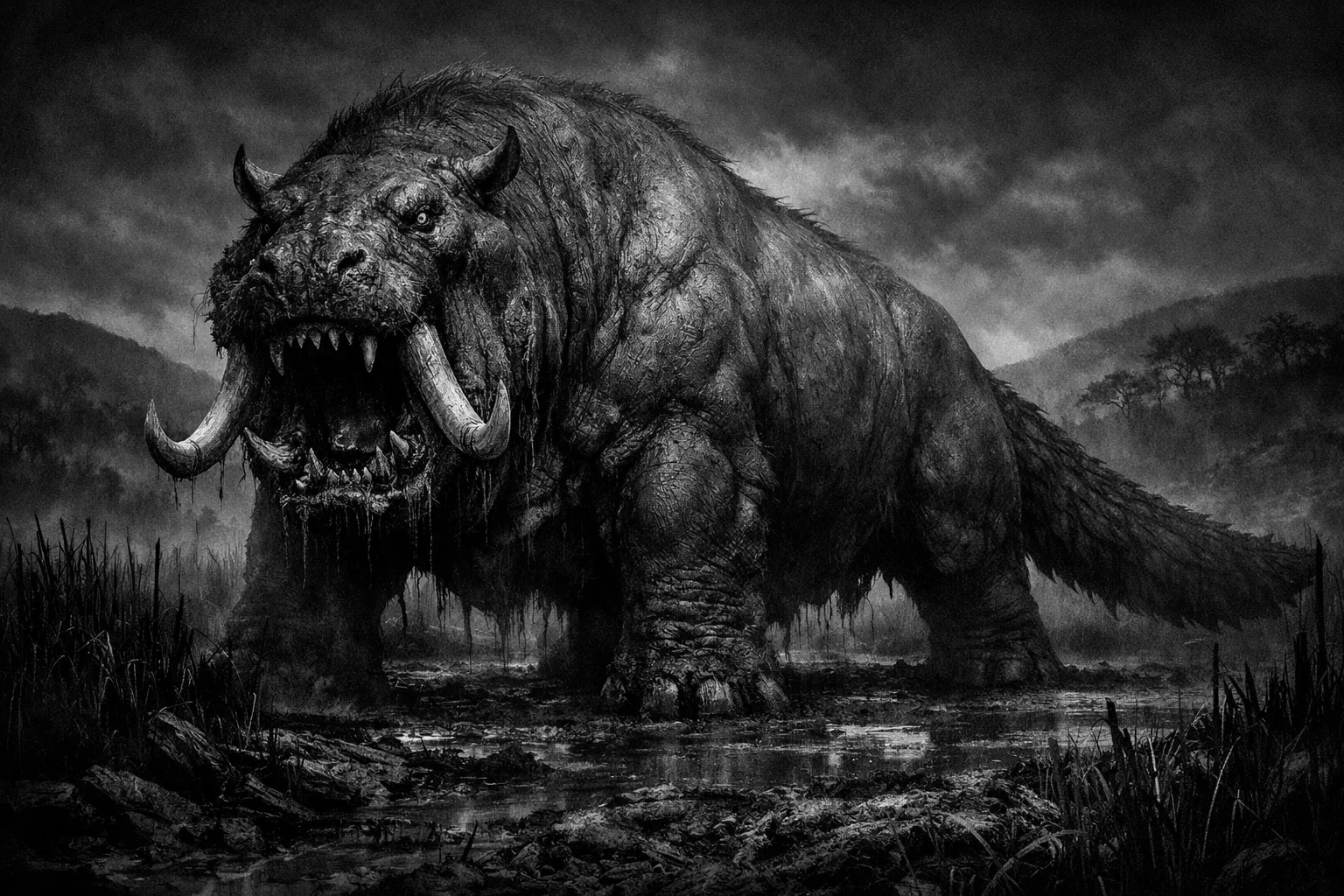

Behemoth is an ancient demon beast from Hebrew cosmology and the Tanakh. In the Bible, it is described as a giant land beast that shows the creative power and authority of God.
In different religious and demonological traditions, Behemoth is sometimes seen as a powerful demon or a prince of the underworld, often linked to the sins of gluttony or physical desire.
Table of Contents
Overview
| Attribute | Details |
| Primary Name | Behemoth |
| Other Names | Bahamut, Beghemet, Behemot, B’hemot |
| Titles | King of the Land, Beast of the Earth, Prince of Gluttony, Grand Cupbearer of Hell, The Primal Land-Monster, Chaos Beast, Watcher of the Desert of Dendain |
| Gender | Male |
| Alignment | Neutral Evil |
| Role | Bringer of Famine, Consumer of Flesh, Guardian of the Abyss, Embodiment of Carnal Excess |
| Rank | One of the Three Great Primordial Beasts, Prince of Hell |
| Hierarchy | Subordinate to Satan / Commands legions of terrestrial demons and gluttonous spirits |
| Legions / Followers | Unknown / Associated with the beastly spirits of the earth |
| Appearance | A colossal creature resembling a hippopotamus, elephant, or bull with a tail like a cedar. |
| Powers & Abilities | Unmatched physical strength, consumption of entire forests, causes earthquakes, immunity to mundane weapons, manipulation of terrestrial matter. |
| Associated Figures | Leviathan, Ziz, Job, Enoch, Satan, Asmodeus, Astaroth, Belphegor, Beelzebub, Rahab, Tannin |
| Weaknesses | Divine intervention, the sword of its Creator, destined to be slain at the End of Days. |
| Opposing Forces | The Creator (YHWH), Archangel Michael |
| Pantheon | Abrahamic (Jewish/Christian) |
| Region of Origin | Ancient Levant / Judea |
| First Known Appearance | Approx. 6th–4th Century BCE (Book of Job) |
| Primary Sources | Book of Job, 1 Enoch, 2 Esdras, Apocalypse of Baruch, Dictionnaire Infernal |
Description
Behemoth stands for the wild and chaotic forces of the Earth. In religious thought, its existence shows that humans have limits, since only its creator can control it. Behemoth also symbolizes the heavy, physical side of the world and endless hunger.
Later demonology changed Behemoth from a primeval beast to a demon linked to gluttony. It is the land version of the sea monster Leviathan and the sky creature Ziz, forming a trio of cosmic beings.
Behemoth is known for its lack of intelligence and great physical strength. It stands for the risks of uncontrolled desires and the chaos that existed before divine order.
Appearance
Behemoth is described as a huge four-legged animal. Its bones are compared to bronze tubes and its legs to iron bars. Its tail is said to be as stiff and large as a cedar tree. Some think it looks like a hippopotamus or an elephant, but with more monstrous features. Its skin is very thick and cannot be pierced by normal metal tools.
Behemoth is known for its strong muscles and powerful belly. Many images show it with ivory tusks or horns and a mouth big enough to eat huge amounts of plants or even whole rivers. Its wide, heavy feet help it move through marshes and mountains.
The Forbidden Book That Even Angels Feared. Limited-Time: Up to 90% OFF!
The ancient apocalyptic text banned from the Bible — visions of the Watchers, fallen angels, the Nephilim giants, secrets of heaven, and the coming judgment: Fallen Watchers ● Nephilim Origins ● Heavenly Journeys ● End-Times Prophecy ● Lost Enochian Mysteries
History
The Primal Split and Genesis of the Waste
At the beginning of the world, on the fifth and sixth days of creation, a balance between the elements was needed. Hebrew tradition and the Book of Enoch say Behemoth was once part of a single chaotic force that was split in two, so the world would not collapse under its own weight.
This event, called the separation of the beasts, happened because the area where the waters gathered, known as the “seventh part” of the world, could not hold the size of both original monsters.
Behemoth became the male force of dry land, so large and heavy that it was placed in the hidden, empty Desert of Dendain (or Duidain), east of the Garden of Eden.
Unlike angels or other heavenly beings, Behemoth comes from the “Beasts of the Earth” in Genesis 1:24. Still, it stands out as a unique example. It was made to eat the plants from a thousand hills, helping to control the wild growth of early Earth.
The Discourse of Job and the Behemoth of Uz
A key story about Behemoth appears in the Book of Job, chapter 40. In this story, God speaks directly to Job, a man from Uz. The story describes Behemoth’s traits to show that some aspects of nature and beyond are beyond human control.
Here, Behemoth is shown as a calm but unbeatable animal that eats grass. It rests among reeds and swamps, not bothered even when the Jordan River floods. The story points out that no hunter can catch it with a snare or attack it with a sword.
This story made Behemoth the main symbol of earthly power, called the “chief of the ways of God.” This means it was seen as the first and best of all land creatures.
The Intertestamental Evolution
In the Second Temple period, Behemoth changed from a real animal to a symbol of the end times. In books like the Syriac Apocalypse of Baruch and the Book of Enoch, Behemoth is not just a hidden beast but a guardian of the Earth’s depths. These stories say it is kept hidden until the time of judgment.
These stories describe the Desert of Dendain as a place of exile, both spiritual and physical. During this time, Behemoth is closely tied to the hidden parts of the Earth. The idea of the “Great Banquet” also became important, with people believing that Behemoth would not die naturally but would be sacrificed by God to feed the righteous after the end of the world.
The Demonization and the Infernal Hierarchy
As time passed from the ancient to the medieval periods, Behemoth was reimagined in Christian demonology. The Dictionnaire Infernal by Jacques Collin de Plancy (1818) describes Behemoth as a large, two-legged demon with an elephant’s head and a big belly, instead of a lone animal in the desert.
During this time, Behemoth was given a special role. He became the Grand Cupbearer of Hell and oversaw the buttery. This change showed a new way of thinking about “consumption.”
In the Bible, Behemoth is described as eating grass as part of nature. In later stories, the demon Behemoth was said to encourage gluttony in people. He was known as the demon in charge of Sabbath feasts and was often mentioned in occult books as a spirit of excess and indulgence.
The Most Dangerous Demon Dictionary Awaits. Up to 33% OFF!
Limited Time: Up to 33% OFF the Expanded 10th Anniversary Edition. Over 1,600 demonic names, etymologies, visions of hell, historical lore, and haunting illustrations from medieval grimoires — the ultimate A–Z of the infernal hierarchy: Fallen Angels ● Goetic Spirits ● Global Demons ● Visions of Hell ● Occult History
The Battle of the Titans
Medieval Jewish stories added a yearly battle to Behemoth’s legend. People believed that every summer solstice, Behemoth would roar loudly. This roar scared all the Earth’s predators, stopping them from attacking smaller animals for the rest of the year.
The most famous story is about the final battle between Behemoth and Leviathan. At the end of time, they will meet. Behemoth will try to stab Leviathan with its iron-hard horns. In contrast, Leviathan will try to suffocate Behemoth with its scales and fins.
This “battle of the monsters” appears often in old manuscripts and rabbinic writings. It stands for the final defeat of chaos that has shaped the world since the beginning.
Genealogy
| Attribute | Details |
| Parents | None (Created directly by YHWH) |
| Siblings | Leviathan (Sea), Ziz (Sky) |
| Consorts | None (Separated from Leviathan to prevent procreation) |
| Offspring | None |
| Other Relationships | Enemy/Counterpart to Leviathan; Subject of the Creator |
Sources
| Source | Quote |
| Job 40:15-18 | Behold now behemoth, which I made with thee; he eateth grass as an ox. Lo now, his strength is in his loins, and his force is in the navel of his belly. He moveth his tail like a cedar: the sinews of his stones are wrapped together. His bones are as strong pieces of brass; his limbs are like bars of iron. |
| Job 40:19-24 | He is the chief of the ways of God: he that made him can make his sword to approach unto him. Surely the mountains bring him forth food, where all the beasts of the field play. He lieth under the shady trees, in the covert of the reed, and fens. The shady trees cover him with their shadow; the willows of the brook compass him about. Behold, he drinketh up a river, and hasteth not: he trusteth that he can draw up Jordan into his mouth. He taketh it with his eyes: his nose pierceth through snares. |
| 1 Enoch 60:7-9 | And on that day were two monsters parted, a female monster named Leviathan, to dwell in the abysses of the ocean over the fountains of the waters. But the male is named Behemoth, who occupied with his breast a waste wilderness named Duidain, on the east of the garden where the elect and righteous dwell, where my grandfather was taken up, the seventh from Adam, the first man whom the Lord of Spirits created. And I besought the other angel that he should show me the might of those monsters, how they were parted on one day and cast, the one into the abysses of the sea, and the other unto the dry land of the wilderness. |
| 2 Esdras 6:49-52 | Then didst thou ordain two living creatures, the one thou calledst Behemoth, and the other Leviathan; And didst separate the one from the other: for the seventh part, namely, where the water was gathered together, might not hold them both. Unto Behemoth thou gavest one part, which was dried up on the third day, that he should dwell in the same part, wherein are a thousand hills: But unto Leviathan thou gavest the seventh part, namely, the moist; and hast kept him to be devoured of whom thou wilt, and when. |
| Psalm 50:10 | For every beast of the forest is mine, and the cattle [Behemoth] upon a thousand hills. |
| Syriac Apocalypse of Baruch (2 Baruch) 29:4 | And Behemoth shall be revealed from his place, and Leviathan shall ascend from the sea, those two great monsters which I created on the fifth day of creation, and shall have kept until that time; and then they shall be for food for all that are left. |
| Dictionnaire Infernal (1863) | Béhémoth: Démon lourd et stupide, malgré ses dignités. Sa force est dans ses reins; son domaine est la gourmandise et les plaisirs du ventre. Plusieurs disent qu’il est le grand sommelier de l’enfer. (English Translation: Behemoth: A heavy and stupid demon, despite his dignities. His strength is in his loins; his domain is gluttony and the pleasures of the belly. Many say he is the grand sommelier of hell.) |
The Complete Lesser Key of Solomon Awaits. Flash Sale – Up to 10% OFF!
The Complete Lemegeton (Books I-V). The legendary 17th-century grimoire of demon summoning, angelic evocation, sacred seals, and ancient magick — all five books in one definitive edition. Ars Goetia ● Theurgia Goetia ● Paulina ● Almadel ● Notoria.
Powers
Behemoth acts as a powerful force of nature, using its huge size to control the land. Its main strength is its toughness; it can crush rocks and change the course of rivers just by walking. According to lore, the beast has an endless hunger, able to eat plants from a thousand mountains, which can cause local famines and strip the land of resources.
Behemoth’s breath is sometimes linked to hot winds that can dry up crops. In demonology, Behemoth is said to influence people by making them feel stronger hunger and thirst. This is not just a natural urge, but a supernatural force that can push people toward gluttony and away from spiritual discipline.
By stirring up these physical desires, Behemoth is said to cause social problems and personal downfall. Its roar is also believed to make the Earth shake, breaking buildings and filling anyone who hears it with deep fear.
Occult correspondences
| Attribute | Details |
| Planet | Saturn |
| Zodiac Sign | Taurus |
| Element | Earth |
| Direction | North |
| Color | Brown, Deep Green |
| Number | 10 |
| Metal | Lead, Bronze |
| Crystal / Mineral | Coal, Desert Glass |
| Herb / Plant | Cedar, Lotus |
| Incense | Sulfur, Musk |
| Sacred Animal / Symbol | Hippopotamus, Ox |
Tags:
Explore More Demons…
January 13, 2026
January 7, 2026
Aghasura (Hindu/Krishna Demon)
December 9, 2025
Amaymon (Demon King of the East/West)
January 15, 2026
Baku (Japanese dream-eater demon)
February 13, 2026
Aeshma (Zoroastrian Demon of Wrath)
December 4, 2025
